



- IAGES
- ASI — Association of Surgeons of India
- SAGES
- International surgical societies
Quick answer
AI & snippet readyMetabolic (bariatric) surgery can put Type 2 diabetes into remission — often within weeks, before much weight is even lost — by changing how the gut signals insulin. In suitable patients it controls blood sugar far better than medication alone, and many people come off some or all of their diabetes medicines. The earlier in the disease it is done, the higher the chance of lasting remission.
Key takeaways
Metabolic surgery often improves blood sugar within weeks
It works by changing gut hormones, not just through weight loss
Many patients reduce or stop their diabetes medication
Earlier surgery means a higher chance of lasting remission
Best suited to Type 2 diabetes with significant excess weight
How does metabolic surgery reverse Type 2 diabetes?
Metabolic surgery does far more than reduce weight — it changes the hormonal signals between the gut, pancreas and brain, so the body uses insulin properly again. This improvement begins almost immediately, often within days and before significant weight is lost, which is why for many people with Type 2 diabetes it leads to lasting remission.
For years, weight-loss surgery was thought to help diabetes simply by reducing weight. We now know that is only part of the story. The moment the gut anatomy is changed, the hormones it releases after eating change too — and those hormones control how much insulin the body makes and how well it works.
That is why a patient can walk into hospital on insulin and leave a few days later with near-normal blood sugars, long before any real weight change. The effect is metabolic, not just mechanical — which is exactly why surgeons now call it "metabolic surgery," not just "weight-loss surgery."
Remission means blood sugar in the normal range without diabetes medication — not that the diabetes is erased forever. It can return if significant weight is regained, which is why follow-up matters.
Does the evidence really support diabetes surgery?
Yes — this is one of the best-studied areas in modern surgery. High-quality randomised trials consistently show that, in suitable patients, metabolic surgery controls blood sugar far better than medication alone, with many people coming off some or all of their diabetes medicines. The earlier it is done, the higher the chance of long-term remission.
Landmark trials such as STAMPEDE followed patients for years and found surgery dramatically outperformed the best medical therapy for blood-sugar control. On the strength of this evidence, major diabetes organisations now formally recommend surgery as a treatment for Type 2 diabetes in appropriate patients — not as a last resort.
What the evidence shows surgery can do
- Put Type 2 diabetes into remission in a large proportion of suitable patients
- Reduce or eliminate the need for insulin and other diabetes drugs
- Lower blood pressure and improve cholesterol at the same time
- Cut the long-term risk of diabetes complications affecting the eyes, kidneys and heart
Who is the best candidate for metabolic surgery?
The best candidates have Type 2 diabetes together with significant excess weight, particularly when blood sugar stays high despite medication. The earlier in the course of diabetes surgery is considered — ideally before the pancreas is exhausted — the better the chance of lasting remission.
Factors that point towards surgery
- Type 2 diabetes that is hard to control on tablets or insulin
- A significant amount of excess weight
- Diabetes of shorter duration (the pancreas still has reserve)
- Willingness to commit to lifelong follow-up and healthier habits
Duration matters because Type 2 diabetes slowly wears out the insulin-producing cells of the pancreas. Operate while those cells still have reserve, and remission is far more likely. Wait many years, and surgery still helps, but full remission becomes less certain.
Surgery is not about appearance. The goal is metabolic health — getting blood sugar, blood pressure and cholesterol under control to protect the heart, kidneys and eyes.
What does the surgery involve and how safe is it?
Modern metabolic surgery — most often a sleeve gastrectomy or gastric bypass — is performed laparoscopically, usually with a one-to-two-day hospital stay. In experienced hands its safety is comparable to a routine gallbladder removal, and far lower than the long-term risks of poorly controlled diabetes.
A sleeve gastrectomy reshapes the stomach into a narrow tube; a gastric bypass also reroutes part of the small intestine. Both change gut hormones favourably — the choice between them depends on your weight, diabetes severity, reflux and other health factors, and is decided together.
Like any operation it carries some risk, but for a person with uncontrolled diabetes the more relevant comparison is the risk of doing nothing: heart disease, kidney failure, vision loss and amputation are the long-term price of years of high blood sugar.
Is surgery the whole treatment, or just one part?
Surgery is one powerful part of a complete programme — it is a tool, not a magic wand. Lasting success also depends on nutrition, physical activity, medical follow-up and long-term support, and the decision should always be made together after an honest discussion of both the benefits and the responsibilities.
After surgery, patients follow a staged diet, take certain vitamin and mineral supplements for life, and attend regular reviews so their progress and nutrition can be tracked. People who engage with this follow-up get the best and most durable results.
This is why a good programme never sells surgery as a quick fix. The operation creates a window of powerful metabolic change; what you do with that window over the following years is what turns it into lifelong health.
Who benefits most from metabolic surgery
| Patient factor | Chance of diabetes remission |
|---|---|
| Recently diagnosed (under ~5 years) | High |
| Long-standing diabetes | Moderate — usually still improves |
| Currently on insulin | Often reduced or stopped |
| Significant excess weight | Among the best candidates |
How we get you better — step by step
Myths vs facts
Bariatric surgery is only cosmetic
It is a powerful metabolic treatment that can reverse Type 2 diabetes.
Diabetes can never be reversed
In suitable patients, surgery frequently achieves lasting remission.
Improvement only comes after major weight loss
Blood sugar often improves within days, before significant weight loss.
The surgery is extremely dangerous
In experienced hands it is comparable in safety to gallbladder surgery.
From the blog
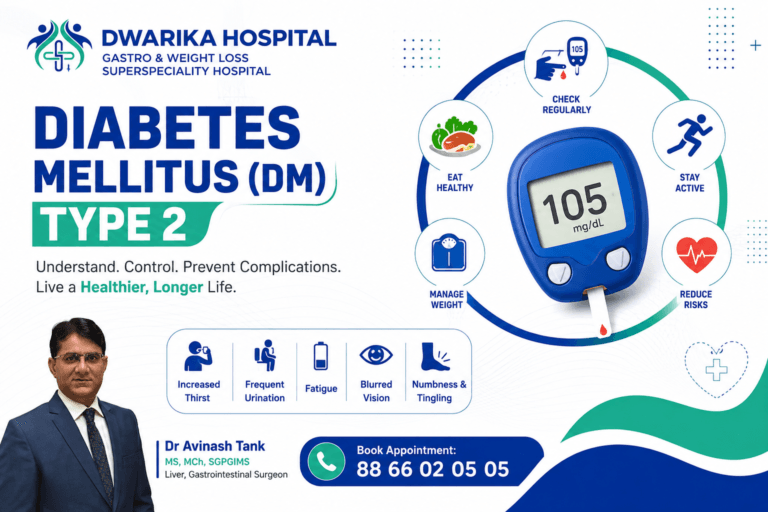 Diabetic
Type 2 Diabetes: What It Is, Why It Happens, and How to Control It
Diabetic
Type 2 Diabetes: What It Is, Why It Happens, and How to Control It
Type 2 Diabetes: What It Is, Why It Happens, and How to Control It Dr. Avinash Tank, MS, …
Read article → Obesity
Why Many Indians Look Slim but Have Dangerous Hidden Fat
Obesity
Why Many Indians Look Slim but Have Dangerous Hidden Fat
Thin-Fat Indian Obesity Phenotype: Why Many Indians Look Slim but Have Dangerous Hidden F…
Read article → Obesity
How Diet Regulates Health, Disease and Healthy Ageing
Obesity
How Diet Regulates Health, Disease and Healthy Ageing
How Diet Regulates Health, Disease and Healthy Ageing: The Science of Food Evidence-based…
Read article →Related patient videos
 DWARIKA HOSPITALVerified Patient Story
Verified
DWARIKA HOSPITALVerified Patient Story
Verified  DWARIKA HOSPITALVerified Patient Story
Verified
DWARIKA HOSPITALVerified Patient Story
Verified  DWARIKA HOSPITALVerified Patient Story
Verified
DWARIKA HOSPITALVerified Patient Story
Verified 
Related treatments & services
A complete programme to reverse Type-2 diabetes — combining metabolic surgery where suitable with diet, medical and lifestyle care.
View service → Bariatric SurgerySurgical weight-loss procedures that reduce stomach capacity and reset metabolism — proven for severe obesity and its complications.
View service → Metabolic SurgerySurgery that improves the body's control of blood sugar — often achieving long-term diabetes remission alongside weight loss.
View service →Frequently asked questions
In suitable patients, metabolic surgery frequently puts Type 2 diabetes into remission, sometimes within weeks, by improving how the body uses insulin.
Many people enjoy long-lasting remission, especially when surgery is done earlier and combined with healthy habits and regular follow-up.
References & sources
- 2nd Diabetes Surgery Summit (DSS-II) — International Consensus
- American Diabetes Association — Standards of Care: Obesity & Metabolic Surgery
- STAMPEDE Trial — New England Journal of Medicine
Guidance is based on peer-reviewed evidence and international clinical guidelines, interpreted by Dr. Avinash Tank.
Super-specialist GI, bariatric & cancer surgeon. SGPGIMS (India's premier GI centre) + advanced training in Japan & South Korea. Read full profile →
Last reviewed: July 2026
Comments
Be the first to share your thoughts on this article.