

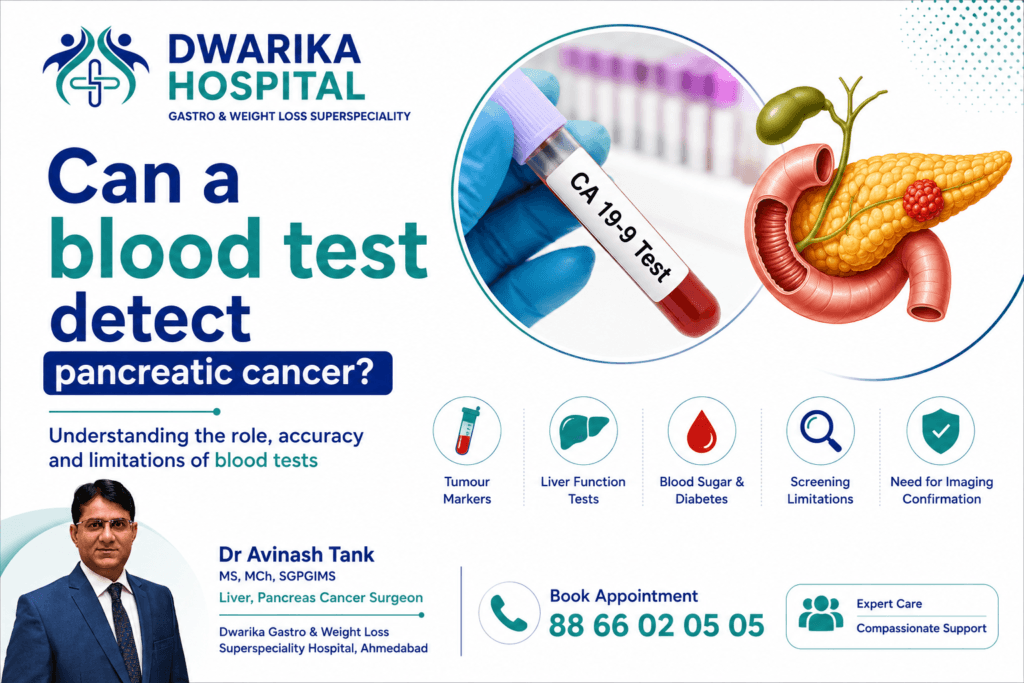
Can Pancreatic Cancer Be Detected in Blood Tests?
Featured Snippet Answer
No single blood test can reliably detect or diagnose pancreatic cancer, especially in its early stages.
Blood tests can provide important clues, such as elevated tumour markers (CA 19-9), abnormal liver function tests caused by bile duct obstruction, or newly developed diabetes.
However, these findings are not specific to pancreatic cancer and may occur in many other conditions, including gallstones, pancreatitis, and liver disease.
If pancreatic cancer is suspected, blood tests are only one part of the evaluation. Diagnosis usually requires contrast-enhanced CT scan, MRI, Endoscopic Ultrasound (EUS), and sometimes a biopsy.
Blood tests help guide doctors but cannot confirm or exclude pancreatic cancer on their own.
Why Patients Ask This Question
Many people hope that a simple blood test can quickly confirm or rule out pancreatic cancer. This is understandable because pancreatic cancer often causes vague symptoms such as indigestion, weight loss, abdominal pain, or fatigue.
Patients commonly ask:
- Can routine blood tests detect pancreatic cancer?
- What is the CA 19-9 blood test?
- If my blood tests are normal, does that mean I don’t have pancreatic cancer?
- Can tumour markers diagnose cancer?
These are important questions because early diagnosis improves treatment options, including the possibility of curative surgery. Understanding the strengths and limitations of blood tests helps patients know what investigations they may need next.
The Short Answer
Blood tests alone cannot diagnose pancreatic cancer.
However, they can:
- Suggest that something is wrong.
- Detect complications caused by the tumour.
- Measure tumour markers such as CA 19-9.
- Help monitor response to treatment.
- Detect recurrence after surgery.
If pancreatic cancer is suspected, doctors combine blood tests with imaging studies and, when necessary, a biopsy to establish the diagnosis.
Understanding the Background
The pancreas lies deep behind the stomach, making small tumours difficult to detect during routine examination. Unlike some blood cancers, pancreatic cancer does not release a unique substance into the bloodstream that can accurately identify every patient.
Different blood tests evaluate different aspects of health:
- Liver function
- Inflammation
- Anaemia
- Blood sugar
- Tumour markers
While these tests provide valuable information, none is accurate enough to be used as a screening test for pancreatic cancer in healthy individuals.
This is why international guidelines recommend imaging studies such as contrast-enhanced CT scan or Endoscopic Ultrasound (EUS) when pancreatic cancer is suspected.
Detailed Answer
Which Blood Tests Are Performed?
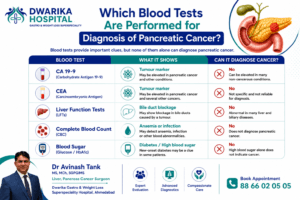
Doctors may order several blood tests when evaluating suspected pancreatic cancer.
| Blood Test | What It Shows | Can It Diagnose Cancer? |
| CA 19-9 | Tumour marker | No |
| CEA | Tumour marker | No |
| Liver Function Tests | Bile duct blockage | No |
| Complete Blood Count | Anaemia or infection | No |
| Blood Sugar (Glucose/HbA1c) | Diabetes | No |
Each test contributes a piece of the puzzle, but none provides the complete answer.
CA 19-9: The Most Common Tumour Marker
CA 19-9 is the blood test most commonly associated with pancreatic cancer.
What is CA 19-9?
CA 19-9 is a protein released into the bloodstream by some pancreatic cancer cells.
Higher levels may be seen in patients with:
- Pancreatic cancer
- Cholangiocarcinoma (bile duct cancer)
- Gallstones
- Pancreatitis
- Liver disease
- Bile duct obstruction
Why CA 19-9 Cannot Diagnose Pancreatic Cancer
Although CA 19-9 is useful, it has important limitations:
- It can be elevated in many non-cancerous diseases.
- Some patients with early pancreatic cancer have normal CA 19-9 levels.
- Around 5–10% of people cannot produce CA 19-9 because of their genetic makeup.
Therefore, an abnormal CA 19-9 level does not prove cancer, and a normal level does not exclude it.
When Is CA 19-9 Most Useful?
Doctors mainly use CA 19-9 to:
- Support clinical suspicion.
- Monitor treatment response.
- Detect recurrence after surgery.
- Follow disease progression.
What About the CEA Blood Test?
CEA (Carcinoembryonic Antigen) is another tumour marker.
However:
- It is less sensitive than CA 19-9.
- It may also be elevated in smokers and several other cancers.
- It is not recommended as a screening test for pancreatic cancer.
CEA is occasionally measured alongside CA 19-9 but has a limited role in diagnosis.
Can Routine Blood Tests Suggest Pancreatic Cancer?
Yes. Routine blood tests may provide indirect clues.
Liver Function Tests (LFTs)
If a tumour blocks the bile duct, blood tests may show:
- Elevated bilirubin
- Raised alkaline phosphatase (ALP)
- Increased GGT
- Elevated liver enzymes
These abnormalities explain symptoms such as:
- Jaundice
- Dark urine
- Pale stools
- Itching
However, similar changes also occur with gallstones and hepatitis.
Blood Sugar Tests
The pancreas produces insulin.
A tumour can interfere with insulin production, causing:
- New-onset diabetes
- High fasting blood sugar
- Elevated HbA1c
Although most people with diabetes do not have pancreatic cancer, diabetes developing after the age of 50—especially with unexplained weight loss—may warrant further investigation.
Complete Blood Count (CBC)
A CBC may detect:
- Anaemia
- Infection
- Inflammation
These findings are nonspecific but help assess overall health before further investigations or treatment.
Can Blood Tests Detect Early Pancreatic Cancer?
Unfortunately, not reliably.
Early pancreatic tumours often produce:
- Normal CA 19-9
- Normal liver tests
- Normal blood counts
This is why blood tests alone cannot be used to screen the general population.
Researchers are actively studying new blood-based biomarkers, circulating tumour DNA (ctDNA), exosomes, and liquid biopsy techniques. These tests are promising but are not yet recommended for routine clinical diagnosis.
What Tests Are Needed to Confirm Pancreatic Cancer?
If symptoms or blood tests raise concern, doctors usually recommend:
- Contrast-enhanced CT scan
- MRI with MRCP (if needed)
- Endoscopic Ultrasound (EUS)
- EUS-guided biopsy
- ERCP in selected patients with bile duct obstruction
Together, these investigations determine:
- Whether cancer is present
- Tumour size
- Blood vessel involvement
- Spread to other organs
- Whether surgery is possible
Can Blood Tests Be Used After Diagnosis?
Yes. Once pancreatic cancer has been diagnosed, blood tests become much more useful.
Doctors may monitor:
- CA 19-9 trends during chemotherapy
- Liver function
- Kidney function
- Blood counts
- Nutritional status
- Diabetes control
Falling CA 19-9 levels often suggest that treatment is working, although results must always be interpreted alongside imaging studies.
What Current Evidence Shows
Current NCCN, ASCO, and ESMO guidelines agree that no blood test is sufficiently accurate to diagnose or screen for pancreatic cancer. CA 19-9 is the most widely used tumour marker but should never be interpreted in isolation. Imaging studies remain the cornerstone of diagnosis.
Research into liquid biopsy, circulating tumour DNA, and multi-marker blood tests is advancing rapidly and may improve early detection in the future. At present, these tests remain investigational and are not part of routine clinical practice.
Common Myths and Facts
Myth 1
A normal blood test means I do not have pancreatic cancer.
Fact: Early pancreatic cancer can have completely normal blood tests.
Myth 2
High CA 19-9 always means pancreatic cancer.
Fact: Gallstones, pancreatitis, and bile duct blockage can also raise CA 19-9 levels.
Myth 3
Blood tests can replace CT scans.
Fact: Imaging is essential for diagnosis and staging.
Myth 4
Everyone with pancreatic cancer has elevated CA 19-9.
Fact: Some patients never develop elevated CA 19-9, especially in early disease.
Myth 5
Tumour markers should be used as a routine cancer screening test.
Fact: Current international guidelines do not recommend tumour marker screening in healthy people.
Dr. Avinash Tank’s Perspective
Blood tests are an important part of evaluating suspected pancreatic cancer, but they should never be viewed as a standalone diagnostic tool. I frequently meet patients who are reassured because their routine blood tests are normal or become alarmed by an elevated CA 19-9 level. Neither situation provides the complete picture.
Persistent symptoms such as jaundice, unexplained weight loss, abdominal pain, back pain, or new-onset diabetes deserve careful assessment regardless of blood test results. High-quality imaging—particularly contrast-enhanced CT scan and Endoscopic Ultrasound (EUS)—remains essential for accurate diagnosis and treatment planning. The best outcomes are achieved when symptoms, blood tests, imaging, and specialist evaluation are considered together.
Key Takeaways
- ✓ No single blood test can diagnose pancreatic cancer.
- ✓ CA 19-9 is the most commonly used tumour marker but is not cancer-specific.
- ✓ Normal blood tests do not exclude pancreatic cancer.
- ✓ Abnormal liver function tests may indicate bile duct obstruction.
- ✓ Blood tests are useful for monitoring treatment and follow-up.
- ✓ CT scan and Endoscopic Ultrasound remain the most important diagnostic investigations.
- ✓ Persistent symptoms should always be evaluated, even if blood tests are normal.
Related Resources
Disease Hub
- Pancreatic Cancer
Service Pages
- Pancreatic Cancer Surgery
- Endoscopic Ultrasound (EUS)
Related Articles
- What Are the First Signs of Pancreatic Cancer?
- Can Pancreatic Cancer Be Cured by Surgery?
- What Is the Survival Rate for Pancreatic Cancer?
Frequently Asked Questions
1. Which blood test is most commonly used for pancreatic cancer?
CA 19-9 is the most widely used tumour marker. It helps monitor treatment but cannot diagnose pancreatic cancer by itself.
2. Can routine health check blood tests detect pancreatic cancer?
No. Routine blood tests may appear normal, especially in early-stage disease.
3. Why is CA 19-9 elevated in non-cancer conditions?
Gallstones, pancreatitis, cholangitis, and liver disease can all increase CA 19-9 levels.
4. Can pancreatic cancer cause abnormal liver function tests?
Yes. Tumours blocking the bile duct may cause elevated bilirubin and liver enzymes.
5. Is there a blood test for early pancreatic cancer screening?
Currently, no blood test is accurate enough for routine screening of healthy individuals.
6. What is the next step if my CA 19-9 is high?
Your doctor may recommend CT scan, MRI, or Endoscopic Ultrasound (EUS) to determine the cause.
References
- NCCN Clinical Practice Guidelines: Pancreatic Adenocarcinoma
- ASCO Guidelines on Pancreatic Cancer
- ESMO Clinical Practice Guidelines for Pancreatic Cancer
- World Health Organization (WHO): Cancer Fact Sheets
- National Cancer Institute (NCI): Pancreatic Cancer (PDQ®)
- Recent PubMed reviews on CA 19-9, liquid biopsy, and pancreatic cancer biomarkers
Internal Linking Suggestions
Include contextual links to:
- Pancreatic Cancer Disease Hub
- Pancreatic Cancer Surgery
- Endoscopic Ultrasound (EUS)
- What Are the First Signs of Pancreatic Cancer?
- Can Pancreatic Cancer Be Cured by Surgery?
- What Is the Survival Rate for Pancreatic Cancer?
Image Suggestions
- Feature Image: Blood sample tube labelled “CA 19-9” with pancreas illustration.
- Comparison Table: Blood Tests vs CT Scan vs MRI vs EUS for pancreatic cancer diagnosis.
- Infographic: “What Does CA 19-9 Mean?”
- Flowchart: Symptoms → Blood Tests → CT Scan → EUS → Biopsy → Diagnosis.
- Myth vs Fact Infographic: Five common misconceptions about blood tests for pancreatic cancer.
Final CTA
Learn More: Visit our Pancreatic Cancer Disease Hub for comprehensive information on symptoms, diagnosis, staging, treatment, and recovery.
Need a Specialist Evaluation? Persistent jaundice, unexplained weight loss, abdominal pain, back pain, or abnormal imaging should be assessed by an experienced hepatopancreatobiliary (HPB) team.
Dr. Avinash Tank (MS, MCh, SGPGIMS)
Liver, Pancreas & Gastrointestinal Cancer Surgeon
Dwarika Gastro & Weight Loss Superspeciality Hospital, Ahmedabad
Book an Appointment / WhatsApp: 88 66 02 05 05

Super-specialist GI, bariatric & cancer surgeon. SGPGIMS (India's premier GI centre) + advanced training in Japan & South Korea. Read full profile →
Last reviewed: July 2026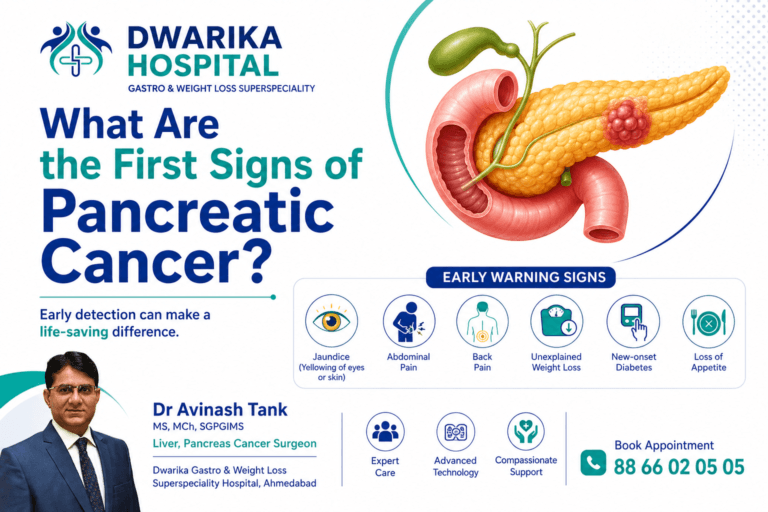




Comments
Be the first to share your thoughts on this article.