

Pancreatic cancer is an aggressive tumour of the pancreas that often causes few early symptoms. Early-stage disease may be cured with major surgery such as the Whipple operation, combined with chemotherapy — making prompt, specialist assessment vital.
Malignant tumour of the pancreas
Smoking, chronic pancreatitis, diabetes, family history
Painless jaundice, weight loss, or a pancreatic mass on a scan
Surgery (e.g. Whipple) for early-stage disease + chemotherapy
What is pancreatic cancer?
Pancreatic cancer arises from the cells of the pancreas, an organ deep in the upper abdomen that aids digestion and controls blood sugar. Most tumours occur in the head of the pancreas, where they can block the bile duct. Because the pancreas is deep-seated, tumours can grow before causing symptoms, so expert evaluation of any warning sign is important.
Symptoms & diagnosis
Classic features include painless yellowing of the eyes and skin (obstructive jaundice), unexplained weight loss, upper-abdominal or back pain, and new-onset diabetes. Diagnosis uses CT, MRI/MRCP and endoscopic ultrasound (EUS), which also allows a precise needle biopsy; ERCP can relieve jaundice with a stent.
Treatment options
For tumours confined to the pancreas, surgery offers the only chance of cure — most often a Whipple operation (pancreaticoduodenectomy) for head tumours, or distal pancreatectomy for body and tail tumours. Chemotherapy before or after surgery improves outcomes, and stenting relieves jaundice when surgery is not immediately possible.
Why a super-specialist matters
Pancreatic surgery is among the most complex GI operations, and outcomes are strongly linked to surgeon and centre experience. Careful staging, multidisciplinary planning and meticulous peri-operative care give the best chance of a safe, curative result.
Cirrhosis is advanced, long-term scarring of the liver caused by ongoing damage…
ERCP (Bile Duct Endoscopy)ERCP is an advanced endoscopic procedure that treats problems of the bile and p…
EUS (Endoscopic Ultrasound)EUS combines endoscopy with high-resolution ultrasound to image the pancreas, b…
How we treat Pancreatic Cancer
 Recommended treatment
Pancreas Cancer
Recommended treatment
Pancreas Cancer
Complex pancreatic cancer surgery (including Whipple's) with expert peri-operative care for the best chance of cure.
View treatment details →Cashless insurance accepted at our network hospitals, with EMI options available. Every patient gets a written, transparent estimate before any procedure — no surprises.

Dr. Avinash Tank, MBBS · MS (General Surgery) · MCh (Surgical Gastroenterology, SGPGIMS)
SGPGIMS (India's premier GI centre) + advanced training in Japan & South Korea. Super-specialist gastrointestinal, bariatric & cancer surgeon treating Pancreatic Cancer at Dwarika Hospital — Gastro, Bariatric & Laparoscopic Surgery Center.
Proof, not promises
 DWARIKA HOSPITALVerified Patient Story
Verified
DWARIKA HOSPITALVerified Patient Story
Verified 
More on Pancreatic Cancer
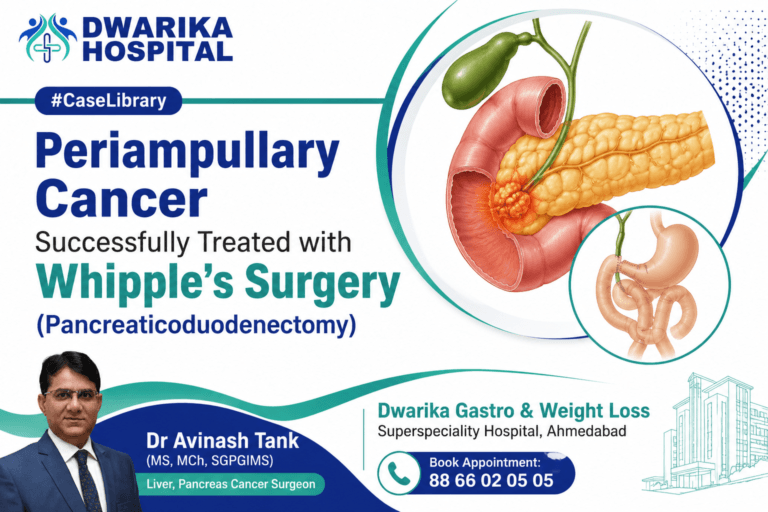 Pancreas CancerPeriampullary Cancer Successfully Treated with Whipple’s Surgery (Pancreaticoduodenectomy)
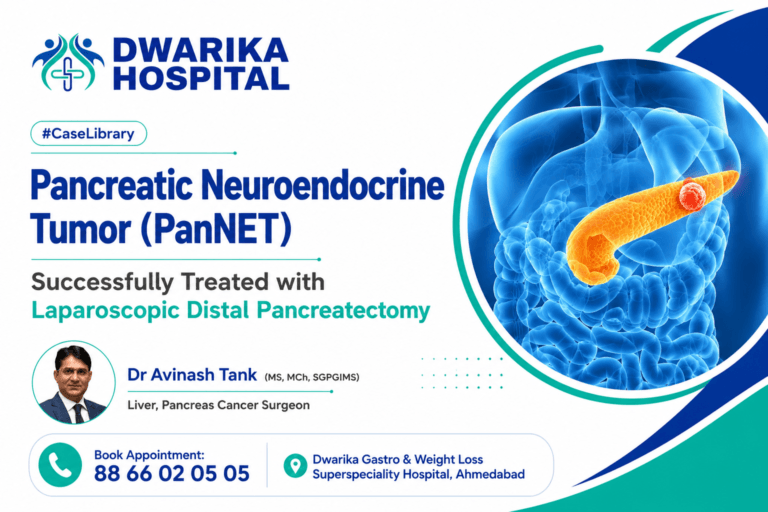 Case LibraryPancreatic Neuroendocrine Tumor (PanNET) Successfully Treated with Laparoscopic Distal Pancreatectomy
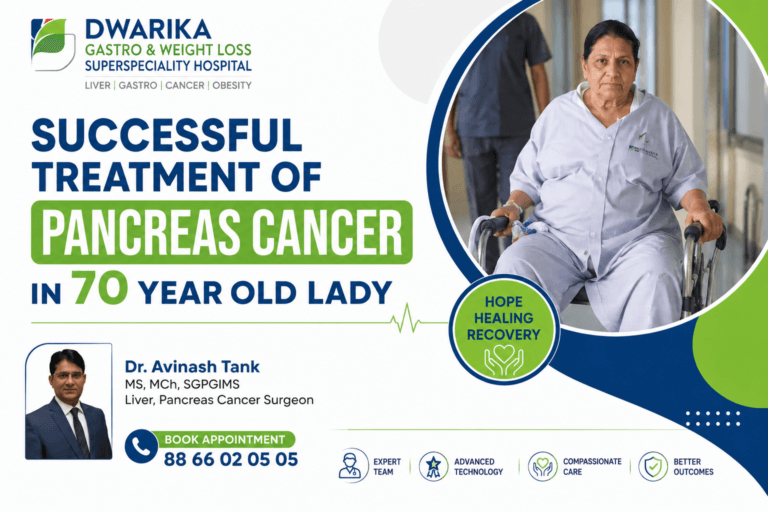 Pancreas CancerWhen Hope Meets Expertise: A 70-Year-Old Woman’s Journey Through Pancreatic Cancer
Frequently asked questions
No. When detected early and confined to the pancreas, surgery combined with chemotherapy can be curative, which is why prompt specialist assessment of warning signs matters.
The Whipple operation removes the head of the pancreas, part of the bile duct, the duodenum and surrounding tissue, then reconnects the digestive tract. It is the standard curative surgery for tumours in the head of the pancreas.
A common early sign is painless jaundice — yellowing of the eyes and skin — often with weight loss. New, unexplained diabetes can also be a clue.
Endoscopic ultrasound (EUS) allows a precise, minimally invasive needle biopsy of the pancreas while imaging the tumour in fine detail.
Super-specialist GI, bariatric & cancer surgeon. SGPGIMS (India's premier GI centre) + advanced training in Japan & South Korea. Read full profile →
Last reviewed: July 2026