

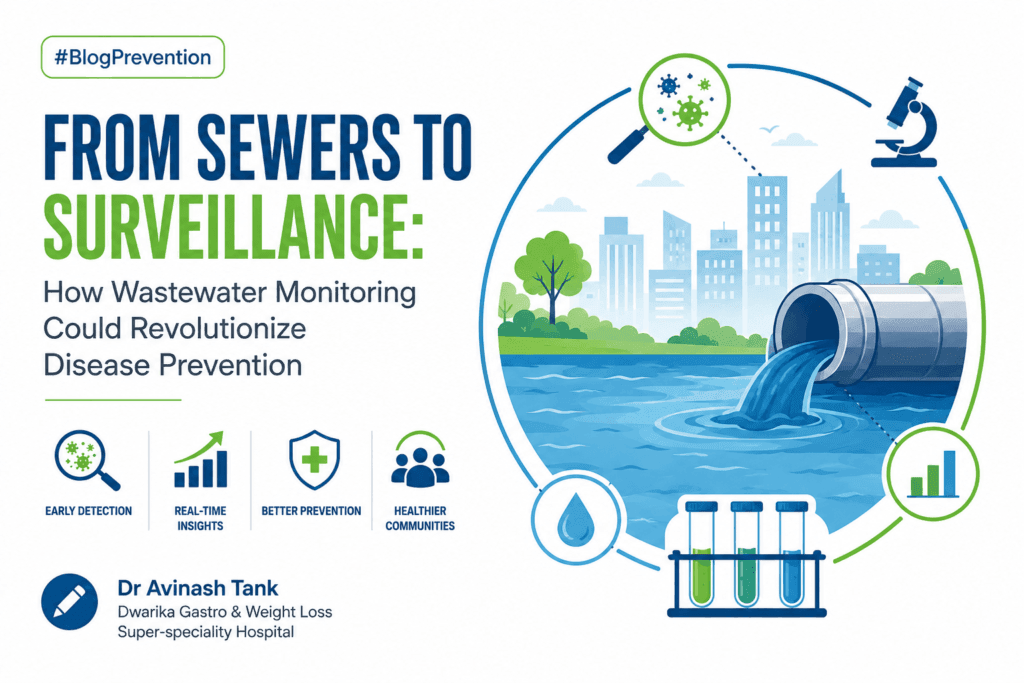
From Sewers to Surveillance: How Wastewater Monitoring Could Revolutionize Disease Prevention.
A Silent Warning System Beneath Our Feet
Globally, wastewater surveillance has evolved from a research tool into a routine component of public health monitoring.
In the United States, the Centers for Disease Control and Prevention (CDC) operates the National Wastewater Surveillance System (NWSS), where many participating sites collect samples between two and seven times per week depending on population size, risk level, and surveillance objectives.
In the United Kingdom, wastewater monitoring has been integrated into national infectious disease surveillance programs, with sampling commonly conducted multiple times per week at major wastewater treatment plants.
Across Europe, the European Commission and public health agencies have encouraged regular wastewater surveillance, particularly since the COVID-19 pandemic, with many countries adopting weekly to several-times-weekly sampling schedules for SARS-CoV-2 and other priority pathogens.
These programs have demonstrated that frequent wastewater monitoring can provide timely insights into disease trends, detect emerging variants, and support public health decision-making.
Increasingly, surveillance networks are expanding beyond COVID-19 to include influenza, respiratory syncytial virus (RSV), poliovirus, antimicrobial resistance markers, hepatitis viruses, and other emerging threats.
In India, wastewater surveillance gained attention during the COVID-19 pandemic, and several research institutions, municipal bodies, and state agencies have conducted pilot projects in cities such as Ahmedabad, Bengaluru, Hyderabad, Pune, and Delhi.
However, India does not yet have a fully standardized nationwide wastewater surveillance program comparable to those operating in the USA, UK, or several European countries.
Existing efforts remain fragmented, project-based, and limited in geographic coverage.
Given India’s large population, rapid urbanization, and recurring burden of infectious diseases, there is a strong case for establishing a national wastewater surveillance framework.
Public health authorities could consider implementing routine sampling at major wastewater treatment plants—ideally at least weekly, and more frequently in high-risk urban centers—while integrating results with clinical surveillance systems.
Such a program could provide early warning of outbreaks, improve pandemic preparedness, support antimicrobial resistance monitoring, and strengthen India’s overall public health resilience.
In 2020, wastewater monitoring programs around the world detected surges of SARS-CoV-2 days to weeks before spikes appeared in clinical testing and hospital admissions, giving public health officials a crucial head start in responding to outbreaks.
This real-world success demonstrated that sewage systems can function as powerful community-wide health sensors, revealing the spread of infectious diseases even when many infected individuals have no symptoms or never seek medical care.
Building on this growing evidence, a recent longitudinal wastewater surveillance study conducted across four major Gujarat cities—Ahmedabad, Vadodara, Gandhinagar, and Rajkot—has demonstrated that wastewater can serve as an effective early-warning system for detecting a wide range of human and animal viruses circulating within communities.
The findings have profound implications for disease prevention, outbreak preparedness, and public health policy in India and beyond.
The study detected viruses responsible for COVID-19, hepatitis, influenza, gastroenteritis, respiratory infections, and several other communicable diseases.
More importantly, many of these viral signals appeared in wastewater before they became evident in clinics and hospitals.
This raises a compelling question: Could monitoring what flows beneath our cities help prevent the next epidemic before it reaches our doorsteps?
Understanding the Science Behind Wastewater Surveillance
Every day, humans shed billions of viral particles through feces, urine, saliva, respiratory secretions, and other bodily fluids.
These biological traces eventually enter sewage systems. By analyzing wastewater samples, scientists can identify and quantify pathogens circulating within a population.
Unlike traditional surveillance systems that depend on symptomatic individuals seeking medical care, wastewater surveillance captures information from entire communities—including asymptomatic carriers who may unknowingly spread infections.
This approach transforms municipal sewage networks into large-scale public health observatories.
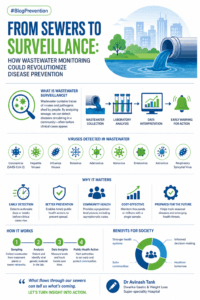
The Gujarat study identified numerous viral families, including:
- Coronaviruses (including SARS-CoV-2)
- Hepatitis viruses
- Influenza viruses
- Rotaviruses
- Adenoviruses
- Astroviruses
- Enteroviruses
- Noroviruses
- Respiratory syncytial viruses
- Human parainfluenza viruses
The diversity of pathogens detected highlights the remarkable ability of wastewater monitoring to provide a comprehensive picture of community health.
Major Disease Categories Detectable Through Wastewater Surveillance
- COVID-19
- Common Cold
- Flu (Influenza)
- Pneumonia
- Bronchitis
- Bronchiolitis
- Croup
- Hepatitis
- Gastroenteritis (Stomach Infection)
- Diarrheal Diseases
- Food Poisoning–Related Viral Infections
- Hand, Foot and Mouth Disease
- Polio
- Meningitis
- Encephalitis
- Myocarditis
- Conjunctivitis (Eye Infection)
- Measles
- Mumps
- Emerging Viral Infections
- Zoonotic Diseases (Animal-to-Human Infections)
In Simple Terms, Wastewater Surveillance Can Help Monitor:
- Respiratory Diseases
- Liver Diseases
- Stomach and Intestinal Diseases
- Childhood Infectious Diseases
- Neurological Diseases
- Heart Infections
- Eye Infections
- Foodborne Diseases
- Seasonal Viral Outbreaks
- Emerging Pandemic Threats
- Animal-to-Human Infectious Diseases (Zoonoses)
Why These Findings Matter
The most significant implication of this study is not merely the detection of viruses. It is the timing.
Researchers observed that wastewater signals often emerged before increases in clinical cases. This means public health authorities may gain days or even weeks of advance warning before outbreaks become visible through conventional healthcare systems.
In public health, timing is everything.
Early detection allows authorities to:
- Intensify disease surveillance
- Mobilize healthcare resources
- Increase diagnostic testing
- Launch public awareness campaigns
- Protect vulnerable populations
- Prevent healthcare system overload
The COVID-19 pandemic repeatedly demonstrated how delays in recognizing outbreaks can lead to exponential spread. Wastewater surveillance offers an opportunity to move from reactive medicine to proactive prevention.
A New Era of Population-Level Diagnostics
Traditionally, healthcare focuses on diagnosing diseases in individual patients. Wastewater surveillance introduces the concept of population-level diagnostics.
Instead of asking, “Is this patient infected?” the question becomes, “What infections are circulating within this community?”
This shift represents a major advancement in public health intelligence.
Imagine a city where health officials can monitor viral trends in real time, detect emerging pathogens, and identify seasonal disease patterns without waiting for hospital admissions to rise.
The Gujarat study demonstrated precisely this potential by documenting seasonal fluctuations in several viral families. Such information can help health systems anticipate disease surges and allocate resources more effectively.
Lessons for India’s Public Health System
India’s dense population, rapid urbanization, and recurring outbreaks of infectious diseases make wastewater surveillance particularly relevant.
The country already faces significant challenges from:
- Viral hepatitis
- Dengue and other vector-borne diseases
- Gastrointestinal infections
- Seasonal influenza
- Emerging zoonotic infections
Many infections remain underreported due to limited access to healthcare, asymptomatic cases, and variations in diagnostic testing.
Wastewater monitoring bypasses these limitations by providing a population-wide snapshot of disease activity.
Importantly, this approach is relatively cost-effective compared with mass individual testing programs. A single wastewater sample may represent thousands—or even millions—of residents.
For a resource-conscious healthcare system, this scalability is highly attractive.
Beyond COVID-19: Preparing for Future Pandemics
One of the most valuable aspects of wastewater surveillance is its flexibility.
The same infrastructure established for monitoring COVID-19 can be adapted to track:
- Influenza outbreaks
- Hepatitis epidemics
- Antimicrobial resistance genes
- Emerging zoonotic viruses
- Novel pandemic threats
History teaches us that pandemics are not rare events. The challenge is not whether another pandemic will occur, but when.
Countries that establish robust environmental surveillance systems today will be better prepared for the infectious disease challenges of tomorrow.
The Gujarat study offers a glimpse into how such systems can function at the city level and potentially scale nationwide.
Challenges That Must Be Addressed
Despite its promise, wastewater surveillance is not a magic bullet.
Several challenges remain:
Standardization
Different laboratories may use different sampling and testing methodologies. National standards will be necessary to ensure reliable and comparable data.
Interpretation
Detecting viral genetic material does not necessarily indicate active disease or transmission. Careful interpretation is required to avoid unnecessary alarm.
Infrastructure Gaps
Many regions in India still lack comprehensive sewage networks. Surveillance systems must be adapted for rural and underserved populations.
Data Integration
Environmental surveillance should complement—not replace—clinical surveillance. Combining laboratory, hospital, and wastewater data will provide the most accurate picture of disease trends.
Ethical and Social Considerations
One of the strengths of wastewater surveillance is that it protects individual privacy while generating valuable public health insights.
Unlike individual testing, wastewater monitoring assesses communities rather than specific persons.
However, transparency remains essential.
Public trust will depend on clear communication regarding how data are collected, interpreted, and used. Authorities must ensure that surveillance serves public health objectives rather than becoming a tool for stigmatization or discrimination.
The Road Ahead
The Gujarat wastewater surveillance study should be viewed as more than an academic achievement. It is a blueprint for the future of disease monitoring.
As climate change, urbanization, global travel, and ecological disruption increase the risk of infectious disease emergence, health systems must evolve beyond traditional models of surveillance.
Wastewater monitoring offers a rare combination of affordability, scalability, sensitivity, and timeliness.
For policymakers, the message is clear: investments in environmental surveillance infrastructure may yield enormous dividends in outbreak prevention.
For clinicians, these data can provide valuable context for understanding emerging community health threats.
For citizens, it serves as a reminder that public health is deeply interconnected. What flows through our sewage systems may reveal far more about community well-being than we ever imagined.
Conclusion
The Gujarat study demonstrates that wastewater is not merely waste—it is information.
Hidden within our sewage systems are biological signals that can reveal the presence of infectious diseases long before hospitals become crowded and outbreaks make headlines.
If integrated into routine public health practice, wastewater surveillance could transform disease prevention from a reactive endeavor into a predictive science.
In an age where the next outbreak may be only a flight away, the ability to listen to these silent warnings could become one of the most powerful tools in modern medicine.
The future of public health may not begin in the hospital. It may begin in the sewer.
By Dr. Avinash Tank
Gastrointestinal Surgeon | Public Health Advocate | Dwarika Hospital

Super-specialist GI, bariatric & cancer surgeon. SGPGIMS (India's premier GI centre) + advanced training in Japan & South Korea. Read full profile →
Last reviewed: July 2026




Comments
Be the first to share your thoughts on this article.