

Sudden severe pain, hard tender lump, vomiting — possible strangulation
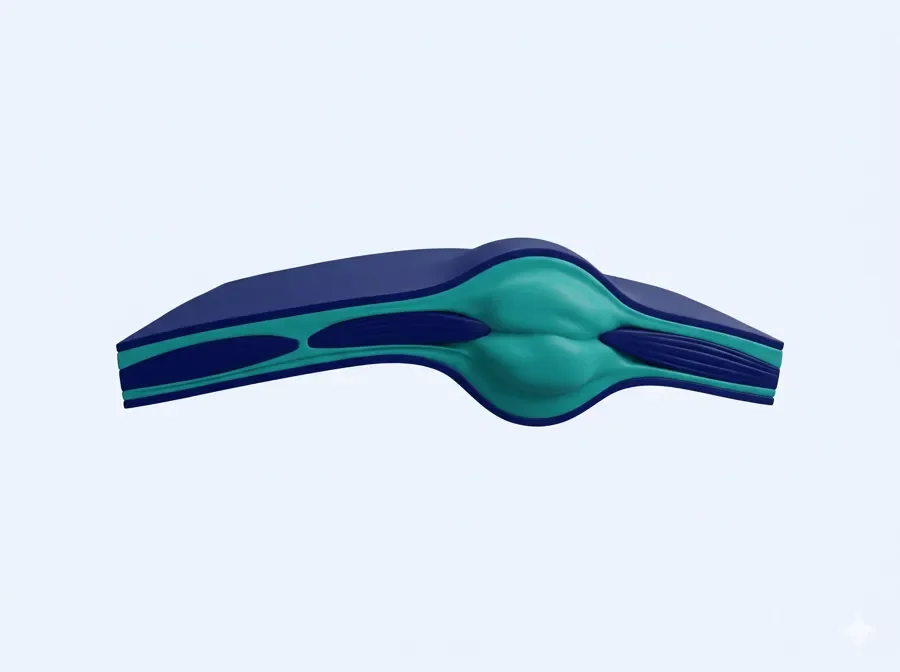
A hernia is a bulge that occurs when an organ or tissue pushes through a weak spot in the abdominal wall. Hernias do not heal on their own; the durable treatment is laparoscopic mesh repair, which restores strength with minimal pain and fast recovery.
Protrusion of tissue through a weak point in the abdominal wall
More common in men; raised by straining, coughing, heavy lifting
Any visible bulge, discomfort, or a hernia that won't push back
Sudden severe pain, hard tender lump, vomiting — possible strangulation
What is a hernia?
A hernia forms when an organ — often part of the intestine — pushes through a weakened area of the abdominal wall, creating a visible bulge. Common types are inguinal (groin), umbilical, incisional and hiatus hernias.
Symptoms & causes
Most hernias appear as a bulge that may ache on standing, coughing or lifting and ease on lying down. They are caused by a combination of muscle weakness and strain.
Diagnosis
Most hernias are diagnosed on clinical examination. An ultrasound or CT scan helps in unclear cases or to plan complex and recurrent repairs.
Treatment options
Hernias do not resolve without surgery. Laparoscopic mesh repair reinforces the weak area with minimal pain, small scars and a low recurrence rate, allowing a quick return to normal activity.
Gallbladder stones are hardened deposits in the gallbladder that can cause righ…
GERD & Acidity (Acid Reflux)GERD (gastro-esophageal reflux disease) is the backflow of stomach acid into th…
Gastroscopy (Upper GI Endoscopy)Gastroscopy is a quick, sedated examination of the food pipe, stomach and duode…
How we treat Hernia (Inguinal, Umbilical, Incisional, Hiatus)
 Recommended treatment
Robotic Hernia Repair
Recommended treatment
Robotic Hernia Repair
Robotic repair of complex, recurrent and large ventral, incisional, inguinal and hiatus hernias — wristed instruments allow precise mesh placement and defect (TAR) closure for durable, low-recurrence results.
View treatment details →Cashless insurance accepted at our network hospitals, with EMI options available. Every patient gets a written, transparent estimate before any procedure — no surprises.

Dr. Avinash Tank, MBBS · MS (General Surgery) · MCh (Surgical Gastroenterology, SGPGIMS)
SGPGIMS (India's premier GI centre) + advanced training in Japan & South Korea. Super-specialist gastrointestinal, bariatric & cancer surgeon treating Hernia (Inguinal, Umbilical, Incisional, Hiatus) at Dwarika Hospital — Gastro, Bariatric & Laparoscopic Surgery Center.
Proof, not promises
 DWARIKA HOSPITALVerified Patient Story
Verified
DWARIKA HOSPITALVerified Patient Story
Verified 
"Complex hernia repaired by laparoscopic surgery. Minimal pain, quick recovery, and a surgeon who genuinely listens."
More on Hernia (Inguinal, Umbilical, Incisional, Hiatus)
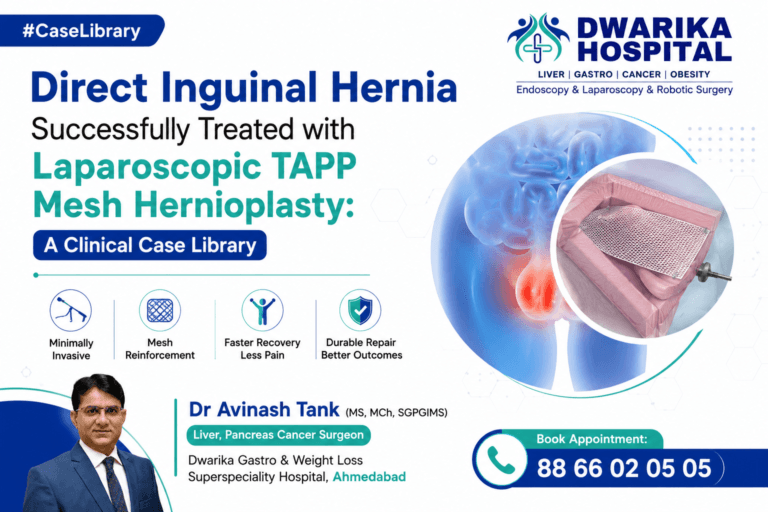 HerniaDirect Inguinal Hernia Successfully Treated with Laparoscopic TAPP Mesh Hernioplasty
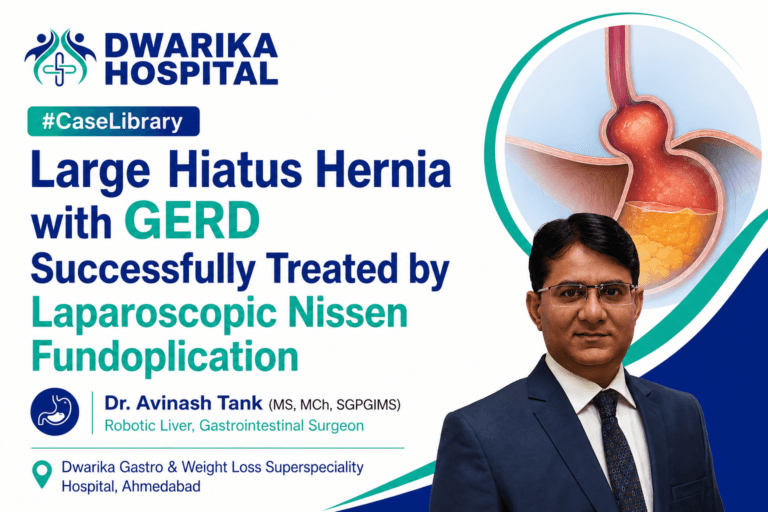 Case LibraryLarge Hiatus Hernia with GERD Successfully Treated by Laparoscopic Nissen Fundoplicatio
Surgical TechniqueLaparoscopic repair of a large paraesophageal hernia
Case LibraryLarge Hiatus Hernia with GERD Successfully Treated by Laparoscopic Nissen Fundoplicatio
Surgical TechniqueLaparoscopic repair of a large paraesophageal hernia
Frequently asked questions
No. A hernia is a physical defect in the muscle wall and only surgery can repair it; waiting risks enlargement and complications.
Mesh repair is the global standard for durable hernia repair, with a low recurrence rate and excellent long-term outcomes.
Strangulation occurs when trapped tissue loses its blood supply — a surgical emergency signalled by sudden severe pain, a hard lump and vomiting.
After laparoscopic repair, most people resume desk work within one to two weeks and heavier activity a little later.
Super-specialist GI, bariatric & cancer surgeon. SGPGIMS (India's premier GI centre) + advanced training in Japan & South Korea. Read full profile →
Last reviewed: July 2026