
Following the Money from Hospitals to Pharma to Insurance
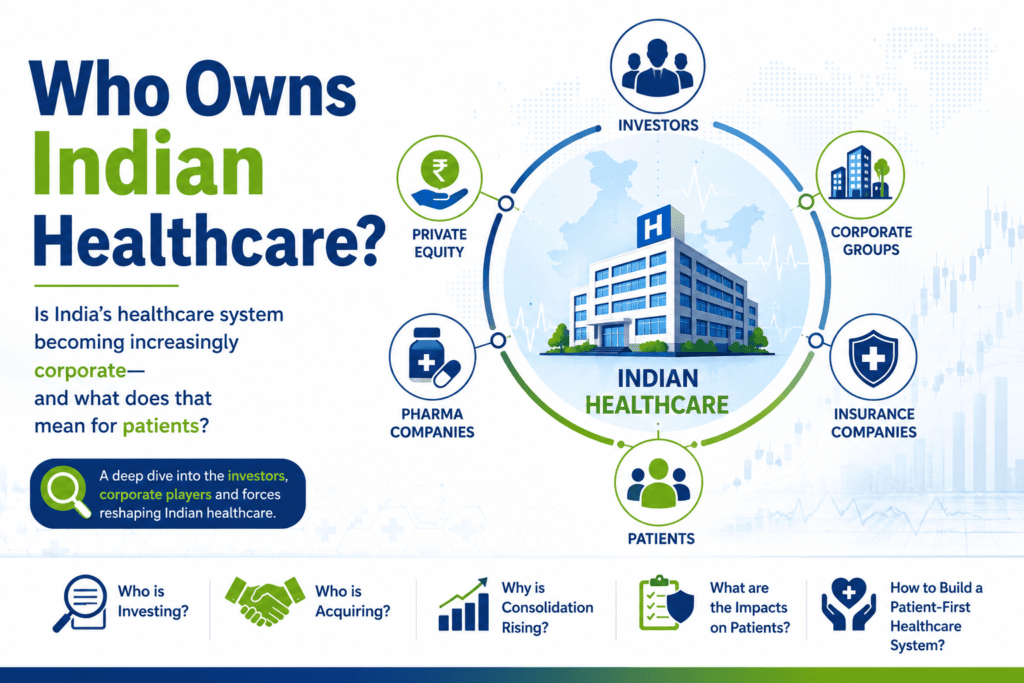
Is India’s healthcare system becoming increasingly corporate—and what does that mean for patients?
There is a message circulating widely on social media claiming that India’s healthcare system has effectively been taken over by foreign investors.
It talks about foreign ownership of hospitals, pharmaceutical companies and insurance companies. It describes a “deadly triangle” in which hospitals generate bills, pharmaceutical companies supply medicines and insurers collect premiums. It suggests that the same foreign investors are sitting on all three sides.
Some of the underlying facts are real.
Some are exaggerated.
And some are simply unsupported.
But beneath the viral claims lies a much more important story:
Indian healthcare is undergoing rapid corporatisation, consolidation and financialisation.
Billions of dollars of institutional and private-equity capital have entered healthcare. Large hospital chains are acquiring regional hospitals. Sovereign wealth funds and global investment firms have taken significant stakes in some of India’s largest hospital networks. Insurance is expanding rapidly, and the government has now permitted up to 100% foreign direct investment in insurance.
At the same time, India continues to struggle with high out-of-pocket healthcare expenditure and rising medical costs.
So the right question is not:
“Are foreigners secretly taking over Indian healthcare?”
The better question is:
“Who owns India’s healthcare businesses, how concentrated is that ownership becoming, and are patients benefiting from the capital flowing into the system?”
1. India’s hospital industry is attracting enormous amounts of capital
India’s private healthcare sector has become one of the most attractive investment opportunities in the country.
The reasons are obvious.
India has:
- a population of more than 1.4 billion
- a rapidly expanding middle class
- increasing life expectancy
- a growing burden of cancer, diabetes and cardiovascular disease
- increasing demand for tertiary and quaternary care
- relatively low hospital-bed density compared with many developed countries
- growing health-insurance penetration
- increasing willingness to pay for advanced medical treatment
This combination creates a powerful investment opportunity.
The result has been a wave of private-equity and sovereign-fund investment.
A 2023 SEBI-filed prospectus noted that Indian healthcare had attracted approximately US$8 billion of private-equity investment over the preceding five years, with consolidation becoming an important feature of the sector.
By 2024, healthcare deal activity remained extremely strong.
The important point is this:
The investment is not imaginary.
What is wrong is the claim that all foreign investment automatically means foreign control of the entire Indian healthcare system.
It does not.
2. Follow the money: India’s major hospital groups
The most useful way to understand the transformation is to examine individual hospital companies.
Major examples of institutional and private-equity involvement
| Hospital group | Major investor / ownership development | Approx. stake / status | What happened |
|---|---|---|---|
| Manipal Health | Temasek | 51% as of Mar 2026 | Temasek acquired an additional 41% in 2023, taking its combined holding to 59%; subsequent dilution and transactions reduced the disclosed holding to 51% by March 2026. |
| CARE Hospitals | Blackstone | Controlling investment | Blackstone acquired control of the CARE Hospitals platform in 2023. CCI documents describe the target as a 17-facility network operating across seven cities. |
| KIMS Hospitals | General Atlantic | Former major PE investor | General Atlantic invested more than US$130 million in 2018 and initially acquired a 42.6% stake. It subsequently exited completely in 2022. By March 2026, promoter Dr Bhaskar Rao held 34.11%, while FPIs held 14.57%. |
| Ujala Cygnus | General Atlantic | Majority stake | General Atlantic acquired a significant majority stake in 2024. Earlier investors Eight Roads, Somerset Indus and Evolvence exited. |
| HealthCare Global / HCG | KKR | ~54% transaction stake | KKR acquired a controlling stake from CVC in 2025 in a transaction valued at about US$400 million. |
| Fortis Healthcare | IHH Healthcare | 31.1% | Malaysia-based IHH completed acquisition of a 31.1% stake in Fortis in 2018 and remains a major strategic shareholder. |
| Aster DM Healthcare | Foreign promoter group | ~53.7% promoter holding in Jul 2026 | The promoter group is classified as foreign promoter; Union Investments/Union Mauritius are major shareholders. |
| Rainbow Children’s Medicare | Indian promoters + institutional investors | ~49.8% promoters | As of June 2026, promoters held about 49.84%; FIIs held about 16.03%, with domestic institutions holding about 22.56%. |
| Jupiter Life Line Hospitals | Indian promoter group + public institutions | 40.91% promoters | June 2026 promoter holding was 40.91%; the remaining shares were publicly held, including institutional investors. |
This table immediately reveals something important.
There is no single ownership model.
Some hospitals are:
- founder controlled
- family controlled
- majority foreign-owned
- PE controlled
- strategically owned by foreign healthcare groups
- widely held public companies
- or combinations of these.
Therefore, saying that “most Indian hospitals are 51–75% foreign owned” is not supported by the evidence.
But saying that foreign capital has become a major force in Indian hospital consolidation is absolutely supported.
3. Manipal is the clearest example
Manipal Health provides perhaps the clearest example of how Indian healthcare ownership has changed.
In April 2023, Singapore’s Temasek acquired an additional 41% stake in Manipal Health, taking its combined holding to approximately 59%. The transaction valued the company at around ₹40,000 crore.
Since then, the company continued its expansion.
Manipal acquired:
- Columbia Asia’s Indian operations
- Vikram Hospital
- AMRI Hospitals
- Medica Synergie
- Sahyadri Hospitals
The Sahyadri transaction alone was reported at around ₹6,400 crore.
Then came an even bigger development.
Manipal Health went public in August 2026.
The company raised approximately US$960 million in its IPO and was valued at roughly US$9 billion on its market debut.
By then, Manipal had expanded to approximately 49 hospitals and more than 13,000 beds.
Temasek’s latest portfolio disclosure shows a 51% holding as of March 31, 2026.
This is not a conspiracy.
It is a textbook example of institutional capital helping build a large healthcare platform through acquisitions and expansion.
The question is whether this model ultimately benefits patients.
4. CARE and KIMS show another important pattern
Blackstone’s involvement in CARE Hospitals illustrates another trend.
The private-equity firm acquired control of the CARE platform, which had approximately 2,400 beds across 17 healthcare facilities in seven cities at the time of the CCI review.
CARE’s expansion subsequently became connected to a broader hospital platform involving KIMS and Evercare.
This illustrates an important feature of modern healthcare investment:
Investors increasingly prefer platforms rather than individual hospitals.
Instead of owning one hospital, the investment strategy can involve:
Hospital A + Hospital B + Hospital C → common platform → shared purchasing → shared technology → common management → geographic expansion.
There can be genuine efficiencies in this model.
But it can also increase market concentration.
And concentration deserves regulatory attention.
5. Private equity is not automatically bad for healthcare
This point is often lost in the debate.
Private-equity investment can provide capital that doctors or individual hospital owners simply cannot raise themselves.
That money can finance:
- new hospitals
- ICU expansion
- robotic surgery
- radiation oncology
- PET-CT
- transplantation infrastructure
- advanced laboratories
- digital health systems
- trained manpower
- expansion into Tier-II and Tier-III cities
For example, General Atlantic described its investment in Ujala Cygnus as a way to expand healthcare access in Tier-II and Tier-III cities.
So the equation:
Foreign investment = bad healthcare
is too simplistic.
The more serious concern is:
What happens when financial return becomes a dominant management objective in a sector where the consumer often cannot make an informed purchasing decision?
Continue Reading — Free
Get the complete expert guide from Dr. Avinash Tank.
Free, always. No payment, no spam.
Continue Reading — Free
Get the complete expert guide from Dr. Avinash Tank.
Free, always. No payment, no spam — just the complete guide sent straight to your screen.
That is a legitimate healthcare-policy question.
6. Healthcare is different from most other businesses
When you buy a car, you can compare ten models.
When you buy a television, you can compare specifications.
When you book a hotel, you can compare prices.
Healthcare is different.
A patient often does not know:
- which test is necessary
- whether surgery is necessary
- which implant is appropriate
- which medicine is equivalent
- whether ICU admission is required
- whether a particular procedure should be performed
- whether a second opinion would change the treatment
The person making the purchasing decision and the person consuming the service are often not the same person.
This creates what economists call an information asymmetry.
And information asymmetry makes healthcare particularly vulnerable to inappropriate incentives.
That is why transparency and clinical governance matter so much.
7. Now look at pharmaceutical companies
The viral message claims that major Indian pharmaceutical companies are 20–35% foreign owned.
That statement is misleading because it mixes up foreign institutional shareholding with foreign ownership or control.
Look at actual shareholding.
As of June 2026:
| Pharmaceutical company | Promoter holding | FII holding |
|---|---|---|
| Sun Pharmaceutical | 54.48% | 14.54% |
| Dr Reddy’s Laboratories | 26.64% | 20.66% |
| Cipla | 29.21% | 20.20% |
| Lupin | 46.85% | 22.42% |
| Aurobindo Pharma | 51.88% | 16.38% |
| Zydus Lifesciences | 75.01% | 6.89% |
These figures demonstrate the problem with the viral claim.
Foreign institutional investors owning shares does not mean foreign investors control the company.
An FII may be:
- a pension fund
- mutual fund
- sovereign fund
- index fund
- insurance company
- asset manager
- hedge fund
and may own shares purely as a financial investment.
Therefore:
foreign shareholding ≠ foreign control.
8. But medicine prices are a genuine issue
This does not mean the pharmaceutical-price problem is imaginary.
India has one of the world’s largest generic-drug industries.
Yet patients can encounter enormous price differences between:
- branded products
- branded generics
- generic medicines
- hospital-supplied medicines
- retail pharmacy prices
- Jan Aushadhi alternatives
The Government’s Jan Aushadhi programme states that its medicines are generally priced 50–80% below branded medicines, with medicines sourced from WHO-GMP-compliant manufacturers and subjected to quality testing.
That is significant.
But the correct question is not simply:
“Why does one strip cost ₹400 and another ₹40?”
The correct questions are:
- Are they therapeutically equivalent for this patient?
- Is the cheaper medicine approved and appropriately manufactured?
- Is bioequivalence established where applicable?
- Is the doctor prescribing by generic name?
- Is the patient being given a genuine choice?
- Is the hospital pharmacy transparent about margins?
Those are much more productive questions than accusing all doctors of taking commissions.
9. Now comes the third side: insurance
Insurance is perhaps the most misunderstood part of the healthcare economy.
The original viral message describes insurance companies as another component of a coordinated healthcare “triangle.”
The evidence does not establish such a cartel.
But insurance is unquestionably becoming a much larger part of Indian healthcare.
Consider some major insurers.
Niva Bupa
As of June 2026, the promoter group held approximately 55.3%, with Bupa Singapore Holdings as the largest promoter shareholder.
ICICI Lombard
As of June 2026, promoters held approximately 51.22%, while foreign institutional investors held 21.45%. The promoter category itself was Indian rather than foreign-controlled.
Go Digit
As of June 2026, promoters held approximately 73%, while FIIs held around 8.23%.
Again:
Foreign institutional investment should not be confused with foreign control.
10. But India’s insurance rules have changed dramatically
There is one fact in the viral message that has become even more important since the message was written.
India has now moved to a framework permitting 100% foreign direct investment in insurance, subject to regulatory requirements.
This is a major policy change.
The government argues that increased foreign capital can improve:
- competition
- capital availability
- insurance penetration
- technology
- product innovation
- distribution
The counterargument is that greater foreign ownership requires strong regulatory oversight to ensure that consumer interests remain protected.
Both arguments deserve consideration.
Foreign ownership itself is neither automatically good nor automatically bad.
Regulation determines whether capital serves the consumer—or merely the shareholder.
11. The real problem may be medical inflation
One of the strongest arguments in the viral message is that healthcare costs are rising.
That concern is real.
Recent reporting citing government and industry discussions has described Indian medical inflation at approximately 12–14% annually, among the highest levels in Asia. The government and IRDAI are considering reforms including standardized treatment rates, a common list of admissible treatments and a national health-claims exchange.
This is much more significant than arguing about whether one particular hospital is foreign owned.
If medical costs continue rising substantially faster than household incomes, insurance premiums will rise.
Then insurers will seek to control claims costs.
Hospitals will seek higher reimbursement.
Patients will face higher premiums and potentially higher out-of-pocket expenses.
And the cycle can reinforce itself.
That is a genuine systemic problem.
12. Hospital profitability deserves scrutiny—but profit is not the same as exploitation
Large hospital companies publish their financial performance.
And the numbers show that modern healthcare delivery can be highly profitable.
For example:
Fortis Healthcare
For FY2026, Fortis reported approximately ₹17,925 crore of revenue from operations and approximately ₹2,303 crore of net profit, with EBITDA around ₹5,622 crore on the reported basis.
Rainbow Children’s Medicare
For FY2026, revenue from operations was approximately ₹1,546 crore, with net profit of approximately ₹250 crore.
Aster DM Healthcare
Aster reported FY2026 India revenue of approximately ₹4,617 crore, with operating EBITDA of approximately ₹969 crore for its India operations, excluding the newly launched Kasargod hospital in the comparison cited.
Apollo Hospitals
Apollo reported Q1 FY2027 revenue from operations of approximately ₹7,043 crore, up 20.6% year-on-year, while net profit rose 34% to approximately ₹581 crore.
These numbers do not prove that hospitals are overcharging.
Hospitals have enormous costs:
- doctors
- nurses
- technicians
- ICU staff
- equipment
- depreciation
- drugs
- consumables
- implants
- electricity
- biomedical waste management
- infection control
- insurance
- maintenance
- financing
- regulatory compliance
A profitable hospital is not necessarily an unethical hospital.
But healthcare profitability should be transparent enough to allow policymakers and patients to understand where the money is going.
13. The “60–70% claims are rejected” claim should be discarded
This is one of the weakest claims in the viral message.
I could not identify credible national data demonstrating that 60–70% of Indian health-insurance claims are rejected or subjected to deductions.
That statistic should therefore not be repeated as fact.
There is, however, a genuine problem with claim disputes.
Patients can face:
- non-payable items
- exclusions
- sub-limits
- room-rent restrictions
- co-payments
- waiting periods
- package-rate differences
- pre-authorisation disputes
- deductions from the final bill
The answer is better claims transparency—not an unsupported statistic.
14. The “deadly triangle” is an interesting hypothesis—but not proven
The viral message proposes:
Hospitals → Pharma → Insurance
and argues that the same investors operate across all three.
There are certainly investors with healthcare exposure across multiple sectors.
There are also conglomerates and investment funds with portfolios spanning hospitals, pharmaceuticals, diagnostics, medical devices and financial services.
But that does not prove a coordinated cartel.
To establish such a claim, one would need to demonstrate:
- common beneficial ownership
- common controlling shareholders
- common management or board influence
- related-party transactions
- coordinated pricing
- anti-competitive conduct
- evidence of deliberate patient exploitation
The viral message provides none of this.
Therefore, the phrase “healthcare cartel” should not be presented as an established fact.
15. What is actually happening?
A more accurate description is:
India’s healthcare sector is being consolidated and institutionalised.
The traditional model was often:
doctor → nursing home → family ownership → local patients
The emerging model increasingly looks like:
investor → healthcare platform → multiple hospitals → centralized management → technology → procurement → insurance contracts → large patient network
This transformation can have advantages.
Potential benefits
- better infrastructure
- standardized processes
- stronger quality systems
- access to capital
- expansion into smaller cities
- advanced technology
- better procurement
- professional management
Potential risks
- excessive consolidation
- reduced competition
- pressure for revenue growth
- aggressive expansion
- higher capital costs
- standardized pricing that may not reflect local economics
- potential overuse of profitable services
- pressure on doctors
- conflicts between clinical judgment and financial targets
The outcome is therefore not predetermined.
Governance matters.
16. What should India do?
India does not need to stop private investment in healthcare.
It needs to regulate it intelligently.
1. Transparent hospital pricing
Patients should receive a clear estimate before planned treatment.
Not merely:
“Package ₹X lakh.”
But a meaningful breakdown of:
- surgeon fees
- room charges
- ICU charges
- investigations
- medicines
- consumables
- implants
- anesthesia
- procedure charges
- expected additional costs
2. Transparent insurance deductions
Insurers should provide patients with a standardized explanation of every deduction.
3. Generic prescribing
Doctors should be encouraged to prescribe medicines using generic names wherever clinically appropriate, while allowing a specific branded product when there is a legitimate clinical reason.
4. Greater price transparency for implants and consumables
Patients should know what they are paying for.
5. Competition oversight
Large hospital acquisitions should be examined not only for financial competition but also for their potential impact on healthcare affordability.
6. Stronger clinical governance
Hospital management should never be allowed to turn clinical decisions into purely financial decisions.
7. Better public healthcare
The strongest counterweight to excessive private pricing is a strong public healthcare system.
India needs both.
17. The most important distinction: ownership versus incentives
The viral message asks:
“Who owns the hospital?”
That is important.
But an equally important question is:
“What incentives does the ownership structure create?”
A hospital owned by a family can have commercial incentives.
A hospital owned by doctors can have commercial incentives.
A hospital owned by private equity can have commercial incentives.
A hospital owned by a listed corporation can have commercial incentives.
The issue is not simply who owns the hospital.
The issue is:
What behaviour does the system reward?
If the system rewards:
more admissions + more procedures + more tests + higher revenue
then there is a potential conflict.
If the system rewards:
better outcomes + lower complications + shorter unnecessary stays + patient satisfaction + appropriate utilization
then the incentives are very different.
That is where healthcare policy should focus.
18. So, has “the West taken over Indian healthcare”?
No—not in the simplistic sense claimed by the viral message.
But something significant is happening.
Foreign investors, sovereign wealth funds and global private-equity firms have become important participants in Indian healthcare.
Temasek has a controlling stake in Manipal Health.
Blackstone controls a major hospital platform through CARE.
General Atlantic has taken a majority stake in Ujala Cygnus.
KKR has acquired control of HCG.
IHH has a major strategic stake in Fortis.
GIC and TPG have invested in healthcare platforms.
These are facts.
At the same time, many major Indian healthcare businesses remain substantially controlled by Indian promoters or widely held Indian/public shareholders.
And foreign institutional investment in pharmaceutical and insurance companies does not automatically mean foreign control.
So the reality is more complicated—and more interesting—than the viral message suggests.
19. The question India should really be asking
The debate should move beyond:
“Foreigners are buying our hospitals.”
That is too simplistic.
The real questions are:
Who owns Indian healthcare?
Who controls the major hospital platforms?
How concentrated is the market becoming?
How much of a hospital bill represents clinical care versus overhead and capital costs?
Are insurance policies providing genuine financial protection?
Are medicine prices transparent?
Are patients given meaningful alternatives?
Are doctors protected from inappropriate commercial pressure?
Does hospital consolidation improve quality and efficiency—or mainly improve investor returns?
And ultimately:
Is the patient still the centre of the healthcare system?
That is the question that matters.
Conclusion: India does not need less investment. It needs better governance.
India needs enormous investment in healthcare.
We need:
- more hospitals
- more ICU beds
- more cancer centres
- more transplant centres
- better diagnostics
- better emergency care
- more doctors and nurses
- modern technology
- better hospitals in Tier-II and Tier-III cities
Private capital can help build all of this.
Foreign capital can help build all of this.
Indian entrepreneurs can build all of this.
Government investment can build all of this.
The problem is not capital.
The problem arises when the financial logic of healthcare becomes stronger than its clinical and social purpose.
Healthcare is not an ordinary consumer product.
A patient does not enter an ICU because the price is attractive.
A family does not undergo cancer surgery because they found a good discount.
They do it because they have no choice.
That creates an enormous responsibility for doctors, hospitals, insurers, pharmaceutical companies, investors and regulators.
The objective should not be:
Profit versus healthcare.
It should be:
Sustainable healthcare with responsible profit.
India should welcome investment—but demand transparency.
It should encourage private hospitals—but preserve competition.
It should expand insurance—but make policies understandable.
It should support pharmaceutical innovation—but protect patients from unnecessary medicine costs.
And above all, it should make sure that:
Healthcare remains a service first—and a business second.
Because when a family is fighting for a loved one’s life, the balance sheet should never become more important than the patient.
Related patient videos
 DWARIKA HOSPITALVerified Patient Story
Verified
DWARIKA HOSPITALVerified Patient Story
Verified  DWARIKA HOSPITALVerified Patient Story
Verified
DWARIKA HOSPITALVerified Patient Story
Verified  DWARIKA HOSPITALVerified Patient Story
Verified
DWARIKA HOSPITALVerified Patient Story
Verified 
Related treatments & services
A complete, personalised weight-loss programme — surgery where needed, plus nutrition, medical and lifestyle support for lasting results.
View service → 360 Diabetes ReversalA complete programme to reverse Type-2 diabetes — combining metabolic surgery where suitable with diet, medical and lifestyle care.
View service → Gallbladder Stone
Minimally invasive removal of the gallbladder (laparoscopic cholecystectomy) — the definitive, day-care treatment for painful gallstones.
View service →Was this guide helpful?
Super-specialist GI, bariatric & cancer surgeon. SGPGIMS (India's premier GI centre) + advanced training in Japan & South Korea. Read full profile →
Last reviewed: July 2026