

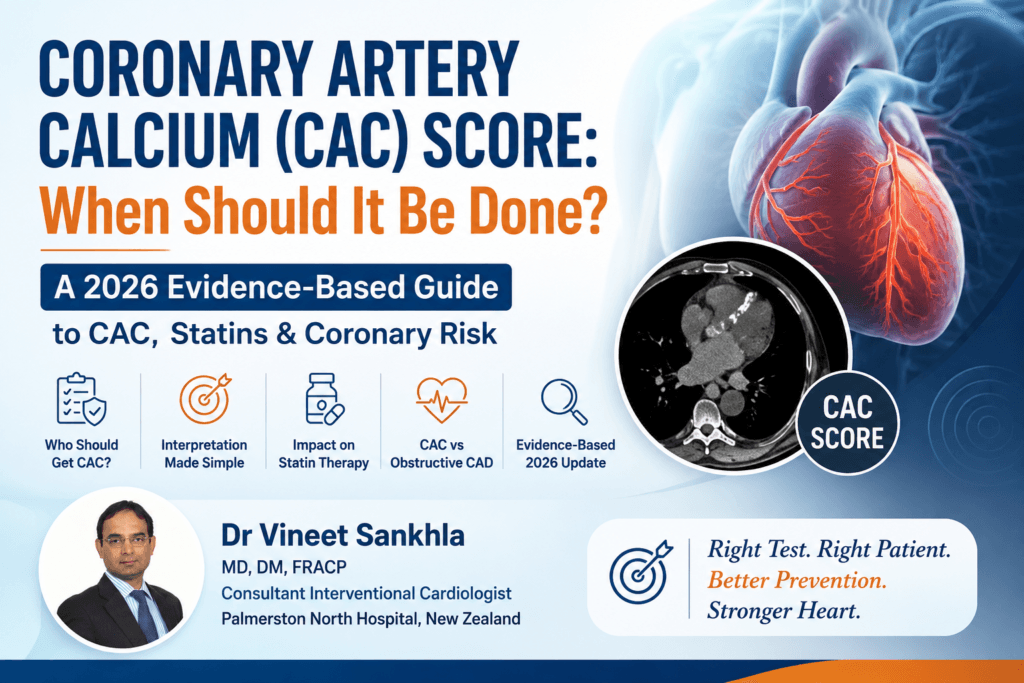

Coronary Artery Calcium (CAC) Score: When Should It Be Done?
An Evidence-Based 2026 Guide to CAC, Statins, Heart Attack Risk & Coronary Angiography
#ExpertRead | Preventive Cardiology
Written by Dr. Vineet Sankhla, MD, DM, FRACP
Consultant Interventional Cardiologist
Palmerston North Hospital, New Zealand
Health New Zealand | Te Whatu Ora
Christian Medical College, Vellore, India
The key message
Coronary artery calcium (CAC) scoring is a risk-reclassification tool—not a routine cardiovascular screening test.
It is most useful when cardiovascular risk has already been estimated and the decision about lipid-lowering treatment remains uncertain, particularly in borderline- or intermediate-risk adults.
It should not be used as a substitute for a clinical risk score, and a high CAC score should not automatically be interpreted as obstructive coronary artery disease or as an indication for coronary angiography.
The 2026 ACC/AHA multisociety dyslipidemia guideline has further refined this approach, recommending the newer PREVENT-ASCVD equations for primary-prevention risk assessment and selective use of CAC.
CAC should not be the first test
One of the commonest mistakes in preventive cardiology is:
“Let’s do a calcium score and see whether the patient has heart disease.”
That is not the appropriate sequence.
The correct approach is:
CALCULATE → PERSONALIZE → RECLASSIFY → TREAT
First calculate cardiovascular risk.
Then consider additional risk-enhancing factors.
Only if uncertainty remains should CAC be considered in an appropriate patient.
The 2026 guideline recommends the PREVENT-ASCVD equations, replacing the older Pooled Cohort Equations for 10- and 30-year risk assessment in primary prevention adults aged 30–79 years.
What is the PREVENT-ASCVD risk?
The contemporary 10-year PREVENT-ASCVD framework broadly categorizes risk as:
| 10-year risk | Category |
| <3% | Low |
| 3–<5% | Borderline |
| 5–<10% | Intermediate |
| ≥10% | High |
The 2026 guideline recommends lipid-lowering therapy after clinician–patient discussion for intermediate-risk patients and considers treatment reasonable in selected borderline-risk patients.
This is important because an older CAC algorithm based on the previous ASCVD/Pooled Cohort thresholds should not simply be carried forward unchanged into 2026.
So, who should undergo CAC testing?
The ideal CAC candidate is an asymptomatic patient in whom:
- cardiovascular risk has already been calculated;
- the patient is in a borderline or intermediate risk category;
- risk-enhancing factors have been considered; and
- there is still genuine uncertainty about whether lipid-lowering therapy should be started or how intensive treatment should be.
The 2026 ACC/AHA guideline specifically recommends selective noncontrast CAC scanning in men ≥40 and women ≥45 years with borderline or intermediate 10-year risk when the result will help with the decision about lipid-lowering therapy.
The key question is:
“Will the CAC result change management?”
If the answer is no, there is usually little reason to order the scan.
CAC is not an all-comer screening test
CAC testing should not become a routine “heart check-up” for everybody.
Low-risk patient
If a patient’s calculated risk is already very low and there is no compelling risk-enhancing feature, CAC usually adds little.
Intermediate/borderline-risk patient
This is where CAC can be extremely useful.
It can help answer:
“Should this patient start lipid-lowering therapy?”
High-risk patient
If the calculated risk is already high and treatment is clearly indicated, CAC usually does not need to be performed merely to decide whether treatment is required.
The 2026 guideline nevertheless allows CAC to help refine treatment intensity in selected situations where uncertainty remains.
CAC = 0: reassuring, but not a guarantee
A CAC score of zero means that no detectable calcified coronary plaque was identified on the scan.
It is associated with a substantially lower near-term ASCVD risk.
In selected low- or intermediate-risk patients without major exceptions, a CAC of zero can support deferring lipid-lowering therapy and reassessing risk later.
But:
CAC = 0 does NOT mean “no coronary disease.”
Why?
Because CAC detects calcified plaque.
It does not reliably detect early non-calcified plaque.
This distinction becomes particularly important in younger patients and in acute coronary syndromes.
Can someone have a heart attack with CAC = 0?
Yes.
This is one of the most important facts patients should understand.
In an ICONIC substudy of patients who subsequently developed acute coronary syndrome, 23% of ACS patients had a CAC score of zero. Their culprit lesions contained significant noncalcified plaque components.
Therefore:
CAC = 0 is not a rule-out test for acute coronary syndrome.
A patient with chest pain, ECG changes and/or elevated cardiac troponin cannot be reassured simply because a previous CAC score was zero.
CAC 1–99: there is already coronary atherosclerosis
A CAC score above zero means that calcified coronary plaque is detectable.
The 2026 guideline states that any detectable CAC supports an LDL-C goal below 100 mg/dL, with more intensive goals as calcium burden increases.
Thus:
CAC 1–99 is not a “normal” calcium score.
It is evidence of coronary atherosclerosis.
In the appropriate borderline/intermediate-risk patient, this finding can strengthen the case for lipid-lowering therapy.
CAC ≥100 or ≥75th percentile
This is a much stronger signal of coronary atherosclerotic burden.
A CAC score of ≥100 Agatston units or ≥75th percentile strongly supports lipid-lowering treatment in the appropriate primary-prevention patient.
The 2026 guideline moves toward lower LDL-C goals as CAC burden increases.
CAC ≥300: significant plaque burden
CAC ≥300 represents a substantially greater burden of coronary calcification.
However, one should avoid oversimplifying the result as:
“CAC ≥300 = LDL <55 for everybody.”
The 2026 guideline provides a more nuanced approach, with LDL-C <70 mg/dL as a major target for high-risk primary-prevention situations and more aggressive targets in selected patients.
CAC ≥1000: very extensive coronary atherosclerosis
A CAC score ≥1000 represents an extreme burden of coronary calcification and identifies a very high-risk phenotype.
Continue Reading — Free
Get the complete expert guide from Dr. Avinash Tank.
Free, always. No payment, no spam.
Continue Reading — Free
Get the complete expert guide from Dr. Avinash Tank.
Free, always. No payment, no spam — just the complete guide sent straight to your screen.
These patients require intensive cardiovascular risk-factor management and aggressive LDL-C lowering according to the overall clinical context.
Again:
The calcium score determines risk and treatment intensity; it does not by itself diagnose an obstructive coronary lesion.
The biggest misconception:
HIGH CAC ≠ OBSTRUCTIVE CAD
This distinction is critical.
CAC measures:
Calcified coronary plaque burden
It does not directly measure:
Percentage coronary artery stenosis
A patient may have extensive calcification but no severe flow-limiting stenosis.
Conversely, a patient can have important noncalcified plaque despite little or no calcium.
Research using coronary CT angiography demonstrates that CAC imperfectly characterizes the total burden and composition of coronary atherosclerosis.
Therefore:
A CAC score is not an angiogram.
High CAC does not automatically mean “severe blockage”
This is an important practical message.
Suppose an asymptomatic patient has:
CAC = 500
That means:
“There is a substantial burden of calcified coronary atherosclerosis.”
It does not automatically mean:
“There is a 90% blockage.”
The anatomical severity of stenosis requires an appropriate anatomical test such as coronary CT angiography, or invasive angiography when clinically indicated.
And whether further anatomical or functional testing is necessary depends on the patient’s symptoms, clinical risk and overall presentation, not simply the CAC number.
CAC should not automatically lead to coronary angiography
A common downstream cascade is:
CAC scan
↓
High CAC
↓
“Severe blockage”
↓
CT angiography
↓
Stress testing / cardiology referral
↓
Sometimes invasive coronary angiography
This is not an appropriate automatic pathway.
The correct question is:
Why is further testing being performed?
If the patient is asymptomatic, a high CAC score primarily indicates that preventive cardiovascular therapy deserves attention.
It does not automatically create an indication for invasive angiography.
What about acute chest pain?
CAC is not the primary diagnostic test for acute chest pain.
If a patient presents with acute chest pain, the evaluation should be based on the clinical presentation and an appropriate chest-pain pathway, including:
- history and symptoms
- physical examination
- ECG
- high-sensitivity cardiac troponin
- clinical risk assessment
- appropriate coronary imaging or functional testing when indicated
A CAC score should not be used to diagnose or exclude ACS.
This is particularly important because ACS can occur in patients with CAC = 0 because the culprit plaque may be predominantly noncalcified.
CAC and statins: another common misconception
One of the most interesting aspects of coronary calcium biology is what happens after statin therapy.
Statins reduce cardiovascular events and modify atherosclerotic plaque biology.
But plaque may undergo calcific densification during treatment.
The PARADIGM study found that in statin-treated patients, increasing CAC was associated with increasing calcified plaque volume but decreasing noncalcified plaque volume, unlike the pattern seen in untreated patients.
Another study found that statin therapy was associated with transformation of coronary atherosclerosis toward higher-density calcium, a phenotype associated with slower plaque progression.
Therefore:
An increase in CAC while taking a statin does not automatically mean that the statin has failed.
Should CAC be repeated to see whether statins are working?
Generally, CAC should NOT be used as a routine treatment-response test.
This is an important practical distinction.
The purpose of CAC is primarily:
Risk assessment and treatment decision-making
It is not:
“Let’s see whether my statin has reduced the calcium score.”
A patient’s CAC may increase despite effective LDL lowering and favorable plaque remodeling.
Therefore, treatment response should primarily be followed with:
- LDL-C
- non-HDL-C
- apoB when appropriate
- adherence
- blood pressure
- diabetes/metabolic control
- smoking status
- lifestyle
- overall ASCVD risk
rather than expecting the CAC score to fall.
The evidence on serial CAC is nuanced: CAC progression is associated with cardiovascular risk at a population level, but statin-associated plaque calcification can represent compositional changes rather than simple treatment failure.
Does calcium stabilize plaque?
This statement needs careful interpretation.
It is tempting to say:
“Calcium stabilizes plaque.”
But coronary calcification is biologically complex.
Macrocalcification and dense calcium
are generally associated with a more stable plaque phenotype.
Microcalcification
can have very different mechanical and biological implications.
Therefore, not all coronary calcium is biologically equivalent.
The Agatston score also cannot tell us the complete microscopic composition or vulnerability of a plaque.
Known CAD is a different clinical category
If a patient already has:
- established coronary artery disease
- previous myocardial infarction
- prior coronary revascularization
- documented ASCVD
then the question is no longer:
“Should I use CAC to decide whether to start preventive therapy?”
The patient already has established disease.
CAC testing therefore generally does not add value for deciding whether lipid-lowering therapy is indicated.
The 2026 guideline recommends much lower LDL-C goals for very-high-risk ASCVD, including <55 mg/dL in appropriate secondary-prevention patients.
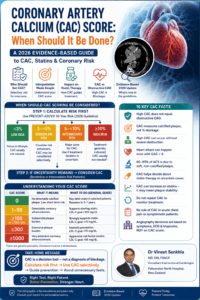
The practical 2026 CAC algorithm
STEP 1 — Does the patient have established ASCVD?
YES
Treat as secondary prevention.
CAC is not required to decide whether lipid-lowering therapy is needed.
↓
NO
Proceed to primary-prevention risk assessment.
STEP 2 — Calculate PREVENT-ASCVD risk
<3%
Low risk
Focus on lifestyle and risk-factor optimization.
CAC usually adds little.
3–<5%
Borderline risk
Personalize risk.
Consider risk enhancers.
If the treatment decision remains uncertain, CAC may be considered selectively.
5–<10%
Intermediate risk
This is a major CAC decision zone.
If uncertainty remains regarding lipid-lowering treatment:
Consider CAC.
≥10%
High risk
Lipid-lowering therapy is generally indicated based on the overall risk profile.
CAC is usually not needed simply to decide whether treatment should be started, although it can occasionally help refine treatment intensity when uncertainty remains.
Then interpret the CAC
| CAC score | What it means clinically |
| 0 | No detectable calcified plaque; can support de-escalation/deferment in selected patients |
| 1–99 | Detectable coronary atherosclerosis |
| ≥100 or ≥75th percentile | Substantial plaque burden; strongly supports lipid-lowering therapy |
| ≥300 | Extensive plaque burden; more intensive prevention is appropriate |
| ≥1000 | Very extensive coronary atherosclerosis; aggressive risk-factor management |
The exact treatment decision should always incorporate age, sex, PREVENT risk, LDL-C, diabetes, smoking, family history, Lp(a), kidney disease and other risk-enhancing factors.
10 CAC facts every patient should know
1. High CAC does not equal obstructive CAD.
2. CAC measures calcified plaque—not percentage blockage.
3. High CAC can occur without severe coronary obstruction.
4. CAC = 0 does not guarantee absence of coronary atherosclerosis.
5. A heart attack can occur despite CAC = 0.
6. CAC is mainly useful for risk stratification and lipid-treatment decisions.
7. CAC is not a substitute for PREVENT-ASCVD risk calculation.
8. CAC progression during statin treatment does not automatically mean treatment failure.
9. CAC should not routinely be repeated just to monitor statin response.
10. A high CAC score alone should not trigger automatic coronary angiography.
The CAC trap
The problem is not CAC itself.
The problem is misuse of CAC.
A powerful test becomes harmful when it is used outside the clinical question for which it was designed.
The wrong approach is:
“Let’s scan everyone and find who has calcium.”
The better approach is:
“First determine cardiovascular risk. If treatment uncertainty remains, can CAC meaningfully change the decision?”
That is the real value of CAC.
The simplest way to remember it
CAC is a decision tool—not a diagnosis of blockage.
Risk score first.
↓
Personalize risk.
↓
CAC selectively when uncertainty remains.
↓
Use CAC to refine preventive treatment.
↓
Do NOT equate CAC with obstructive CAD.
↓
Do NOT use CAC as the primary test for acute chest pain.
Final Take-Home Message
Coronary artery calcium scoring is one of the most useful tools in preventive cardiology—but only when used for the right patient and the right clinical question.
It is particularly valuable when an otherwise healthy, asymptomatic patient has borderline or intermediate cardiovascular risk and uncertainty remains about lipid-lowering therapy.
It is not a routine screening test for everybody.
It is not an angiogram.
It does not measure the severity of coronary obstruction.
And it cannot exclude acute coronary syndrome simply because the CAC score is zero.
The modern approach is:
CALCULATE → PERSONALIZE → RECLASSIFY → TREAT
rather than:
SCAN → PANIC → ANGIOGRAPHY
Use CAC to improve prevention—not to create unnecessary downstream testing.
Frequently Asked Questions
Is CAC recommended for everyone over 40?
No. The 2026 ACC/AHA guideline recommends selective CAC use in appropriate adults—particularly men ≥40 and women ≥45 with borderline or intermediate risk—when the result is expected to influence the lipid-treatment decision.
Is CAC useful in a low-risk patient?
Usually not. If the patient’s risk is already clearly low and there is no important risk-enhancing factor, CAC is unlikely to change management.
Is CAC useful in a high-risk patient?
Usually it is not necessary merely to decide whether lipid-lowering therapy is indicated. Treatment is generally already warranted. CAC may occasionally help refine treatment intensity in selected circumstances.
Does CAC 100 mean I have a 100% blocked artery?
Absolutely not. CAC is an Agatston calcium score, not a percentage stenosis.
Can CAC 0 rule out a heart attack?
No. Acute coronary syndrome can arise from noncalcified plaque. In the ICONIC substudy, 23% of ACS patients had CAC = 0.
Should I repeat CAC every year?
No. Routine annual CAC scanning is not a standard way to monitor preventive treatment.
Can CAC increase after starting statins?
Yes. Statin therapy can be associated with increasing/densifying coronary calcium while reducing higher-risk noncalcified plaque characteristics.
Does high CAC mean I need coronary angiography?
No. Angiography decisions should be based on the clinical presentation and appropriate diagnostic evaluation—not the CAC number alone.
Authoritative references
1. 2026 ACC/AHA Multisociety Dyslipidemia Guideline — current primary guideline for PREVENT-ASCVD, LDL-C targets and selective CAC use. Read the 2026 ACC/AHA Dyslipidemia Guideline
2. American College of Cardiology — 2026 Guideline Summary — practical summary of PREVENT, CAC and treatment recommendations. ACC/AHA Release: New Dyslipidemia Guideline
3. ICONIC study — ACS despite CAC = 0. PubMed: CAC = 0 and acute coronary syndrome
4. Coronary plaque progression and CAC. PubMed: CAC and atherosclerosis progression
5. PARADIGM study — CAC progression and statin therapy. PubMed: CAC progression according to statin use
6. Statins and coronary plaque composition. PubMed: Statin treatment and plaque composition
7. Global CAC guideline comparison. ACC: Major Global Coronary Artery Calcium Guidelines
Related patient videos
 DWARIKA HOSPITALVerified Patient Story
Verified
DWARIKA HOSPITALVerified Patient Story
Verified  DWARIKA HOSPITALVerified Patient Story
Verified
DWARIKA HOSPITALVerified Patient Story
Verified  DWARIKA HOSPITALVerified Patient Story
Verified
DWARIKA HOSPITALVerified Patient Story
Verified 
Related treatments & services
A complete, personalised weight-loss programme — surgery where needed, plus nutrition, medical and lifestyle support for lasting results.
View service → 360 Diabetes ReversalA complete programme to reverse Type-2 diabetes — combining metabolic surgery where suitable with diet, medical and lifestyle care.
View service → Gallbladder Stone
Minimally invasive removal of the gallbladder (laparoscopic cholecystectomy) — the definitive, day-care treatment for painful gallstones.
View service →Was this guide helpful?
Super-specialist GI, bariatric & cancer surgeon. SGPGIMS (India's premier GI centre) + advanced training in Japan & South Korea. Read full profile →
Last reviewed: July 2026