


Why You Can Look “Normal” and Still Have Dangerous Abdominal Fat
You do not have to be visibly obese to have excess body fat that increases your risk of type 2 diabetes.
Two people can have the same weight and even the same Body Mass Index (BMI), yet have very different metabolic health.
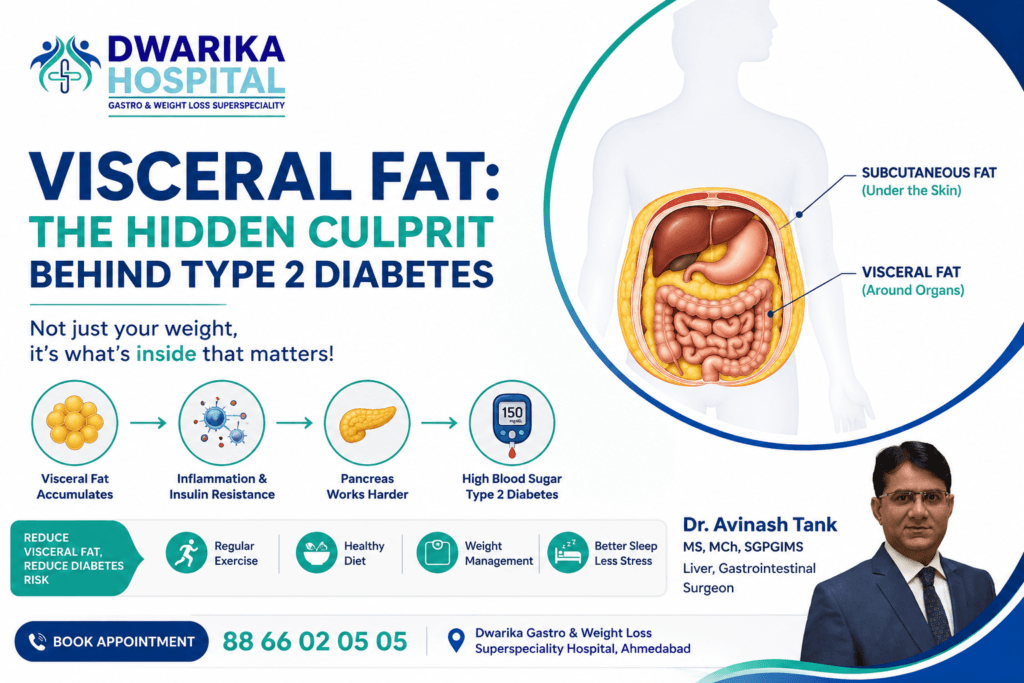
One may carry most of the excess fat underneath the skin. The other may have a larger amount of visceral adipose tissue (VAT)—fat stored deep inside the abdomen around organs such as the liver, pancreas and intestines.
This distinction matters.
Visceral fat is metabolically active. It can release free fatty acids and inflammatory signals that interfere with insulin action and contribute to insulin resistance, fatty liver, abnormal cholesterol, high blood pressure and type 2 diabetes.
This is one reason why waist size and body-fat distribution can sometimes tell us more about metabolic risk than body weight alone.
A 2024 review published in Nutrients, titled “Visceral Adipose Tissue: The Hidden Culprit for Type 2 Diabetes,” examined the relationship between visceral fat, insulin resistance and type 2 diabetes.
For Indians and other South Asians, this subject is particularly important because metabolic disease can develop at a comparatively lower BMI.
What Is Visceral Fat?
Visceral fat is fat stored deep inside the abdominal cavity around internal organs.
It is different from the soft fat that you can pinch underneath your skin, called subcutaneous fat.
The two major abdominal fat compartments
| Type of fat | Where it is located | Metabolic significance |
|---|---|---|
| Subcutaneous fat | Under the skin | Generally less metabolically harmful |
| Visceral fat | Deep inside the abdomen around organs | Strongly associated with insulin resistance and cardiometabolic disease |
Visceral adipose tissue is not simply an inactive energy-storage depot.
It behaves like an endocrine and metabolic organ, releasing fatty acids, hormones, cytokines and other signalling molecules that can influence metabolism throughout the body.
That is why two people with identical BMI can have very different diabetes risk.
Why Is Visceral Fat Dangerous?
The central problem is metabolic dysfunction.
When visceral fat expands, several processes can occur simultaneously:
Visceral fat accumulation → increased fatty-acid flux → insulin resistance → compensatory insulin secretion → metabolic dysfunction → increased diabetes risk
But this is not a single pathway.
Visceral adiposity interacts with:
- genetics
- diet
- physical inactivity
- age
- sex hormones
- liver fat
- muscle mass
- pancreatic β-cell function
- inflammation
- sleep and stress
- overall energy balance
Therefore, visceral fat should be considered an important component of a much larger metabolic picture.
How Does Visceral Fat Cause Insulin Resistance?
1. Visceral fat releases more free fatty acids
Visceral adipose tissue has a high metabolic turnover.
Excess fatty acids released from visceral fat can reach the liver through the portal circulation and contribute to abnormal lipid metabolism and hepatic insulin resistance.
This can interfere with the body’s ability to regulate glucose effectively.
The result may be:
More visceral fat → more abnormal fatty-acid exposure → impaired insulin signalling → insulin resistance
2. The liver becomes metabolically stressed
The liver plays a central role in glucose regulation.
Normally, insulin suppresses excessive glucose production by the liver.
When hepatic insulin resistance develops, this suppression becomes less effective.
The liver may continue producing glucose even when blood glucose is already elevated.
This contributes to:
- high fasting glucose
- prediabetes
- type 2 diabetes
Visceral adiposity is also closely linked with metabolic dysfunction-associated steatotic liver disease (MASLD).
Therefore:
Belly fat → insulin resistance → liver fat → worsening insulin resistance
can become a self-reinforcing metabolic cycle.
3. Visceral fat promotes chronic low-grade inflammation
Healthy adipose tissue is not inherently harmful.
The problem occurs when adipose tissue becomes metabolically dysfunctional.
Expansion of visceral fat can be associated with altered immune-cell activity and production of inflammatory mediators.
This creates a state of chronic low-grade inflammation, which can interfere with normal insulin signalling.
The result is another pathway toward insulin resistance.
4. The pancreas has to work harder
When tissues become resistant to insulin, the pancreas initially compensates by producing more insulin.
This can maintain apparently normal blood glucose for some time.
A person may therefore have:
Normal glucose + high insulin + increasing insulin resistance
before developing prediabetes.
Over time, susceptible pancreatic β-cells may fail to compensate adequately.
Blood glucose then begins to rise.
This is why diabetes does not necessarily appear suddenly.
There may be years of metabolic dysfunction before the diagnosis is made.
5. Visceral fat can be present even when BMI is not very high
This is one of the most important lessons.
BMI measures body weight relative to height. It does not tell you where your fat is stored.
The 2026 American Diabetes Association Standards specifically note that BMI does not measure fat distribution and recommend additional anthropometric measures such as waist circumference or waist-to-height ratio when appropriate.
This is particularly relevant in Asian populations.
Why Indians Can Develop Diabetes at a Lower BMI
South Asians have a distinctive body-composition pattern often described as the “Asian Indian phenotype.”
Compared with many European populations, South Asians may develop:
- greater abdominal adiposity
- more visceral fat
- greater insulin resistance
- lower lean muscle mass
- ectopic fat accumulation
at comparatively lower BMI levels.
Research in Asian Indians has shown that insulin resistance can correlate more strongly with visceral fat than with total or subcutaneous fat.
This means:
A person can look “not very overweight” but still carry metabolically important abdominal fat.
That is one reason relying exclusively on BMI can underestimate metabolic risk in South Asians.
Your Waist May Tell You Something Your Weight Doesn’t
For an Indian adult, waist circumference is an important practical marker of central adiposity.
Commonly used South Asian thresholds are approximately:
Men
≥90 cm
Women
≥80 cm
These thresholds have been incorporated into South Asian metabolic-risk frameworks and are also reflected in current obesity assessment recommendations for Asian adults.
However, waist circumference is not a direct measurement of visceral fat.
It is a practical surrogate for abdominal adiposity.
Two people with the same waist circumference can still have different amounts of visceral fat.
What About Waist-to-Height Ratio?
Another useful practical measure is:
Waist-to-height ratio = waist circumference ÷ height
For example:
If your waist is 90 cm and your height is 170 cm:
90 ÷ 170 = 0.53
This provides another way of assessing central adiposity and can sometimes be more informative than BMI alone.
The 2026 ADA obesity standards recognize waist circumference and waist-to-height ratio as useful measures of adiposity assessment, particularly when BMI does not adequately represent metabolic risk.
Can You Have Visceral Fat Without Being Obese?
Yes.
This is particularly important in Asian populations.
Studies of non-obese Asian people with type 2 diabetes have found that they can have a greater proportion of intra-abdominal and intra-hepatic fat despite not having markedly higher total body fat.
Continue Reading — Free
Get the complete expert guide from Dr. Avinash Tank.
Free, always. No payment, no spam.
Continue Reading — Free
Get the complete expert guide from Dr. Avinash Tank.
Free, always. No payment, no spam — just the complete guide sent straight to your screen.
This explains the common clinical situation:
“My weight is normal. Why did I develop diabetes?”
The answer may involve several factors, including:
- visceral fat
- liver fat
- low muscle mass
- genetic susceptibility
- impaired β-cell reserve
- physical inactivity
- dietary pattern
- age
- family history
Therefore, normal BMI does not guarantee normal metabolic health.
How Can Visceral Fat Be Measured?
There is no single perfect test for routine clinical practice.
1. Waist circumference
Simple, inexpensive and easily available.
It is useful for identifying central adiposity but cannot directly quantify visceral fat.
2. Waist-to-height ratio
Another inexpensive indicator of central adiposity.
3. Bioelectrical impedance analysis
Some body-composition devices estimate visceral fat.
These measurements can be useful for monitoring trends, but the accuracy of individual visceral-fat estimates varies between devices.
4. DEXA
Dual-energy X-ray absorptiometry can provide detailed body-composition information.
However, it is not usually required simply to assess diabetes risk.
5. CT or MRI
CT and MRI can directly quantify visceral adipose tissue more accurately than routine anthropometric measurements.
However, they are generally not necessary simply to screen every person for visceral fat.
They may be used when imaging is clinically indicated for another reason.
Can You Lose Visceral Fat Without Losing a Huge Amount of Weight?
Yes.
This is an important concept in metabolic health.
A person’s metabolic health can improve with changes in:
- body weight
- waist circumference
- physical activity
- muscle mass
- diet quality
- insulin sensitivity
Therefore, the goal should not be simply:
“Lose weight.”
A better goal is:
Reduce excess adiposity and improve metabolic health.
The 2026 ADA Standards emphasize that even 5–7% weight loss can improve glycemia and cardiovascular risk factors in appropriate people, while greater sustained weight loss may provide additional metabolic benefits.
What Is the Best Way to Reduce Visceral Fat?
There is no single “visceral fat burning” food or exercise.
The most effective approach is a comprehensive metabolic-health strategy.
1. Reduce excess calorie intake
Persistent calorie excess promotes fat accumulation.
The dietary pattern should emphasize:
- vegetables
- whole fruits
- legumes
- adequate protein
- whole grains where appropriate
- nuts and seeds
- minimally processed foods
and reduce:
- sugar-sweetened beverages
- sweets
- refined carbohydrates
- highly processed foods
- excessive calorie-dense foods
The ADA’s 2026 recommendations similarly emphasize nutrient quality, appropriate calorie intake and reduction of refined and ultra-processed foods in people with prediabetes or diabetes.
2. Increase physical activity
Exercise improves insulin sensitivity even before substantial weight loss occurs.
A combination of:
Aerobic activity
such as:
- brisk walking
- cycling
- swimming
- jogging
and
Resistance training
such as:
- weight training
- resistance bands
- body-weight exercises
can be particularly valuable.
Resistance exercise is important because muscle is a major site of glucose disposal.
Therefore, metabolic health is not just about losing fat.
It is also about preserving and building muscle.
3. Reduce prolonged sitting
Someone can exercise for 30–45 minutes and still spend most of the day sitting.
Breaking up prolonged sedentary periods with regular movement can be a simple but useful component of metabolic-health management.
4. Improve sleep
Poor sleep can adversely affect appetite regulation, insulin sensitivity and weight management.
If someone has:
- loud snoring
- excessive daytime sleepiness
- witnessed pauses in breathing
- resistant hypertension
- unexplained fatigue
evaluation for obstructive sleep apnea may be appropriate.
5. Treat obesity as a chronic disease when necessary
Lifestyle modification is fundamental, but it is not always sufficient.
Some individuals require additional treatment, including:
- structured obesity-management programmes
- anti-obesity medications
- management of diabetes and metabolic complications
- metabolic/bariatric surgery in appropriately selected patients
The ADA 2026 Standards recognize lifestyle intervention, pharmacotherapy and metabolic surgery as potential components of individualized obesity treatment.
Is Visceral Fat the Same as Belly Fat?
Not exactly.
A large abdomen may contain:
- subcutaneous abdominal fat
- visceral fat
- enlarged internal organs
- bloating
- other causes of abdominal distension
Therefore, you cannot determine the exact amount of visceral fat simply by looking at someone’s abdomen.
However, increasing waist circumference is a useful warning sign of increased central adiposity.
Can Exercise Reduce Visceral Fat Even Without Major Weight Loss?
Yes.
Exercise can improve insulin sensitivity and body composition even when the weighing scale changes only modestly.
This is why waist circumference, physical fitness, strength, blood glucose, HbA1c and metabolic health should not be judged exclusively by body weight.
A person may become metabolically healthier even when weight loss is relatively modest.
What Are the Warning Signs of Metabolic Risk?
Visceral fat itself usually produces no specific symptoms.
That is why it is often called a “hidden” risk.
You should pay attention to combinations such as:
- increasing waist circumference
- increasing weight
- fatty liver
- high triglycerides
- low HDL cholesterol
- high blood pressure
- prediabetes
- increasing fasting glucose
- elevated HbA1c
- family history of diabetes
- sedentary lifestyle
The combination is more important than any single measurement.
Who Should Be Particularly Alert?
People with the following characteristics may benefit from early metabolic-risk assessment:
Family history of type 2 diabetes
Genetic susceptibility can substantially influence diabetes risk.
Increasing abdominal circumference
A growing waist can be an early warning sign even before diabetes develops.
South Asian ancestry
South Asians have increased metabolic risk at comparatively lower BMI levels.
Fatty liver
Liver fat and insulin resistance are closely interconnected.
Sedentary lifestyle
Low physical activity promotes insulin resistance and loss of muscle mass.
Increasing age
Age is associated with changes in body composition, muscle mass and fat distribution.
History of gestational diabetes
Women with previous gestational diabetes have an increased future risk of type 2 diabetes.
Can Visceral Fat Be Prevented?
Often, yes—but prevention needs to begin before diabetes develops.
The important window may be the period of:
Normal glucose → insulin resistance → prediabetes → type 2 diabetes
If excessive visceral fat and metabolic dysfunction are identified early, intervention can potentially delay or prevent progression.
The 2026 ADA Standards emphasize that effective obesity management can delay progression from prediabetes to type 2 diabetes.
The Important Difference Between Weight Loss and Fat Loss
This distinction is often overlooked.
A reduction in body weight can come from:
- fat
- muscle
- water
- glycogen
Therefore, a successful metabolic-health programme should aim for fat loss while preserving lean mass.
The ideal outcome is:
↓ visceral/central adiposity
↓ waist circumference
↓ liver fat
↑ insulin sensitivity
↑ muscle fitness
↓ diabetes risk
rather than simply:
↓ number on the weighing scale
What About “Skinny Fat”?
The term “skinny fat” is commonly used to describe someone whose BMI appears normal but who has relatively high body fat and/or central adiposity with low muscle mass.
It is not a formal medical diagnosis.
However, the underlying concept is clinically relevant.
A person may have:
Normal BMI + low muscle mass + central fat + insulin resistance
and therefore have significant metabolic risk despite not appearing obese.
This is particularly relevant to Asian populations.
Does Everyone With Visceral Fat Develop Diabetes?
No.
Visceral adiposity is an important risk factor, but it is not destiny.
Type 2 diabetes develops through an interaction of:
genetic susceptibility + adiposity + insulin resistance + β-cell function + lifestyle + age + ectopic fat + other metabolic factors
Some people with obesity never develop diabetes.
Conversely, some lean people develop type 2 diabetes.
Therefore, visceral fat should be viewed as a major modifiable risk factor, not as the sole cause of diabetes.
The Bigger Picture: Visceral Fat, Liver Fat and Muscle
It is increasingly useful to think beyond “body weight.”
Metabolic disease can involve fat accumulation in several locations:
Visceral fat
→ promotes insulin resistance and inflammatory signalling
Liver fat
→ contributes to hepatic insulin resistance and abnormal glucose production
Muscle fat
→ may interfere with insulin-mediated glucose metabolism
Pancreatic fat
→ may be associated with β-cell dysfunction in susceptible individuals
These processes can interact.
This helps explain why diabetes is fundamentally a metabolic disease involving multiple organs, rather than simply a disease caused by high blood sugar.
What Should You Check If You Are Worried About Visceral Fat?
A practical metabolic assessment may include:
Basic measurements
- Weight
- BMI
- Waist circumference
- Blood pressure
Blood tests
- Fasting blood glucose
- HbA1c
- Lipid profile
- Liver enzymes when appropriate
Additional assessment when indicated
- Liver ultrasound or other imaging
- Body-composition assessment
- Evaluation for sleep apnea
- Assessment of cardiovascular risk
Not everyone needs every test.
The appropriate assessment depends on age, symptoms, family history, body composition and existing medical conditions.
A Simple Metabolic Health Checklist
If you want to assess your metabolic risk, ask yourself:
1. Is my waist increasing?
2. Is my BMI normal but my abdomen disproportionately large?
3. Do I have fatty liver?
4. Is my fasting glucose increasing?
5. Is my HbA1c in the prediabetes range?
6. Do I have high triglycerides or low HDL?
7. Do I have high blood pressure?
8. Am I physically inactive?
9. Am I losing muscle as I gain abdominal fat?
10. Do I have a strong family history of diabetes?
If several answers are “yes,” it is worth discussing your metabolic risk with a healthcare professional.
The Take-Home Message
Type 2 diabetes is not simply a disease of body weight. It is a disease of metabolic dysfunction.
Visceral adipose tissue—the fat stored deep inside the abdomen—can play a major role in this process.
It can contribute to:
Visceral fat
↓
Increased fatty-acid release and metabolic dysfunction
↓
Insulin resistance
↓
Higher insulin requirements
↓
Progressive β-cell stress in susceptible individuals
↓
Prediabetes
↓
Type 2 diabetes
But this pathway is modifiable.
Reducing excess body fat, particularly central adiposity, maintaining muscle mass, improving diet quality, exercising regularly and treating obesity when appropriate can substantially improve metabolic health.
For Indians and other South Asians, this message is especially important:
Do not judge your diabetes risk by your weight alone. Look at your waist, your body composition, your metabolic markers and your lifestyle.
A “normal” BMI does not necessarily mean a metabolically healthy body.
Frequently Asked Questions
What is visceral fat?
Visceral fat is fat stored deep inside the abdomen around internal organs. It is metabolically active and is associated with insulin resistance and cardiometabolic disease.
Is visceral fat more dangerous than subcutaneous fat?
Generally, excess visceral fat is more strongly associated with insulin resistance and cardiometabolic risk than subcutaneous fat, although both fat depots can become metabolically dysfunctional.
Can a thin person have visceral fat?
Yes. A person can have a normal BMI while carrying relatively high abdominal or visceral fat.
Does belly fat cause diabetes?
Excess abdominal/visceral adiposity can substantially increase diabetes risk, but type 2 diabetes has multiple causes and risk factors.
What waist size increases diabetes risk in Indians?
A commonly used South Asian threshold is 90 cm or more for men and 80 cm or more for women. These are risk/central-adiposity thresholds, not a diagnosis of diabetes.
Can visceral fat be reduced?
Yes. Calorie control, healthy eating, physical activity, resistance training, adequate sleep and appropriate medical obesity treatment can reduce excess adiposity and improve metabolic health.
Is BMI enough to assess diabetes risk?
No. BMI is useful but does not show where fat is stored. Current ADA guidance recommends considering measures such as waist circumference or waist-to-height ratio where appropriate.
Can losing 5% of body weight help?
Yes. In people with overweight or obesity, approximately 5–7% weight loss can improve glycemia and other cardiometabolic risk factors. Greater sustained weight loss may provide additional benefits.
Does exercise help even if I don’t lose much weight?
Yes. Exercise can improve insulin sensitivity, fitness and body composition even when the change on the weighing scale is modest.
Should everyone get a CT scan to measure visceral fat?
No. CT and MRI can quantify visceral fat, but they are not routinely necessary for everyone. Waist circumference, waist-to-height ratio and clinical/metabolic assessment are much more practical for routine risk assessment.
Medical Disclaimer
This article is intended for general health education and does not replace individualized medical evaluation. Visceral fat is only one component of type 2 diabetes risk. If you have prediabetes, diabetes, obesity, fatty liver, increasing waist circumference or other metabolic risk factors, consult an appropriately qualified healthcare professional for personalized assessment and treatment.
Scientific Source
Dhokte S, Czaja K. Visceral Adipose Tissue: The Hidden Culprit for Type 2 Diabetes. Nutrients. 2024;16(7):1015. doi:10.3390/nu16071015.
Related patient videos
 DWARIKA HOSPITALVerified Patient Story
Verified
DWARIKA HOSPITALVerified Patient Story
Verified  DWARIKA HOSPITALVerified Patient Story
Verified
DWARIKA HOSPITALVerified Patient Story
Verified  DWARIKA HOSPITALVerified Patient Story
Verified
DWARIKA HOSPITALVerified Patient Story
Verified 
Related treatments & services
A complete, personalised weight-loss programme — surgery where needed, plus nutrition, medical and lifestyle support for lasting results.
View service → 360 Diabetes ReversalA complete programme to reverse Type-2 diabetes — combining metabolic surgery where suitable with diet, medical and lifestyle care.
View service → Gallbladder Stone
Minimally invasive removal of the gallbladder (laparoscopic cholecystectomy) — the definitive, day-care treatment for painful gallstones.
View service →Was this guide helpful?
Super-specialist GI, bariatric & cancer surgeon. SGPGIMS (India's premier GI centre) + advanced training in Japan & South Korea. Read full profile →
Last reviewed: July 2026