

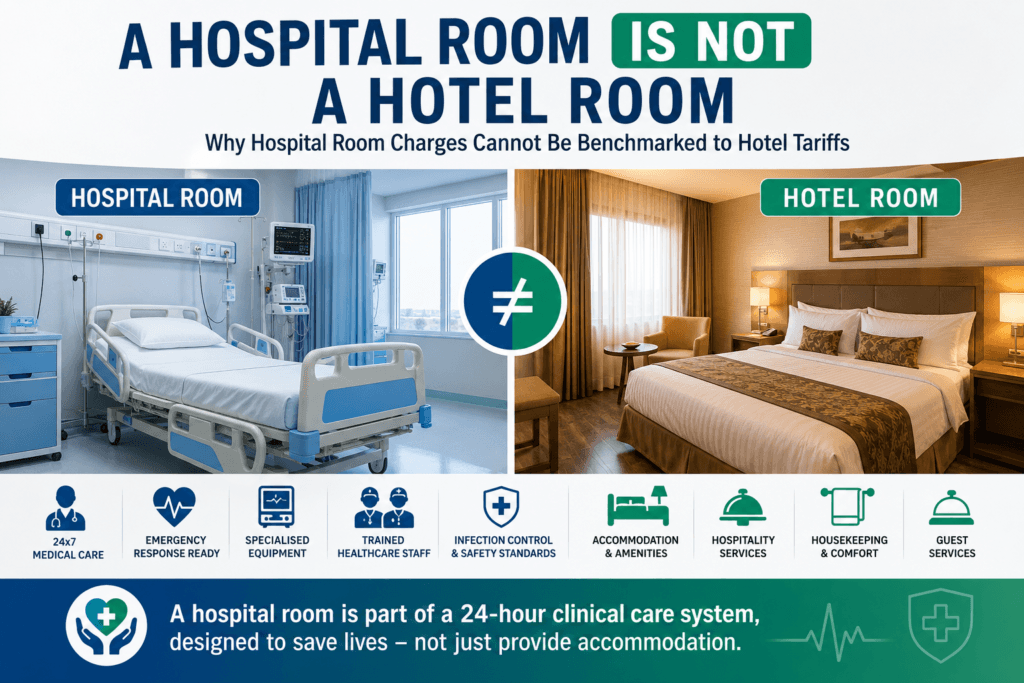

Healthcare affordability matters—but comparing a hospital bed with a hotel bed misses the real economics of healthcare
The debate over hospital room charges has recently taken an unexpected turn.
A Parliamentary Standing Committee on Health & Family Welfare has recommended that private hospital room charges in metropolitan cities should not exceed the average tariff of a nearby three-star hotel. The recommendation is part of the Committee’s 176th Report, Affordability and Accessibility of Healthcare Facilities in Public and Private Sector, presented in Parliament on 7 August 2026. (Onmanorama)
The objective behind the recommendation is understandable.
Healthcare must be affordable. Patients should not face unpredictable bills. Hospitals should be transparent about their charges. Excessive or arbitrary billing must be addressed.
But there is a fundamental problem with the proposed benchmark:
A hospital room is not a hotel room.
The two may both contain a bed, bathroom, air-conditioning, electricity and housekeeping. But economically, operationally and clinically, they are completely different products.
And this is not merely the opinion of doctors or hospital administrators.
The Competition Commission of India (CCI) has specifically considered this question and concluded that hospital rooms and three- and four-star hotel rooms are different relevant products and are not substitutable. (Competition Commission of India)
That distinction deserves much greater attention in the current policy debate.
The Parliamentary Committee has identified a real problem
It is important to begin by acknowledging what the Parliamentary Committee is trying to address.
Private healthcare costs can impose a significant financial burden on Indian families. The Committee’s report highlights concerns regarding variations in hospital charges, affordability, transparency and out-of-pocket expenditure.
The Committee has therefore recommended several measures beyond room-rent benchmarking, including upfront treatment-cost estimates, financial navigators for patients, standardisation of charges for common procedures and measures to reduce arbitrary variations in billing. (News Today)
These are legitimate objectives.
Patients deserve to know what they are paying for.
Hospitals should be accountable for their prices.
Insurance companies should have transparent reimbursement structures.
And policymakers should work towards reducing avoidable financial hardship.
The question is not whether healthcare should be affordable. It should.
The question is:
Is the tariff of a three-star hotel the correct economic benchmark for the cost of maintaining a hospital bed?
The evidence suggests that it is not.
A hotel sells accommodation. A hospital provides healthcare.
A hotel room is fundamentally an accommodation service.
The customer pays for:
- A room
- A bed
- Housekeeping
- Electricity and air-conditioning
- Water
- Furniture
- Security
- Hospitality
- Basic amenities
The hotel does not have to maintain a clinical environment.
A hospital room is fundamentally different.
When a patient occupies a hospital bed, the patient is not purchasing accommodation as a standalone product.
The patient is receiving treatment.
The room exists inside a clinical ecosystem that includes:
- Doctors
- Nurses
- Resident medical officers
- Technicians
- Pharmacists
- Emergency services
- Diagnostic facilities
- Medical equipment
- Medical gases
- Infection-control systems
- Biomedical waste management
- Sterilisation facilities
- Backup electricity
- Fire and life-safety systems
- Information technology
- 24-hour clinical supervision
The room is therefore only one visible component of a much larger healthcare infrastructure.
The Competition Commission of India (CCI) has already addressed this comparison
This is perhaps the most important evidence in the debate.
In orders dated 21 May 2026, the Competition Commission of India considered allegations concerning private super-specialty hospitals and specifically examined comparisons between hospital room rents and nearby three- and four-star hotels.
The CCI rejected the premise that the two are substitutable.
The Commission stated that hospital rooms and three-/four-star hotel rooms are different relevant products because hospital rooms are not merely discretionary lodging facilities. They are designed around the clinical needs of patients and include features such as automatic patient beds, trained medical staff and emergency-response mechanisms for immediate medical attention—facilities that are absent in hotel accommodation. (Competition Commission of India)
This is an important regulatory finding.
It does not mean that hospitals should be permitted to charge unlimited prices.
It means something more fundamental:
A hotel tariff cannot automatically be treated as the cost benchmark for a hospital room because the two products are not economically substitutable.
The CCI’s reasoning directly challenges the assumption underlying a simple hotel-room comparison.
The CCI made another crucial point: compare costs, not unrelated products
The CCI’s reasoning becomes even more relevant when it discusses how excessive pricing should be assessed.
In the Apollo hospital New Delhi case, the Commission noted that the investigation had compared hospital room rents with government hospitals and three-/four-star hotels but had not compared the hospital’s room rents with the associated costs of providing those rooms. (Competition Commission of India)
The Commission further observed that neighbouring hospital room rates showed mixed results.
Most importantly, it concluded that:
Without comparative cost analysis of hospital rooms across hospitals, it could not conclude that the hospital was charging an excessive or unfair price. (Competition Commission of India)
This is a powerful principle for healthcare policy.
If policymakers want to determine whether a hospital room is expensive, the first question should be:
What does it actually cost to provide that hospital bed safely?
Not:
What does a nearby hotel charge for a room?
The IMA costing data tells an important story
The Indian Medical Association has also published costing figures that demonstrate the difference between a simplistic tariff comparison and the actual economics of healthcare delivery.
In its advisory on cashless healthcare, IMA provides sample comparative costing figures.
For a non-AC room, the document lists:
| Service | Comparison rate | IMA costing rate |
|---|---|---|
| Room rent | ₹1,500/day | ₹5,308/day |
| Visiting charges | ₹500 | ₹1,000–1,500 |
| ICU | ₹3,500/day | ₹10,130/day |
| Ventilator | ₹2,500/day | ₹6,000/day |
| OT – first hour | ₹500–2,500 | ₹5,666 |
| Surgeon | ₹2,000–11,000 | ₹2,500–30,000 |
| Anaesthetist | ₹900–3,600 | ₹3,500–7,500 |
These are IMA’s costing figures, not a universal statutory tariff, and they should not be interpreted as saying that every hospital in India must charge these amounts.
But they make one thing very clear:
The cost of providing healthcare infrastructure is not the same as the price of ordinary accommodation.
The IMA document is particularly relevant because the room-cost figure of ₹5,308 is more than three times the ₹1,500 comparison rate shown in the same table. (IMA India)
The policy discussion therefore needs to distinguish between:
tariff benchmarking
and
cost accounting.
They are not the same exercise.
What exactly is hidden behind a hospital bed?
A patient sees a bed.
A hospital sees a capital-intensive clinical asset.
Consider what has to be maintained for that bed to function safely.
1. Building infrastructure
The hospital must pay for:
- Land
- Construction
- Civil infrastructure
- Elevators
- Fire-safety systems
- Water systems
- Electrical infrastructure
- Air-conditioning and ventilation
These capital costs have to be recovered over the life of the facility.
2. Medical infrastructure
A hospital room may require:
- Medical-gas pipelines
- Oxygen supply
- Suction
- Nurse-call systems
- Patient monitoring
- Emergency equipment
- Medical-grade electrical systems
None of these are necessary in a conventional hotel room.
3. 24-hour staffing
A hotel can operate primarily around accommodation and hospitality.
A hospital cannot close its clinical operations at night.
Continue Reading — Free
Get the complete expert guide from Dr. Avinash Tank.
Free, always. No payment, no spam.
Continue Reading — Free
Get the complete expert guide from Dr. Avinash Tank.
Free, always. No payment, no spam — just the complete guide sent straight to your screen.
Patients may deteriorate at 2 am.
A postoperative patient may suddenly bleed.
A patient may develop respiratory distress.
A diabetic patient may become hypoglycaemic.
A patient may develop cardiac arrhythmia.
The hospital has to be ready.
That readiness has a cost.
4. Infection control
Hospitals must deal with:
- Surgical wounds
- Infectious diseases
- Immunocompromised patients
- Multidrug-resistant organisms
- Sterile procedures
- Biomedical waste
The cleaning and infection-control requirements are therefore fundamentally different from those of a hotel.
5. Emergency readiness
A hospital bed is connected to a system capable of escalating care.
The patient may move from:
Ward → HDU → ICU → Operating Theatre → Emergency intervention
within minutes.
That capacity has to exist whether or not the patient eventually requires it.
Hospitals carry a cost that hotels do not: clinical readiness
Perhaps the simplest way to understand the difference is this:
What happens when a hotel guest suddenly deteriorates?
The hotel calls an ambulance.
What happens when a hospital patient suddenly deteriorates?
The hospital is expected to respond.
A nurse may immediately assess the patient.
A doctor may arrive.
Oxygen may be started.
An ECG may be performed.
Emergency medication may be administered.
A defibrillator may be used.
Laboratory investigations may be ordered.
The patient may be transferred to the ICU.
An anaesthetist or specialist may be called.
Emergency surgery may become necessary.
That infrastructure is part of what the hospital is maintaining.
A hotel tariff does not pay for it.
A hospital bed is also an asset that must remain available
There is another economic factor that is frequently overlooked.
Hospitals cannot operate purely on the same occupancy model as hotels.
A hospital needs reserve capacity.
An ICU bed may have to remain available for an emergency.
An isolation room may remain vacant because it is required for infection-control purposes.
A bed may not be suitable for every patient because different clinical conditions require different levels of care.
An emergency department cannot simply stop accepting patients because occupancy has reached a commercial target.
This means that hospitals carry standby capacity.
The cost of maintaining that capacity ultimately has to be recovered from healthcare activity.
The real cost of a hospital room extends far beyond the room
A rational hospital-bed costing model should therefore consider:
Capital costs
Land + building + medical infrastructure
Operational costs
Staff + utilities + housekeeping + security + maintenance
Clinical costs
Nursing + emergency readiness + medical gases + monitoring
Safety costs
Fire safety + infection control + biomedical waste
Technology costs
IT + medical equipment + equipment maintenance
Financial costs
Interest + depreciation + insurance + replacement of infrastructure
Compliance costs
Regulatory requirements + accreditation + audits + quality systems
A hotel tariff does not capture these variables.
Healthcare is not a conventional hospitality business
The photograph of a hospital room can sometimes make the comparison visually tempting.
A hotel room may have:
- A bed
- Side tables
- Television
- Air-conditioning
- Bathroom
- Linen
A hospital room may also have:
- A bed
- Side tables
- Television
- Air-conditioning
- Bathroom
- Linen
But the similarity ends there.
The hospital bed may additionally sit within a clinical environment with:
oxygen + suction + nurse call + monitoring + trained nurses + doctors + emergency equipment + infection control + medical gases + diagnostic access + ICU backup.
The Competition Commission of India has explicitly recognised this difference. (Competition Commission of India)
Does this mean hospital rooms should be expensive?
Not necessarily.
And this distinction is important.
The argument is not:
“Hospitals should charge whatever they want.”
The argument is:
“Hospital room prices should be reasonable, transparent and evidence-based—not artificially constrained by an unrelated hotel tariff.”
There is a substantial difference.
Hospitals should disclose their room categories and charges.
Patients should receive estimates before planned treatment.
Insurance companies should have transparent reimbursement rules.
Hospitals should avoid arbitrary billing.
And patients should have access to grievance mechanisms.
But the solution to high healthcare costs should not be to impose an economically inappropriate benchmark.
Parliament’s concern and the hospital industry’s concern can coexist
The Parliamentary Committee’s concern about affordability is legitimate.
Its recommendation for greater transparency is valuable.
Its call for upfront treatment-cost estimates is particularly constructive.
But a policy intended to make healthcare affordable must also ensure that hospitals remain financially viable.
If room tariffs are artificially suppressed below the actual cost of providing safe hospital infrastructure, several consequences could follow:
- Hospitals may reduce investment.
- Infrastructure upgrades may be delayed.
- Staffing levels may come under pressure.
- Smaller hospitals may become financially unsustainable.
- New hospital projects may become less attractive.
- Quality and safety investments may be compromised.
- Costs may simply migrate to other components of the hospital bill.
In other words:
A low room tariff does not necessarily mean a low healthcare bill.
It can simply redistribute the cost.
The wrong question: “Why does a hospital room cost more than a hotel room?”
The better question is:
“What does it cost to maintain a safe hospital bed?”
This is the question policymakers should ask before imposing a price ceiling.
A scientifically designed hospital-room tariff could take into account:
Capital expenditure
Depreciation
Nursing and support staff
Utilities
Medical infrastructure
Emergency preparedness
Infection control
Maintenance
Insurance and regulatory compliance
Cost of standby capacity
Reasonable operating margin
=
Evidence-based hospital room tariff
That would be a far more defensible approach.
The Parliamentary Committee itself is seeking a more transparent healthcare system
Interestingly, the Committee’s broader recommendations point in precisely this direction.
It has called for greater price transparency, upfront cost estimates, financial navigators and standardised mechanisms for healthcare pricing. (News Today)
These objectives can be supported without treating a hotel room as the economic equivalent of a hospital room.
Indeed, greater transparency is a better solution than an arbitrary comparison.
Imagine a patient being told:
Deluxe room: ₹X/day
and then being shown clearly what that amount covers:
- Room infrastructure
- Nursing services
- Utilities
- Medical gases
- Infection-control systems
- Housekeeping
- 24-hour clinical readiness
- Hospital infrastructure
- Equipment and maintenance
This would allow patients and insurers to evaluate the price rationally.
The answer is not unlimited pricing. It is rational pricing.
There is a legitimate middle ground between two extremes.
Extreme 1:
“Hospital charges should be whatever the hospital wants.”
That is unacceptable.
Extreme 2:
“A hospital room should cost no more than a three-star hotel room.”
That ignores the economics of healthcare delivery.
The sensible approach:
Hospital room charges should be:
- Reasonable
- Transparent
- Cost-based
- Comparable across hospitals
- Justifiable
- Disclosed in advance
- Subject to appropriate regulation
But the benchmark should reflect healthcare costs, not hospitality costs.
India’s healthcare infrastructure needs investment, not artificial suppression
India still needs enormous expansion of healthcare infrastructure.
We need:
- More hospital beds
- More ICU capacity
- Better emergency care
- Better district hospitals
- More trained nurses
- More specialists
- Better infection-control infrastructure
- Modern operating theatres
- Better diagnostic facilities
- Better cancer centres
- Better critical-care infrastructure
All of this requires capital.
Private hospitals play an important role in providing this capacity alongside the public sector.
If policy focuses only on reducing visible room tariffs without addressing the underlying cost of healthcare infrastructure, India risks creating a paradox:
We want world-class hospitals but want to price their infrastructure like hotel accommodation.
Those two objectives cannot easily coexist.
What should policymakers do instead?
A better healthcare pricing policy could have five pillars.
1. Cost transparency
Hospitals should disclose the basis of room tariffs.
2. Upfront estimates
Patients undergoing planned major procedures should receive realistic cost estimates.
3. Evidence-based benchmarking
Compare hospital room costs with other hospitals of comparable clinical complexity, not with hotels.
4. Independent cost studies
The government could commission an independent national study of the actual cost of hospital beds across:
- District hospitals
- Secondary hospitals
- Tertiary hospitals
- Super-specialty hospitals
- Teaching hospitals
5. Stronger insurance coverage
If healthcare affordability is the objective, increasing health-insurance coverage and reducing out-of-pocket expenditure may be more effective than simply suppressing room rent.
A hospital room is part of a life-saving system
The most important point is simple.
When a person checks into a hotel, they are buying accommodation.
When a person is admitted to a hospital, they are entering a system designed to diagnose, treat, monitor and, when necessary, save their life.
The room is only the physical location where that care takes place.
The cost of the room therefore includes much more than the mattress, walls and air-conditioner.
It includes the invisible infrastructure surrounding the patient.
It includes the nurse who is awake at 3 am.
It includes the oxygen pipeline.
It includes the emergency equipment.
It includes the backup generator.
It includes the infection-control team.
It includes the trained staff.
It includes the ICU that can receive the patient if the condition suddenly worsens.
It includes the infrastructure that must be maintained even when it is not being actively used.
The right message is affordability with sustainability
The Parliamentary Committee has done something valuable by forcing a national discussion about healthcare affordability.
That discussion should continue.
But affordability cannot be achieved by pretending that a hospital bed and a hotel bed are equivalent.
The Competition Commission of India has already recognised that they are not substitutable products. (Competition Commission of India)
The Indian Medical Association’s costing data demonstrates the substantial cost involved in providing hospital infrastructure. (IMA India)
And even the Parliamentary Committee’s broader recommendations recognise the need for greater transparency and rationalisation rather than simply ignoring the complexity of healthcare costs. (News Today)
Therefore, the policy objective should not be:
“Make hospital rooms cost like hotels.”
It should be:
“Make hospital pricing transparent, reasonable, evidence-based and sustainable.”
That is better for patients.
It is better for doctors.
It is better for hospitals.
And ultimately, it is better for India’s healthcare system.
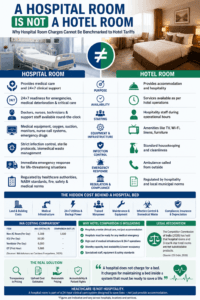
Conclusion: Don’t price a hospital bed like a hotel bed
A hospital room is not a luxury accommodation product.
It is a component of a 24-hour clinical care system.
The relevant question is not whether a three-star hotel can offer a room for less.
The relevant question is whether a hospital can maintain the infrastructure, trained manpower, clinical readiness, safety systems and emergency capability necessary to care for a patient at the proposed tariff.
If policymakers genuinely want affordable healthcare, they should demand transparent and evidence-based hospital pricing.
They should identify the true cost of maintaining hospital infrastructure.
They should strengthen public healthcare.
They should expand insurance coverage.
They should prevent arbitrary billing.
They should improve price transparency.
But they should not confuse hospitality economics with healthcare economics.
A hotel room provides a place to stay.
A hospital room provides a place to receive care when your health—and sometimes your life—depends on it.
The price should be reasonable. The billing should be transparent. But the benchmark must reflect the real cost of healthcare, not the tariff of a hotel room.
Key references
1. Times of India — “Hotel tariff & hospital rent… not the correct comparison” (20 August 2026)
The interview with Apollo founder and chairman Dr Prathap C Reddy directly addresses why hotel tariffs are not an appropriate comparison for hospital room costs. (The Times of India)
Read the Times of India interview
2. Competition Commission of India — official 21 May 2026 order
This is the most important regulatory reference. The CCI expressly states that hospital rooms and three-/four-star hotel rooms are different relevant products and are not substitutable. It also notes the absence of comparative hospital-room cost analysis before an excessive-price conclusion can be reached. (Competition Commission of India)
Read the official CCI order (Case No. 77(10) of 2015)
3. Indian Medical Association — IMA costing advisory
IMA’s published costing table gives ₹5,308/day as its sample costing rate for a non-AC room, compared with ₹1,500 in the comparison-rate column, along with costing figures for ICU, ventilator, OT and professional fees. (IMA India)
4. Parliamentary Standing Committee on Health & Family Welfare — 176th Report
The Committee’s subject is Affordability and Accessibility of Healthcare Facilities in Public and Private Sector. PRS records the Committee’s consideration and adoption of the 176th Report on 6 August 2026. (PRS Legislative Research)
5. Times of India — Parliamentary Committee recommendation
The report’s specific recommendation regarding benchmarking private hospital room rents against nearby three-star hotel tariffs is reported here. (The Times of India)
Read the Times of India report on the Parliamentary recommendation
One editorial point I would strongly recommend: don’t title this as “Why Hospital Room Charges Should Be Higher.” That sounds like an industry defence. The stronger and more credible position is “Why hospital room charges should be appropriate, evidence-based and not benchmarked against hotel tariffs.” It supports the legitimacy of reasonable/higher hospital rates while keeping the argument patient-centred.
The CCI finding is your strongest independent authority, while the IMA ₹5,308 costing figure is your strongest numerical evidence. The Parliamentary Committee itself should be presented fairly: its affordability objective is valid, but its hotel benchmark methodology is what deserves scrutiny.
Related patient videos
 DWARIKA HOSPITALVerified Patient Story
Verified
DWARIKA HOSPITALVerified Patient Story
Verified  DWARIKA HOSPITALVerified Patient Story
Verified
DWARIKA HOSPITALVerified Patient Story
Verified  DWARIKA HOSPITALVerified Patient Story
Verified
DWARIKA HOSPITALVerified Patient Story
Verified 
Related treatments & services
A complete, personalised weight-loss programme — surgery where needed, plus nutrition, medical and lifestyle support for lasting results.
View service → 360 Diabetes ReversalA complete programme to reverse Type-2 diabetes — combining metabolic surgery where suitable with diet, medical and lifestyle care.
View service → Gallbladder Stone
Minimally invasive removal of the gallbladder (laparoscopic cholecystectomy) — the definitive, day-care treatment for painful gallstones.
View service →Was this guide helpful?
Super-specialist GI, bariatric & cancer surgeon. SGPGIMS (India's premier GI centre) + advanced training in Japan & South Korea. Read full profile →
Last reviewed: July 2026