

Presentation
A patient in their 40s with years of recurrent right-upper-abdomen pain, several past attacks of gallstone inflammation, and growing fear of a "big operation".
Investigations
Ultrasound showed a contracted, stone-filled gallbladder with a thick wall. MRCP confirmed a clear bile duct and mapped the scarred anatomy before surgery.
Operative Findings
At surgery the gallbladder was densely adherent to surrounding structures from repeated inflammation — a classic high-risk "difficult gallbladder" where bile-duct injury risk is real.
Surgical Strategy
A critical-view-of-safety technique was used: structures were positively identified before any clip or cut, with a low threshold to convert to open if safety demanded.
The Procedure
Meticulous laparoscopic dissection separated the inflamed gallbladder from the bile duct and achieved a complete laparoscopic removal — no conversion, no drain.
Outcome
Home the next day, pain-free, back to normal life within a week with three tiny scars.
Follow-up
Reviewed at two weeks — wounds healed, eating normally, no further attacks.
Even a difficult gallbladder can usually be removed safely by laparoscopic surgery when approached with the right technique and patience.

Super-specialist GI, bariatric & cancer surgeon. SGPGIMS (India's premier GI centre) + advanced training in Japan & South Korea. Read full profile →
Last reviewed: July 2026From the blog
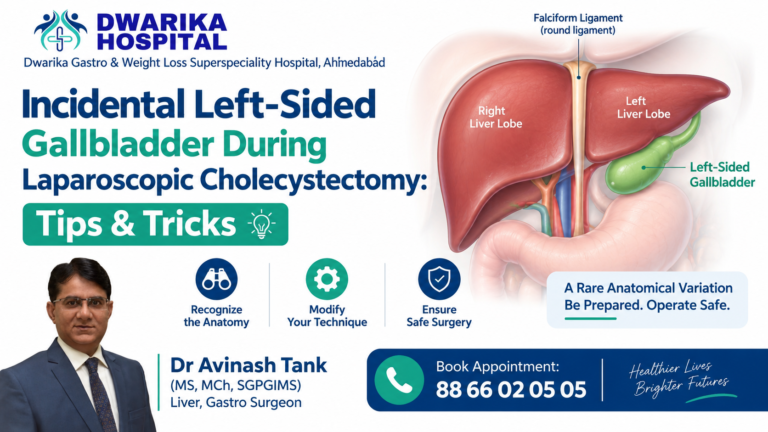 Gallbladder
Incidental Left-Sided Gallbladder During Laparoscopic Cholecystectomy: Tips & Tricks
Gallbladder
Incidental Left-Sided Gallbladder During Laparoscopic Cholecystectomy: Tips & Tricks
Laparoscopic Cholecystectomy When a Left-Sided Gallbladder Is Found Incidentally: Tips & …
Read article →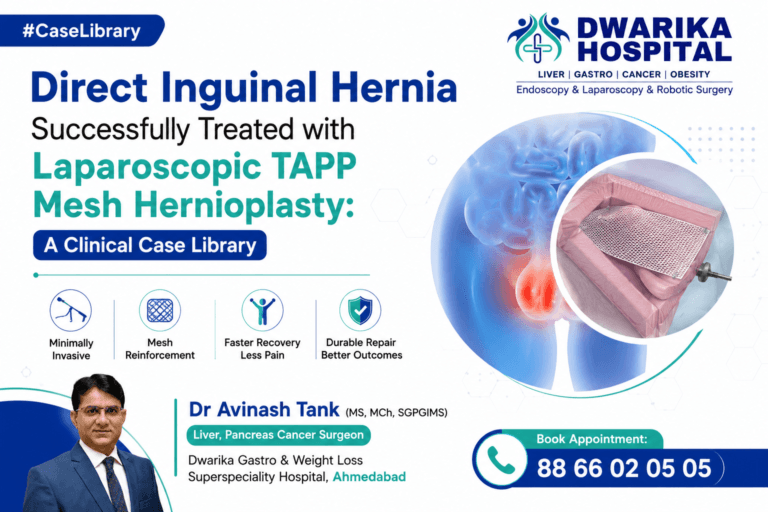 Hernia
Direct Inguinal Hernia Successfully Treated with Laparoscopic TAPP Mesh Hernioplasty
Hernia
Direct Inguinal Hernia Successfully Treated with Laparoscopic TAPP Mesh Hernioplasty
Direct Inguinal Hernia Successfully Treated with Laparoscopic TAPP Mesh Hernioplasty: A C…
Read article →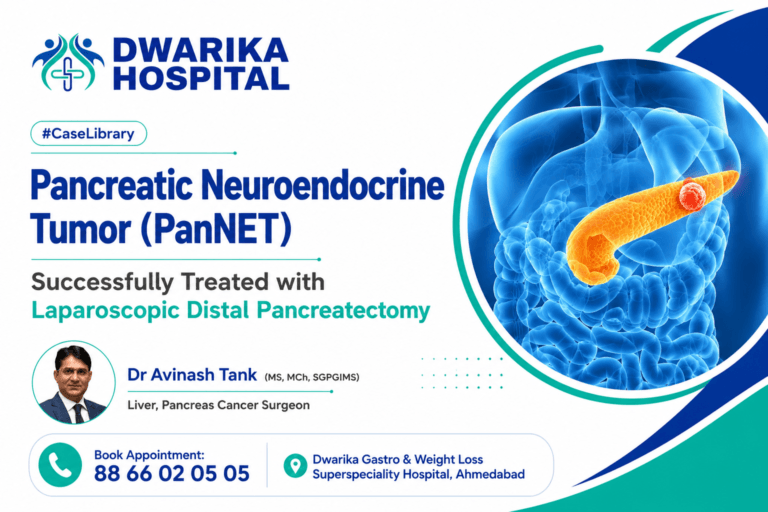 Case Library
Pancreatic Neuroendocrine Tumor (PanNET) Successfully Treated with Laparoscopic Distal Pancreatectomy
Case Library
Pancreatic Neuroendocrine Tumor (PanNET) Successfully Treated with Laparoscopic Distal Pancreatectomy
Pancreatic Neuroendocrine Tumor (PanNET) Successfully Treated with Laparoscopic Distal Pa…
Read article →Real Patient Experiences
Hear directly from patients who underwent this treatment at Dwarika Hospital.
 DWARIKA HOSPITALVerified Patient Story
Verified
DWARIKA HOSPITALVerified Patient Story
Verified  DWARIKA HOSPITALVerified Patient Story
Verified
DWARIKA HOSPITALVerified Patient Story
Verified  DWARIKA HOSPITALPatient Education

Frequently asked questions
Medicines rarely dissolve stones reliably and they often recur. For symptomatic stones, laparoscopic gallbladder removal is the definitive, lasting solution.
Yes. The liver continues to make bile, and the vast majority of people digest food normally after gallbladder removal.
It is usually a safe day-care laparoscopic procedure with small cuts, minimal pain and a return to routine within about a week.
Have a similar problem?
Get an honest, expert opinion from Dr. Avinash Tank — same-week consultations available, and patients welcome from other cities.
Understand the condition & explore treatment