

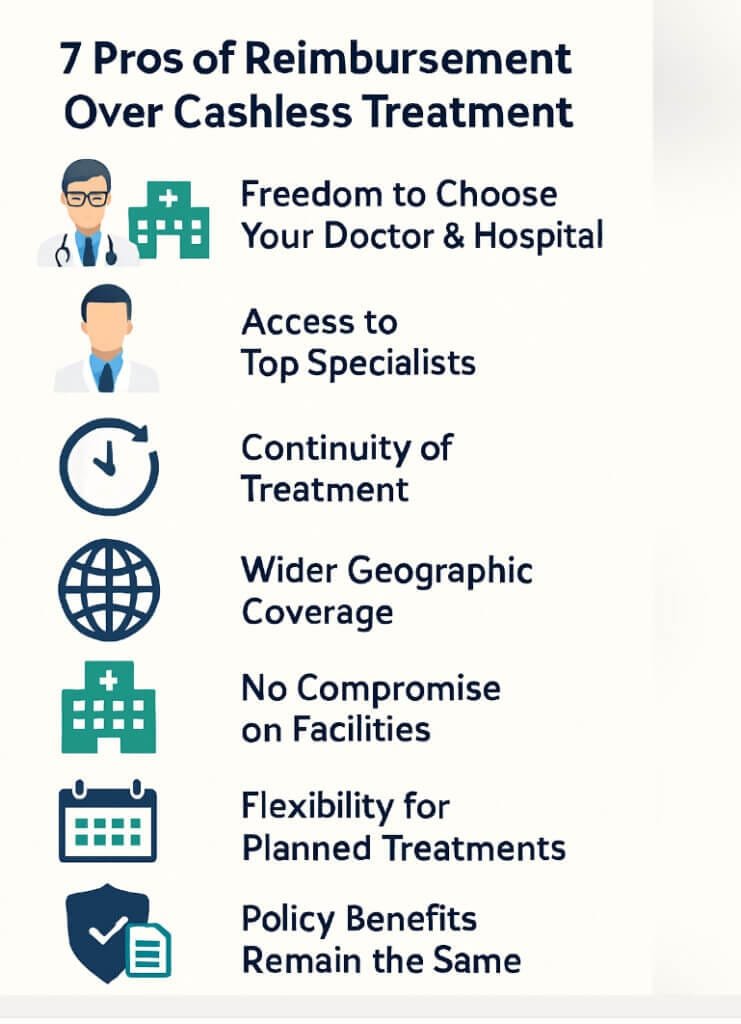
Choosing the Right Claim Method: Why Reimbursement Wins for Preferred Doctors & Hospitals.
Health insurance is designed to ensure financial support when you need medical care. Most insurers offer two ways to settle hospital bills—**cashless treatment** and **reimbursement claims**. While cashless is often considered hassle-free, it comes with one limitation: you can only use it at *network (empaneled) hospitals*.
But what if the specialist you trust practices in a hospital that your insurance company has not empaneled? In these cases, **reimbursement settlement is not just an option—it may be the smarter choice.**
What is Cashless vs Reimbursement in Health Insurance?[wl_navigator]
– **Cashless:** Insurance company directly settles bills with the hospital. Available only at empaneled (network) hospitals.
– **Reimbursement:** You pay bills upfront, submit required documents, and the insurer pays you back later (within policy limits).
While cashless saves upfront payment, **reimbursement grants you unmatched flexibility**, especially for planned treatments and doctor preference.
7 Pros of Reimbursement Over Cashless Treatment
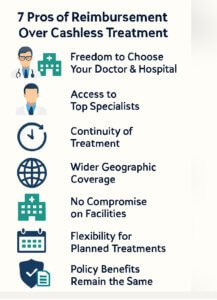
1. Freedom to Choose Your Doctor & Hospital
Cashless restricts you to network hospitals only. With reimbursement, you are free to pick the doctor and hospital of your choice—even if they are not empaneled.
2. Access to Top Specialists
Renowned doctors often consult only at certain private hospitals. With reimbursement, you don’t have to compromise just because they are not in your insurer’s network.
3. Continuity of Treatment
If you are already under treatment with a trusted doctor, reimbursement ensures you don’t have to shift to another hospital for the sake of insurance coverage.
4. Wider Geographic Coverage
Sometimes the nearest hospital isn’t empaneled with your insurer. Reimbursement allows treatment at a convenient location without worrying about insurer tie-ups.
5. No Compromise on Facilities
Some network hospitals may not have advanced infrastructure or the specific equipment required. With reimbursement, you can go to the best-equipped hospital confidently.
6. Flexibility for Planned Treatments
Surgeries such as knee replacement, cardiac bypass, or elective procedures can be better managed via reimbursement—you can plan, pay, and then claim.
7. Policy Benefits Remain the Same
Whether you go cashless or reimbursement, as long as your claim is within the insurance policy limits and conditions, you are still eligible for reimbursement.
Things to Keep in Mind with Reimbursement
While reimbursement offers freedom, you must:
– Pay bills upfront before claiming.
– Collect and submit all medical records, bills, prescriptions, and reports.
– Be mindful of policy clauses like room rent cap, co-pay, and exclusions.
***
FAQs on Reimbursement vs Cashless
**Q1: Is reimbursement claim slower than cashless settlement?**
Yes, reimbursement usually takes a few days to weeks after document submission, while cashless is immediate.
**Q2: Can I go for reimbursement even if a hospital is in the cashless network?**
Yes, reimbursement is always an option—even for empaneled hospitals.
**Q3: Will I get full reimbursement if I choose a non-network hospital?**
Yes, up to the limits of your policy (sum insured, room rent, co-pay, sub-limits).
**Q4: Which is better—cashless or reimbursement?**
For emergencies, cashless is better. For planned treatments where you want a specific doctor or hospital not covered by your insurer, reimbursement is superior.
***
Conclusion
Choosing the Right Claim Method: Why Reimbursement Wins for Preferred Doctors & Hospitals. Health decisions should never be influenced solely by insurance network limitations.
If your priority is quality medical care from a trusted doctor, **reimbursement claims provide flexibility, assurance, and peace of mind over cashless treatment.
Was this article helpful?

Super-specialist GI, bariatric & cancer surgeon. SGPGIMS (India's premier GI centre) + advanced training in Japan & South Korea. Read full profile →
Last reviewed: July 2026




Comments 8
Nice blog here Also your site loads up fast What host are you using Can I get your affiliate link to your host I wish my web site loaded up as quickly as yours lol
I wanted to take a moment to commend you on the outstanding quality of your blog. Your dedication to excellence is evident in every aspect of your writing. Truly impressive!
Wonderful web site Lots of useful info here Im sending it to a few friends ans additionally sharing in delicious And obviously thanks to your effort
I have been browsing online more than three hours today yet I never found any interesting article like yours It is pretty worth enough for me In my view if all website owners and bloggers made good content as you did the internet will be a lot more useful than ever before
I was recommended this website by my cousin I am not sure whether this post is written by him as nobody else know such detailed about my difficulty You are wonderful Thanks
Its like you read my mind You appear to know so much about this like you wrote the book in it or something I think that you can do with a few pics to drive the message home a little bit but other than that this is fantastic blog A great read Ill certainly be back
Your blog is a testament to your dedication to your craft. Your commitment to excellence is evident in every aspect of your writing. Thank you for being such a positive influence in the online community.
Thank you for the auspicious writeup It in fact was a amusement account it Look advanced to far added agreeable from you However how can we communicate