

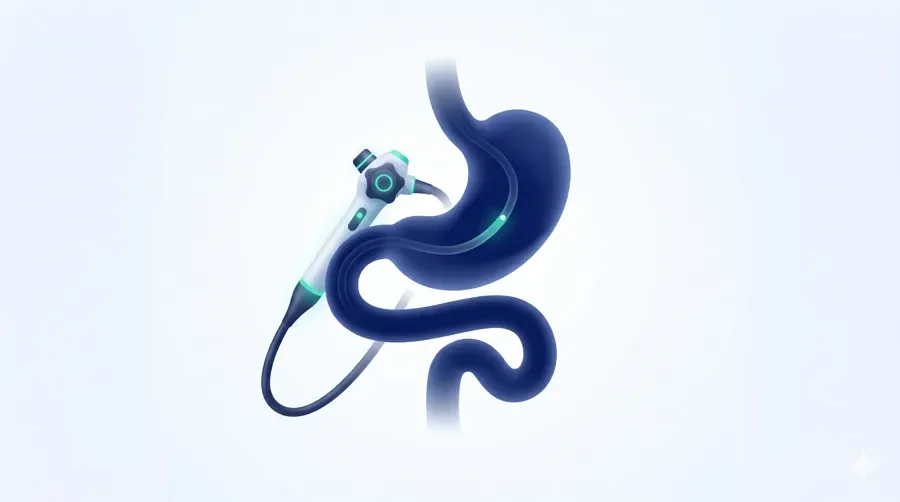
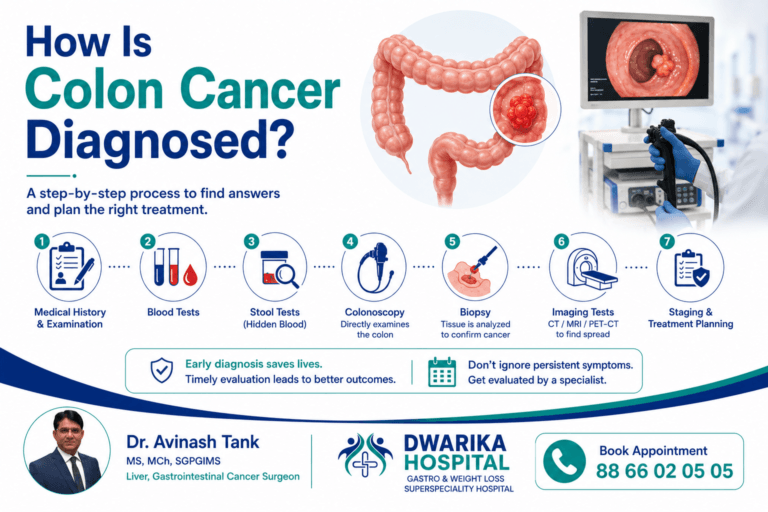
Colonoscopy is an endoscopic examination of the large intestine using a thin flexible camera. It diagnoses bleeding, polyps and cancer, and can remove polyps in the same sitting — preventing colon cancer before it starts.
Camera examination of the large bowel
Screen for cancer, find bleeding, remove polyps
Done under sedation — painless
About 20–30 minutes, same-day discharge
What is a colonoscopy?
A colonoscopy uses a slim flexible tube with a camera to examine the entire large intestine. It is the gold-standard test for colon cancer screening and for investigating bleeding or a change in bowel habits.
What it detects & treats
Colonoscopy finds polyps, inflammation, diverticular disease and cancers. Crucially, polyps can be removed during the same procedure (polypectomy), preventing them from becoming cancer.
What to expect
After a bowel-cleansing preparation, the procedure is performed under sedation and takes about 20–30 minutes. Most people return home the same day and resume normal activity quickly.
Piles (haemorrhoids) are swollen blood vessels in and around the anal canal tha…
Rectal ProlapseRectal prolapse is the protrusion of the rectum through the anus, causing a vis…
Fissure-in-Ano (Anal Fissure)An anal fissure is a small tear in the lining of the anal canal that causes sha…
How we treat Colonoscopy
 Recommended treatment
Colonoscopy
Recommended treatment
Colonoscopy
A camera examines the entire large intestine to investigate bleeding, change in bowel habit or pain, screen for cancer and remove polyps in the same sitting.
View treatment details →Cashless insurance accepted at our network hospitals, with EMI options available. Every patient gets a written, transparent estimate before any procedure — no surprises.

Dr. Avinash Tank, MBBS · MS (General Surgery) · MCh (Surgical Gastroenterology, SGPGIMS)
SGPGIMS (India's premier GI centre) + advanced training in Japan & South Korea. Super-specialist gastrointestinal, bariatric & cancer surgeon treating Colonoscopy at Dwarika Hospital — Gastro, Bariatric & Laparoscopic Surgery Center.
Proof, not promises
A pre-cancerous polyp found and removed during screening — a colon cancer prevented before it could form.
Read the full case → DWARIKA HOSPITALPatient Education

"A colonoscopy caught a polyp early. Calm, reassuring and thorough — I am grateful for the careful approach."
More on Colonoscopy
Frequently asked questions
No. It is done under sedation, so it is essentially painless, and most patients recover within an hour.
Screening is generally advised from around age 45–50, or earlier with symptoms or a family history of colon cancer.
Yes. Polyps found during colonoscopy are usually removed there and then, which can prevent colon cancer.
Super-specialist GI, bariatric & cancer surgeon. SGPGIMS (India's premier GI centre) + advanced training in Japan & South Korea. Read full profile →
Last reviewed: July 2026