

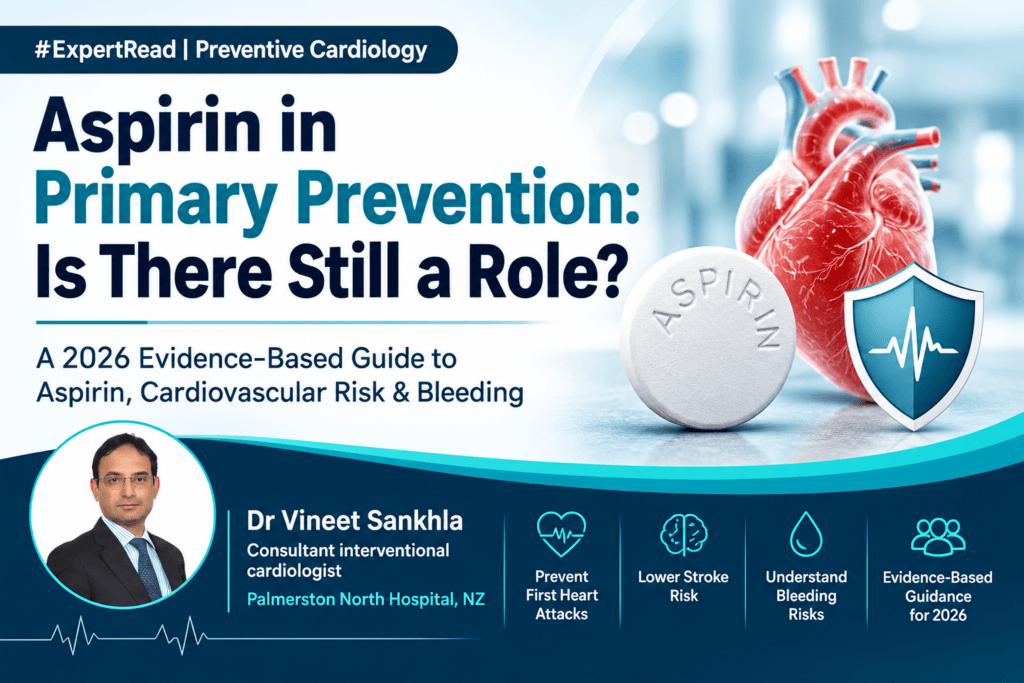

A 2026 Evidence-Based Guide to Aspirin, Cardiovascular Risk & Bleeding
#ExpertRead | Preventive Cardiology
Dr Vineet Sankhla
Consultant interventional cardiologist
Palmerston North Hospital, NZ
The Clinical Question
Should aspirin be routinely prescribed to prevent a first heart attack or stroke?
Short Answer
For most people without established cardiovascular disease, the answer is no.
Aspirin remains an important medication for secondary prevention—patients who have already experienced myocardial infarction, ischemic stroke, or established atherosclerotic cardiovascular disease (ASCVD).
Its role in primary prevention, however, has become much more limited.
The reason is simple:
Aspirin can prevent some cardiovascular events, but it also causes major bleeding—and in contemporary patients, the absolute cardiovascular benefit is often similar to, or smaller than, the bleeding harm.
The decision therefore should not be based simply on age, diabetes, cholesterol level, or the presence of risk factors. It requires an individualized assessment of cardiovascular risk versus bleeding risk.
What Is the Difference Between Primary and Secondary Prevention?
Primary prevention
A person has not previously had a cardiovascular event or established ASCVD.
The goal is to prevent the first:
- Myocardial infarction
- Ischemic stroke
- Other atherosclerotic cardiovascular event
Secondary prevention
The patient already has established cardiovascular disease—for example:
- Previous myocardial infarction
- Established coronary artery disease
- Previous ischemic stroke/TIA
- Peripheral arterial disease
- Previous coronary revascularization
Aspirin has a well-established role in many secondary-prevention settings.
The controversy is primarily about primary prevention.
Why Does Aspirin Help—and Why Can It Hurt?
Aspirin irreversibly inhibits platelet aggregation.
This reduces platelet-mediated arterial thrombosis and can therefore reduce myocardial infarction and ischemic stroke.
But the same antiplatelet effect increases bleeding risk, particularly:
- Gastrointestinal bleeding
- Intracranial hemorrhage
- Other major bleeding
In primary prevention, the baseline cardiovascular event rate is generally lower than in secondary prevention.
Therefore, the absolute cardiovascular benefit becomes relatively small, while the bleeding risk remains clinically important.
What Did the Major Modern Trials Show?
Three major contemporary randomized trials fundamentally changed how clinicians think about aspirin.
1. ASCEND : What About Patients With Diabetes?
The ASCEND trial (A Study of Cardiovascular Events iN Diabetes)
evaluated patients with diabetes who did not have established cardiovascular disease.
Aspirin reduced serious vascular events:
8.5% vs 9.6%
But major bleeding increased:
4.1% vs 3.2%
Thus, the cardiovascular benefit was largely counterbalanced by bleeding harm.
The important clinical lesson is:
Diabetes alone is no longer an automatic indication for aspirin.
The decision should depend on the individual’s overall cardiovascular risk and bleeding risk.
2. ASPREE: What About Older Adults?
ASPREE studied (Aspirin in Reducing Events in the Elderly (ASPREE) trial) healthy older adults, predominantly aged 70 years or older, without established cardiovascular disease.
Aspirin did not significantly reduce cardiovascular disease.
However, major hemorrhage increased:
8.6 vs 6.2 events per 1,000 person-years
with aspirin versus placebo.
This was a particularly important finding because it challenged the traditional assumption that aspirin should automatically be started for cardiovascular prevention simply because cardiovascular risk increases with age.
Clinical message
Older age increases cardiovascular risk—but it also increases bleeding risk.
Therefore, age alone does not create an indication for aspirin.
3. ARRIVE: What About Patients at Moderate Cardiovascular Risk?
The ARRIVE trial (Aspirin to Reduce Risk of Initial Vascular Events) enrolled patients considered to be at moderate cardiovascular risk.
Aspirin did not significantly reduce the primary cardiovascular endpoint:
4.29% vs 4.48%
But gastrointestinal bleeding occurred more frequently:
0.97% vs 0.46%
with aspirin versus placebo.
Again, the anticipated cardiovascular benefit was not clearly demonstrated in the contemporary primary-prevention population.
What Does the Overall Evidence Show?
A major meta-analysis involving:
13 trials
164,225 participants
found that aspirin reduced cardiovascular events, but increased major bleeding.
The absolute cardiovascular risk reduction was approximately:
0.41%
while the absolute increase in major bleeding was approximately:
0.47%
The estimated:
- Number needed to treat (NNT): ~241
- Number needed to harm (NNH): ~210
for the respective composite outcomes in that analysis.
This is the central reason aspirin has moved from a routine preventive medication to a selective therapy.
Continue Reading — Free
Get the complete expert guide from Dr. Avinash Tank.
Free, always. No payment, no spam.
Continue Reading — Free
Get the complete expert guide from Dr. Avinash Tank.
Free, always. No payment, no spam — just the complete guide sent straight to your screen.
What Do Current Guidelines Say?
ACC/AHA
The ACC/AHA guideline states that low-dose aspirin 75–100 mg daily may be considered selectively in adults approximately 40–70 years old who have higher ASCVD risk but are not at increased bleeding risk.
Routine aspirin is discouraged in adults over 70 and in people with increased bleeding risk.
Practical interpretation
High cardiovascular risk + low bleeding risk + appropriate age
may justify a discussion about aspirin.
It does not mean that aspirin should automatically be prescribed.
The U.S. Preventive Services Task Force (USPSTF) Recommendation
The USPSTF takes a similarly selective approach.
Age 40–59 years
For individuals with:
≥10% estimated 10-year CVD risk
the decision to initiate low-dose aspirin should be individualized because the net benefit is small.
Age ≥60 years
The USPSTF recommends:
Do not initiate aspirin routinely for primary prevention.
Importantly, this recommendation concerns starting aspirin for primary prevention. It should not be interpreted as meaning that every patient already taking aspirin should abruptly stop it without discussing the indication with their clinician.
What About Diabetes?
This is one of the most common clinical questions.
Does diabetes automatically mean aspirin?
No.
The ASCEND trial showed that aspirin reduced serious vascular events in patients with diabetes without established cardiovascular disease, but major bleeding increased substantially as well.
Therefore:
Diabetes increases cardiovascular risk, but diabetes alone is not sufficient justification for aspirin.
Aspirin may occasionally be considered when cardiovascular risk is particularly high and bleeding risk is low.
Who Might Still Be Considered for Aspirin?
A carefully selected patient may be considered when most of the following are present:
Cardiovascular risk
- High estimated ASCVD/CVD risk
- Multiple major cardiovascular risk factors
- Particularly high overall atherosclerotic risk
Bleeding risk
- No previous major gastrointestinal bleeding
- No active peptic ulcer disease
- No previous intracranial hemorrhage
- No significant bleeding disorder
- No major thrombocytopenia
- No major medication-related bleeding risk
Patient factors
- Generally younger than 70 years
- Understands that the cardiovascular benefit is modest
- Accepts the potential bleeding risk
- Participates in shared decision-making
Who Should Generally Avoid Aspirin for Primary Prevention?
Factors arguing against aspirin include:
- Previous gastrointestinal bleeding
- Peptic ulcer disease
- Previous intracranial hemorrhage
- Anticoagulant therapy
- Thrombocytopenia
- Chronic kidney disease
- Uncontrolled hypertension
- Regular NSAID use
- Advanced age
- Other conditions associated with increased bleeding risk
These factors are important because cardiovascular risk and bleeding risk do not necessarily rise together.
The Most Important Clinical Principle
Before considering aspirin, clinicians should optimize interventions with a much better benefit-to-risk ratio.
The prevention hierarchy
1. Stop smoking
↓
2. Control blood pressure
↓
3. Optimize LDL cholesterol
↓
4. Treat diabetes appropriately
↓
5. Exercise regularly
↓
6. Optimize weight and metabolic health
↓
7. Assess overall cardiovascular risk
↓
8. Assess bleeding risk
↓
9. Consider aspirin only in carefully selected patients
This approach is more important than simply asking:
“Should I take aspirin?”
The better question is:
“What is my absolute cardiovascular risk, what is my bleeding risk, and does aspirin provide enough additional benefit to justify that bleeding risk?”
Aspirin and CAC Score: Does Coronary Calcium Change the Decision?
A high coronary artery calcium (CAC) score indicates a higher burden of coronary atherosclerosis and may identify people whose cardiovascular risk is underestimated by conventional risk calculators.
Therefore, CAC can sometimes help with risk refinement.
However:
A high CAC score does not automatically mean “take aspirin.”
The decision still requires assessment of:
- Absolute ASCVD risk
- CAC burden
- Age
- Bleeding risk
- Other preventive therapies
- Patient preferences
In other words:
CAC may help identify a patient with higher potential cardiovascular benefit—but it does not eliminate aspirin’s bleeding risk.
This is particularly important because aspirin should not become a reflex response to an abnormal CAC score.
A Practical 2026 Aspirin Decision Algorithm
STEP 1 — Does the patient have established ASCVD?
YES → aspirin may be indicated for secondary prevention, depending on the clinical situation.
NO → proceed to primary-prevention assessment.
STEP 2 — Estimate cardiovascular risk
Assess:
- Age
- Blood pressure
- Lipids
- Diabetes
- Smoking
- Family history
- Other risk-enhancing factors
- Evidence of subclinical atherosclerosis when appropriate
STEP 3 — Assess bleeding risk
Ask about:
- Previous GI bleeding
- Peptic ulcer disease
- Intracranial bleeding
- Anticoagulants
- NSAIDs
- Kidney disease
- Thrombocytopenia
- Uncontrolled hypertension
- Advanced age
STEP 4 — Optimize conventional prevention first
Statin therapy, blood-pressure control, smoking cessation, diabetes management, exercise and weight optimization generally provide a more favorable preventive strategy.
STEP 5 — Shared decision-making
Only when cardiovascular risk is sufficiently high and bleeding risk is sufficiently low should aspirin be discussed.
STEP 6 — Reassess periodically
Aspirin is not a “set it and forget it” medication in primary prevention.
Risk changes with:
- Age
- New diseases
- New medications
- Bleeding episodes
- Changes in cardiovascular risk
Aspirin Primary Prevention: The Bottom Line
Should everyone take a baby aspirin?
No.
Should people with diabetes automatically take aspirin?
No.
Should people over 60 start aspirin routinely for primary prevention?
No.
Can aspirin still have a role?
Yes—but only selectively.
The contemporary evidence shows that aspirin can reduce first cardiovascular events, but the absolute benefit is modest and is frequently offset by major bleeding.
Therefore:
Aspirin in primary prevention should be the exception—not the rule.
For most people without established ASCVD, the priority should be aggressive management of modifiable cardiovascular risk factors rather than routine aspirin therapy.
Frequently Asked Questions
1. Is aspirin still useful for heart attack prevention?
Yes, but the answer depends on whether prevention is primary or secondary.
Aspirin remains an important treatment in many patients with established ASCVD. Its routine use in people who have never had cardiovascular disease is much less favorable.
2. Should a healthy 65-year-old start aspirin?
Generally, aspirin should not be routinely initiated for primary prevention at this age. The USPSTF recommends against initiating aspirin for primary prevention in adults aged 60 years or older.
3. I have diabetes. Should I take aspirin?
Not automatically. ASCEND demonstrated a reduction in serious vascular events but a similar-sized increase in major bleeding.
4. Does a high cholesterol level mean I need aspirin?
No. The first priority is appropriate lipid-lowering therapy and comprehensive cardiovascular-risk reduction.
5. Does a high CAC score mean I should take aspirin?
Not automatically. CAC can help refine cardiovascular risk, but aspirin still requires an assessment of bleeding risk and expected absolute benefit.
6. Can I stop aspirin if I have been taking it for years?
Do not stop prescribed aspirin without discussing it with your doctor.
The reason for aspirin matters. Aspirin prescribed after a heart attack, coronary stent, stroke, or established ASCVD is a different situation from aspirin started solely for primary prevention.
7. Is low-dose aspirin completely safe?
No.
Even low-dose aspirin can cause major gastrointestinal or intracranial bleeding.
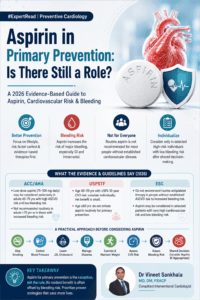
Key Take-Home Messages
1. Aspirin remains important for many patients with established cardiovascular disease.
2. Routine aspirin is no longer recommended for most people without established ASCVD.
3. The cardiovascular benefit in primary prevention is modest.
4. Major bleeding is the principal trade-off.
5. Diabetes alone is not an indication for aspirin.
6. Older age does not automatically justify aspirin—in fact, bleeding risk becomes increasingly important.
7. Cardiovascular risk and bleeding risk must be assessed together.
8. Smoking cessation, blood-pressure control, LDL reduction, diabetes management, exercise and weight optimization should come first.
9. Aspirin may still be reasonable in a carefully selected high-risk patient with low bleeding risk.
10. Primary prevention with aspirin should be an individualized shared decision—not a routine prescription.
One-Line Clinical Summary
In 2026, aspirin for primary cardiovascular prevention is best viewed as a selective risk–benefit decision rather than a routine preventive medication.
Related patient videos
 DWARIKA HOSPITALVerified Patient Story
Verified
DWARIKA HOSPITALVerified Patient Story
Verified  DWARIKA HOSPITALVerified Patient Story
Verified
DWARIKA HOSPITALVerified Patient Story
Verified  DWARIKA HOSPITALVerified Patient Story
Verified
DWARIKA HOSPITALVerified Patient Story
Verified 
Related treatments & services
A complete, personalised weight-loss programme — surgery where needed, plus nutrition, medical and lifestyle support for lasting results.
View service → 360 Diabetes ReversalA complete programme to reverse Type-2 diabetes — combining metabolic surgery where suitable with diet, medical and lifestyle care.
View service → Gallbladder Stone
Minimally invasive removal of the gallbladder (laparoscopic cholecystectomy) — the definitive, day-care treatment for painful gallstones.
View service →Was this guide helpful?
Super-specialist GI, bariatric & cancer surgeon. SGPGIMS (India's premier GI centre) + advanced training in Japan & South Korea. Read full profile →
Last reviewed: July 2026