

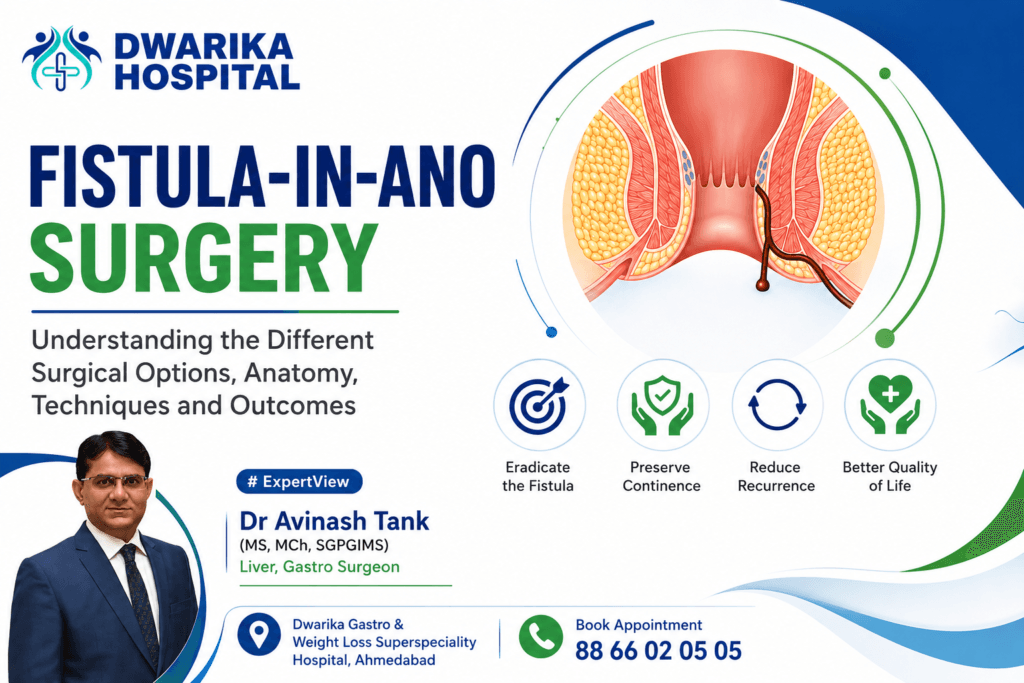

Fistula-in-Ano Surgery: Understanding the Different Surgical Options, Anatomy, Techniques and Outcomes
Anal fistula (fistula-in-ano) is an abnormal tunnel connecting the anal canal or rectum to the skin around the anus. It commonly develops after an anal abscess has drained, leaving behind a persistent tract between the internal opening and the external opening.
Although an anal fistula is usually not life-threatening, it can cause recurrent pain, swelling, pus discharge, skin irritation and repeated abscess formation. In most patients, a definitive cure requires surgery.
The challenge is that the fistula is not simply a tunnel that needs to be removed. The tunnel may pass through the muscles responsible for controlling stool. Therefore, successful fistula surgery has two goals:
Eradicate the fistula while preserving anal sphincter function and continence.
The correct operation depends primarily on the anatomy of the fistula, especially how much of the external anal sphincter is involved.
1. Understanding the Surgical Anatomy for Fistula-in-Ano Surgery
To understand fistula surgery, it is useful to understand the basic anatomy of the anal sphincter.
The anal canal is surrounded mainly by two important muscles:
Internal anal sphincter
This is the continuation of the circular smooth muscle of the rectum. It is involuntary and contributes substantially to resting anal pressure.
External anal sphincter
This is a voluntary skeletal muscle surrounding the anal canal. It is particularly important for maintaining continence when there is urgency, loose stool or increased intra-abdominal pressure.
Between the internal and external sphincters is the:
Intersphincteric plane
This plane is extremely important in modern fistula surgery.
The fistula may pass:
- Between the sphincters
- Through the external sphincter
- Above the external sphincter
- Outside the sphincter complex
These relationships form the basis of the Parks classification:
- Intersphincteric
- Transsphincteric
- Suprasphincteric
- Extrasphincteric
The ASCRS also emphasizes that fistulas are classified according to their relationship with the sphincter complex because this relationship directly influences treatment selection. (FASCRS)
2. Simple vs Complex Anal Fistula
This is one of the most important decisions before surgery.
Simple fistula
A simple fistula generally has:
- A relatively straight tract
- No significant secondary branches
- No horseshoe extension
- No large abscess cavity
- Limited sphincter involvement
A low fistula involving only a small portion of the external sphincter may be safely treated with fistulotomy in a carefully selected patient.
Complex fistula
A fistula becomes more difficult when there is:
- Significant external sphincter involvement
- High transsphincteric tract
- Suprasphincteric or extrasphincteric anatomy
- Horseshoe extension
- Multiple secondary tracts
- Large abscess cavity
- Recurrent fistula
- Previous sphincter surgery
- Crohn’s disease
- Anterior fistula in a woman in selected circumstances
- Pre-existing continence impairment
In these situations, simply cutting open the fistula may damage too much sphincter muscle.
This is why sphincter-preserving procedures such as LIFT and advancement flap have become important.
3. Why MRI Matters before Fistula-in-Ano Surgery
Not every fistula requires MRI.
However, MRI pelvis is particularly valuable when the fistula is:
- Complex
- Recurrent
- Associated with an abscess
- Associated with multiple external openings
- Suspected to have horseshoe extension
- Difficult to define clinically
- Associated with Crohn’s disease
MRI can identify:
- Internal opening
- External opening
- Primary fistula tract
- Secondary extensions
- Abscess cavities
- Horseshoe components
- Relationship with the sphincter
- Supralevator extension
The ASCRS patient guidance notes that pelvic MRI can provide highly accurate mapping of fistula anatomy, while the clinical examination and examination under anesthesia remain fundamental. (FASCRS)
4. Fistulotomy — The Traditional and Highly Effective Operation
What is fistulotomy?
Fistulotomy means laying open the fistula tract.
Imagine the fistula as a tunnel running from the anal canal to the skin.
Instead of removing the entire tunnel, the surgeon:
- Identifies the tract.
- Probes the tract.
- Opens the tissue over the tract.
- Converts the tunnel into an open groove.
- Removes or curettes unhealthy granulation tissue when appropriate.
- Allows the wound to heal gradually from the base outward.
The ASCRS describes fistulotomy as unroofing the fistula tract so that it can heal from the bottom upward. (FASCRS)
When is fistulotomy appropriate?
Fistulotomy is particularly suitable for:
- Simple fistula
- Low fistula
- Intersphincteric fistula
- Low transsphincteric fistula
- Minimal external sphincter involvement
- Straightforward anatomy
- Patients with normal baseline continence
The key principle is:
If only a small and functionally acceptable amount of sphincter would be divided, fistulotomy can provide the highest probability of cure with a single operation.
The ASCRS patient information reports healing rates of approximately 92–97% for appropriately selected fistulotomy cases. (FASCRS)
When should fistulotomy be avoided?
Fistulotomy becomes less attractive when the tract crosses a substantial amount of the external sphincter.
Potentially unsuitable situations include:
- High transsphincteric fistula
- Suprasphincteric fistula
- Extensive horseshoe fistula
- Significant pre-existing incontinence
- Multiple previous sphincter operations
- Complex recurrent fistula
- Selected anterior fistulas in women
The reason is simple:
More sphincter division → greater potential risk of continence disturbance.
Therefore, the surgeon must balance the probability of fistula cure against the amount of sphincter muscle that would be sacrificed.
5. Fistulectomy — Is Removing the Entire Tract Better?
Fistulectomy means excision of the fistula tract rather than simply opening it.
The theoretical attraction is that the entire tract is removed.
However, fistulectomy generally creates a larger wound and does not necessarily provide better long-term fistula control than fistulotomy.
More importantly, if the fistula passes through sphincter muscle, excising the tract can result in more tissue disruption.
Therefore:
For a suitable low fistula, fistulotomy is generally preferred over aggressive fistulectomy.
Modern fistula surgery is increasingly focused on selective treatment of the tract rather than simply removing as much tissue as possible.
6. LIFT — Ligation of the Intersphincteric Fistula Tract
LIFT is one of the most important sphincter-preserving operations for transsphincteric fistula.
The basic concept
The fistula passes through the external sphincter.
Instead of cutting through the external sphincter, the surgeon approaches the tract through the intersphincteric plane.
The sequence is broadly:
- Identify the intersphincteric groove.
- Make a small incision over the tract.
- Dissect between the internal and external sphincters.
- Identify the fistula tract.
- Isolate the tract.
- Ligate it close to the internal opening.
- Divide the tract.
- Clean/curette the remaining external component where appropriate.
- Allow appropriate drainage and healing.
The critical principle is:
The fistula is interrupted without deliberately dividing the external sphincter.
When is LIFT useful?
LIFT is particularly attractive for:
- Transsphincteric fistula
- Moderate or high transsphincteric fistula
- Fistula where fistulotomy would divide a significant amount of external sphincter
- Patients in whom preservation of continence is particularly important
The ASCRS guideline gives LIFT a strong recommendation for transsphincteric fistulas. (FASCRS)
Important technical point in LIFT
The operation depends on accurately identifying the tract in the intersphincteric plane.
The surgeon should:
- Avoid creating a false tract
- Clearly identify the fistula before ligation
- Secure the tract close to the internal sphincter/internal opening
- Divide the tract after secure ligation
- Ensure that any external cavity or secondary extension has adequate drainage
A persistent abscess or untreated secondary tract is an important reason why an apparently technically successful LIFT may fail.
Continue Reading — Free
Get the complete expert guide from Dr. Avinash Tank.
Free, always. No payment, no spam.
Continue Reading — Free
Get the complete expert guide from Dr. Avinash Tank.
Free, always. No payment, no spam — just the complete guide sent straight to your screen.
7. How Successful is LIFT?
Published results vary substantially.
An earlier systematic review found a pooled healing rate of approximately 71%, although individual studies ranged widely. (PubMed)
More recent evidence continues to show variability.
A 2025 systematic review and network meta-analysis of sphincter-sparing procedures reported failure rates of approximately:
- LIFT: 28.6%
- VAAFT: 22.3%
- FiLaC: 43.9%
- Endoanal advancement flap: 25.9%
These figures should not be interpreted as direct head-to-head success rates because the studies differed in patient selection, fistula complexity and follow-up. (PubMed)
The major advantage of LIFT is not necessarily that it always has the highest healing rate.
Its major advantage is:
It can treat a transsphincteric fistula without deliberately dividing the external sphincter.
8. Advancement Flap
An endorectal or endoanal advancement flap is another sphincter-preserving procedure.
Instead of opening the entire fistula tract, the surgeon attempts to close the internal opening.
How is it performed?
Broadly:
- Identify the internal opening.
- Prepare the surrounding tissue.
- Raise a healthy mucosal/submucosal flap.
- Excise or curette the internal fistula opening.
- Close the internal opening.
- Advance the flap over the defect.
- Secure the flap without excessive tension.
The external opening may be opened or drained depending on the anatomy.
The concept is:
Remove the internal source of contamination and cover it with healthy vascularized tissue.
9. When is Advancement Flap Useful?
It may be considered for:
- High transsphincteric fistula
- Complex fistula
- Recurrent fistula
- Fistula unsuitable for fistulotomy
- Fistula where LIFT is technically unsuitable or has failed
- Selected cases with difficult internal openings
It is particularly useful when the surgeon wants to preserve the sphincter but cannot safely perform a fistulotomy.
Limitations of Advancement Flap
Failure may occur because of:
- Poor blood supply
- Excessive tension
- Infection
- Persistent internal opening
- Crohn’s disease
- Previous surgery and scarring
- Radiation
- Smoking
- Persistent distal tract or abscess
The ASCRS notes that recurrence after advancement flap can be substantial and that factors such as Crohn’s disease, radiation, previous repair and smoking can adversely affect healing. (FASCRS)
A 2024 meta-analysis also confirms that advancement flap is an effective sphincter-preserving option, but outcomes vary according to patient and fistula characteristics. (PubMed)
10. Seton — Usually a Staged Strategy Rather Than a Final Cure
A seton is a loop of suture or soft material passed through the fistula tract.
There are two fundamentally different concepts:
Loose/draining seton
Its purpose is to:
- Maintain drainage
- Prevent premature closure of the external opening
- Control sepsis
- Allow inflammation to settle
- Allow the tract to mature
A loose seton is particularly useful when there is:
- Active infection
- Abscess
- Complex fistula
- Crohn’s disease
- High transsphincteric fistula
- Need for staged surgery
The ASCRS patient guidance describes draining setons as a method of maintaining controlled drainage and allowing inflammation to settle before definitive treatment. (FASCRS)
Cutting seton
A cutting seton gradually cuts through the sphincter while fibrosis develops behind it.
Although historically used, it carries a greater concern for continence disturbance.
For this reason, a cutting seton should not be considered equivalent to a modern sphincter-preserving loose seton strategy.
11. Staged Surgery
Complex fistulas often benefit from a staged approach.
Stage 1
Drain infection and control sepsis
Possible procedures include:
- Abscess drainage
- Debridement where appropriate
- Loose seton placement
- Drainage of secondary cavities
Stage 2
After inflammation and infection have settled:
- LIFT
- Advancement flap
- Selected minimally invasive procedure
- Fistulotomy if the residual tract has become suitable
- Other individualized sphincter-preserving procedure
This approach is particularly useful when immediate definitive surgery would be performed in an inflamed or poorly defined field.
12. VAAFT — Video-Assisted Anal Fistula Treatment
VAAFT uses a small fistuloscope introduced through the external opening.
The surgeon can:
- Identify the fistula tract under direct vision.
- Locate the internal opening.
- Clean/debride the tract.
- Treat the tract.
- Close the internal opening.
The attraction of VAAFT is that it is minimally invasive and sphincter-preserving.
It can be particularly attractive in selected complex fistulas where preservation of the sphincter is important.
However, long-term comparative evidence remains less mature than for traditional fistulotomy.
The recent meta-analysis reported a failure rate of approximately 22.3%, but also emphasized that the available studies are heterogeneous and that VAAFT did not demonstrate a statistically significant superiority over LIFT in network comparison. (PubMed)
13. FiLaC — Fistula Laser Closure
FiLaC uses a radial laser fiber placed inside the fistula tract.
The laser energy is delivered along the tract to collapse and seal it while attempting to preserve the sphincter.
Its theoretical advantages include:
- Minimal tissue disruption
- No deliberate sphincter division
- Small external wound
- Potentially less postoperative pain
- Sphincter preservation
However, published outcomes are variable.
The 2025 systematic review reported a failure rate of approximately 43.9% in the included studies, although the wide range between studies highlights the uncertainty around the true long-term effectiveness. (PubMed)
Therefore, FiLaC should be viewed as a selected sphincter-preserving option rather than automatically the best procedure for every fistula.
14. Fibrin Glue and Fistula Plug
Other sphincter-preserving approaches include:
Fibrin glue
The fistula tract is cleaned and filled with fibrin sealant.
Advantages:
- No sphincter division
- Relatively simple
Limitations:
- Variable healing
- Recurrence can be significant
- Less predictable in complex fistulas
Fistula plug
A biological or synthetic plug is placed into the fistula tract.
Again, the principal advantage is sphincter preservation, but healing rates are variable.
These techniques may be considered in selected situations but are generally less predictable than a well-selected definitive surgical procedure.
15. What About Recurrence?
Recurrence is one of the most important outcomes when discussing fistula surgery.
But “recurrence rate” is difficult to compare directly between studies because:
- Definitions of healing differ
- Follow-up duration differs
- Simple and complex fistulas are mixed
- Some studies rely on clinical examination
- Others use MRI or endoanal ultrasound
- Patient populations differ
A large network meta-analysis of 52 randomized trials found no statistically significant difference in short- or long-term success between the various procedures studied, highlighting how strongly patient selection and fistula anatomy influence outcomes. (Springer)
Therefore, the best operation is not necessarily the procedure with the highest published success rate.
It is the procedure that is best matched to that patient’s anatomy.
16. What About Fecal Incontinence?
This is arguably the most important consideration in fistula surgery.
Incontinence may involve:
- Flatus
- Liquid stool
- Stool staining
- Urgency
- Difficulty controlling stool
The risk increases when significant sphincter muscle is divided or damaged.
This is why the principle of modern fistula surgery is:
Do not sacrifice sphincter unnecessarily to obtain fistula healing.
A 2023 network meta-analysis of 52 randomized trials found LIFT ranked best for minimizing bowel incontinence among the procedures evaluated for both simple and complex fistulas. However, the authors also emphasized that there was insufficient evidence to declare one procedure universally superior for fistula healing. (Springer)
A newer 2025 review of sphincter-sparing procedures reported continence disturbance of approximately:
- LIFT: 1.5%
- Endoanal flap: 7.3%
- VAAFT: no worsening continence reported in the included studies
- FiLaC: no worsening continence reported in the included studies
Again, these figures should be interpreted cautiously because the underlying studies were heterogeneous. (PubMed)
17. A Practical Comparison of Major Operations
| Procedure | Best suited for | Sphincter division | Healing / recurrence | Continence risk |
|---|---|---|---|---|
| Fistulotomy | Simple, low fistula | Yes, limited | Generally highest healing in appropriately selected simple fistulas | Low when carefully selected; increases with sphincter division |
| Fistulectomy | Selected simple fistula | May involve sphincter | Good, but larger tissue disruption | Depends on sphincter involvement |
| LIFT | Transsphincteric fistula | No deliberate sphincter division | Variable; failure ~29% in recent pooled evidence | Very low in contemporary series |
| Advancement flap | Complex/high fistula | No deliberate division | Variable; failure ~26% in recent pooled evidence | Generally low, but not zero |
| Loose seton | Sepsis/complex fistula/staged treatment | No | Usually drainage/staging rather than definitive cure | Very low |
| Cutting seton | Selected complex fistula | Gradual division | Can be effective | Higher continence concern |
| VAAFT | Selected complex fistula | No | Failure ~22% in recent pooled evidence | Very low in reported studies |
| FiLaC | Selected sphincter-preserving cases | No | Failure ~44% in recent pooled evidence | Very low in reported studies |
| Fibrin glue/plug | Selected cases | No | Variable | Very low |
The numerical estimates above come from heterogeneous studies and should not be interpreted as direct head-to-head probabilities for an individual patient. (PubMed)
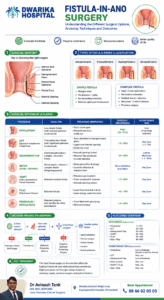
18. How Do We Choose the Operation?
A useful clinical decision-making framework is:
Step 1 — Is there an abscess or active sepsis?
YES
Control sepsis first.
Drain the abscess and, where appropriate, use a loose seton.
Definitive fistula surgery may be performed later once the anatomy is clearer and inflammation has settled.
NO
Proceed to anatomical assessment and definitive planning.
Step 2 — How much external sphincter does the fistula involve?
Minimal sphincter involvement
Consider:
Fistulotomy
This may offer the highest probability of cure in an appropriately selected simple fistula.
Significant sphincter involvement
Avoid unnecessary sphincter division.
Consider:
LIFT / advancement flap / selected VAAFT / FiLaC / staged strategy
Step 3 — Is the fistula complex?
Look for:
- Horseshoe extension
- Secondary tracts
- Large cavity
- Multiple external openings
- Recurrent disease
- Crohn’s disease
- Supralevator extension
If present, a simple fistulotomy is generally inappropriate.
19. An Important Concept: “The Lowest-Risk Operation That Can Reliably Cure the Fistula”
There is no universally “best” fistula operation.
For example:
Low simple fistula
Fistulotomy may be preferable to an elaborate sphincter-preserving procedure.
Why?
Because there is little sphincter to sacrifice and fistulotomy can provide very high healing rates.
High transsphincteric fistula
LIFT may be preferable.
Why?
Because cutting the tract open could divide a substantial amount of external sphincter.
High/complex fistula with unsuitable intersphincteric anatomy
Advancement flap may be preferable.
Fistula with active abscess
Drainage ± loose seton → reassessment → definitive surgery
may be safer than attempting immediate definitive repair.
Recurrent fistula
The previous operative history becomes extremely important.
The surgeon should determine:
- What sphincter has already been divided?
- Where is the current internal opening?
- Is there an occult secondary tract?
- Is there an abscess?
- Is the current anatomy suitable for LIFT?
- Would an advancement flap be more appropriate?
20. Can a Failed LIFT Still Be Useful?
Yes.
One interesting advantage of LIFT is that failure does not necessarily leave the patient with a worse sphincter situation.
The persistent tract may become an intersphincteric fistula.
That tract can sometimes subsequently be treated with a relatively straightforward fistulotomy.
Therefore, LIFT can sometimes be thought of as:
A sphincter-preserving attempt at definitive treatment that may also convert a difficult transsphincteric fistula into a simpler tract if it fails.
This is one reason LIFT remains an important operation in the surgical armamentarium. (PubMed Central (PMC))
21. The Role of Patient Factors
The anatomy of the fistula is not the only consideration.
The surgeon should also consider:
- Baseline continence
- Age
- Previous anal surgery
- Previous fistulotomy
- Previous obstetric sphincter injury
- Gender and fistula location
- Crohn’s disease
- Smoking
- Immunosuppression
- Diabetes and wound healing
- Previous radiation
- Patient preference
- Ability to attend follow-up
A patient with pre-existing borderline continence may reasonably choose a sphincter-preserving procedure even when a limited fistulotomy could technically be performed.
22. Fistula Surgery Is an Anatomy-Driven Decision
The most important lesson is that the MRI report should not simply say “fistula present.”
For surgical planning, the surgeon needs to know:
Where is the internal opening?
Where is the external opening?
What is the course of the tract?
How much external sphincter is involved?
Are there secondary branches?
Is there a horseshoe component?
Is there an abscess?
Is there supralevator extension?
Has the patient undergone previous fistula surgery?
Only after answering these questions should the definitive operation be selected.
23. Final Take-Home Message
Anal fistula surgery is fundamentally a balance between two objectives:
1. Cure the fistula
and
2. Preserve continence.
Fistulotomy remains the benchmark for appropriately selected low/simple fistulas because it can provide very high healing rates.
LIFT is an important sphincter-preserving option for transsphincteric fistulas.
Advancement flap is another valuable sphincter-preserving procedure, particularly when LIFT is unsuitable or has failed.
Loose seton is primarily a drainage and staging tool rather than necessarily a definitive cure.
VAAFT and FiLaC offer minimally invasive, sphincter-preserving approaches for selected patients, but their long-term evidence is less mature and outcomes remain variable.
Staged surgery is often the most logical strategy when there is active sepsis, abscess, complex branching or uncertain anatomy.
The central principle is therefore:
The best fistula operation is not the operation with the most impressive success rate in a study. It is the operation that achieves the highest probability of healing while causing the least unnecessary damage to the patient’s sphincter.
For this reason, fistula surgery should be individualized according to MRI anatomy, sphincter involvement, internal opening, sepsis, previous surgery and baseline continence.
This article is intended for medical education and does not replace individualized examination, MRI interpretation and surgical decision-making by a colorectal/anal fistula specialist.
Related patient videos
 DWARIKA HOSPITALVerified Patient Story
Verified
DWARIKA HOSPITALVerified Patient Story
Verified  DWARIKA HOSPITALVerified Patient Story
Verified
DWARIKA HOSPITALVerified Patient Story
Verified  DWARIKA HOSPITALVerified Patient Story
Verified
DWARIKA HOSPITALVerified Patient Story
Verified 
Related treatments & services
A complete, personalised weight-loss programme — surgery where needed, plus nutrition, medical and lifestyle support for lasting results.
View service → 360 Diabetes ReversalA complete programme to reverse Type-2 diabetes — combining metabolic surgery where suitable with diet, medical and lifestyle care.
View service → Gallbladder Stone
Minimally invasive removal of the gallbladder (laparoscopic cholecystectomy) — the definitive, day-care treatment for painful gallstones.
View service → Super-specialist GI, bariatric & cancer surgeon. SGPGIMS (India's premier GI centre) + advanced training in Japan & South Korea. Read full profile →
Last reviewed: July 2026