

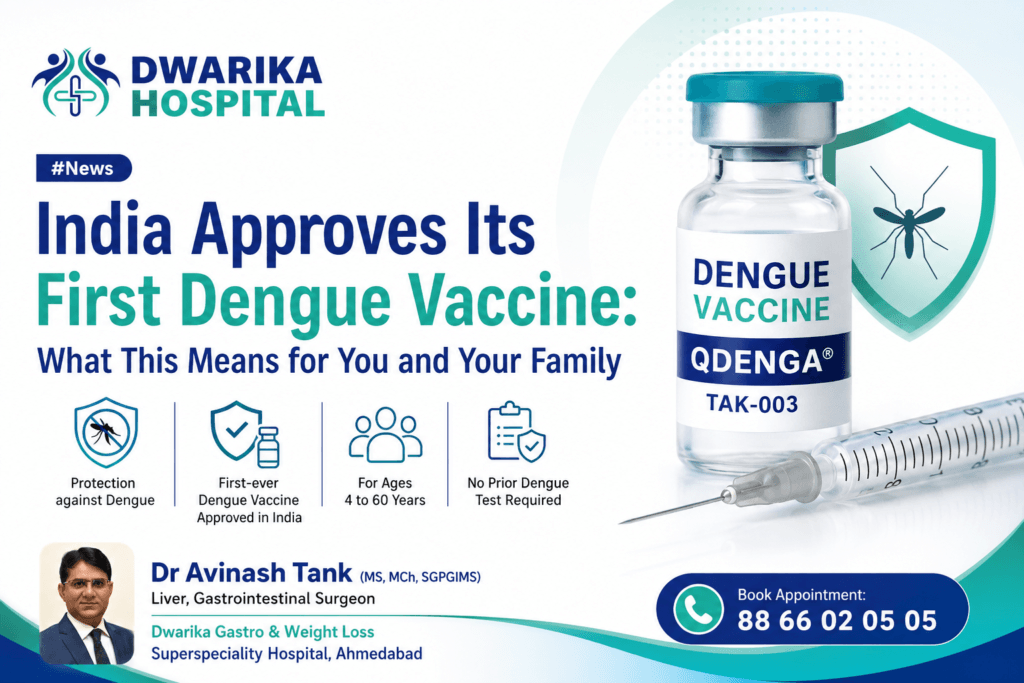
India has taken a major step in the fight against dengue by approving its first dengue vaccine. The Drug Controller General of India (DCGI) has granted marketing approval for QDENGA® (TAK-003), developed by Takeda, making it the country’s first approved vaccine against dengue.
With dengue cases increasing every year, this development offers new hope in preventing severe illness, hospitalization, and deaths.
Why Is This News Important?
Dengue has become one of India’s fastest-growing mosquito-borne diseases.
Every monsoon, hospitals witness a surge in patients with:
- High fever
- Severe body pain
- Low platelet counts
- Bleeding complications
- Dengue shock syndrome
Thousands require hospitalization, and unfortunately, some patients lose their lives due to severe dengue.
Unlike bacterial infections, there is currently no specific antiviral medicine that cures dengue. Treatment mainly focuses on supportive care, fluids, careful monitoring, and timely management of complications.
That is why prevention remains the best strategy, and vaccination could become an important addition to mosquito control measures.
What Is QDENGA?
QDENGA (TAK-003) is a live attenuated tetravalent dengue vaccine designed to protect against all four dengue virus serotypes (DENV-1, DENV-2, DENV-3, and DENV-4).
Protection against all four strains is important because infection with one type does not provide lifelong immunity against the others. In fact, a second infection with a different serotype may increase the risk of severe dengue.
Who Can Receive the Vaccine?
According to the approval, the eligible age group is:
- Children aged 4 years
- Adolescents
- Adults
- Up to 60 years of age
How Many Doses Are Needed?
The vaccine schedule includes:
- First dose
- Second dose after 3 months
Both doses are necessary for optimal protection.
A Major Advantage: No Prior Dengue Testing Required
One of the biggest advantages of QDENGA is that:
- It does not require blood testing before vaccination.
- It can be given regardless of whether a person has had dengue before.
This makes vaccination much easier than earlier dengue vaccines used in some countries, which required testing for previous dengue infection before administration.
How Effective Is It?
Clinical trials conducted across several countries have shown that the vaccine:
- Reduces symptomatic dengue infection
- Significantly lowers the risk of hospitalization
- Provides protection against severe dengue
- Is generally safe and well tolerated
Indian Phase III clinical trial data also demonstrated good safety and immune response in participants aged 4–60 years.
As with any vaccine, protection is substantial but not 100%, so mosquito bite prevention remains essential.
When Will It Be Available?
Although the vaccine has now been approved, it is expected to become commercially available in India during the first half of 2027, subject to manufacturing and distribution timelines.
Pricing has not yet been officially announced.
Will Vaccination Eliminate Dengue?
No. Even after vaccination, it is important to continue:
- Preventing mosquito breeding
- Using mosquito repellents
- Wearing full-sleeved clothing
- Sleeping under mosquito nets when needed
- Eliminating stagnant water around homes
- Seeking early medical attention if fever develops
Vaccination should complement—not replace—these preventive measures.
Who May Benefit the Most?
Vaccination may be particularly valuable for:
- People living in dengue-endemic cities
- School-going children
- Healthcare workers
- Individuals with repeated mosquito exposure
- Residents of areas experiencing frequent dengue outbreaks
Government recommendations and expert guidelines will further clarify priority groups once the vaccine becomes available.
What Are the Symptoms of Dengue?
Seek medical advice if you develop:
- Sudden high fever
- Severe headache
- Pain behind the eyes
- Muscle and joint pain
- Skin rash
- Nausea or vomiting
- Bleeding from gums or nose
- Persistent abdominal pain
- Excessive weakness
Warning signs require immediate medical evaluation.
Expert Perspective
The approval of India’s first dengue vaccine is a significant public health milestone. While it is not a complete solution, it represents an important advance in reducing severe disease and hospitalizations.
Combined with mosquito control, public awareness, early diagnosis, and prompt medical care, vaccination has the potential to substantially reduce the burden of dengue in India over the coming years.
Key Takeaways
- India has approved its first dengue vaccine, QDENGA (TAK-003).
- Approved for people 4–60 years of age.
- Two-dose schedule, administered 3 months apart.
- Protects against all four dengue virus serotypes.
- No prior dengue infection or blood test is required before vaccination.
- Expected to be available in India in 2027.
- Vaccination complements, but does not replace, mosquito bite prevention.
Was this article helpful?

Super-specialist GI, bariatric & cancer surgeon. SGPGIMS (India's premier GI centre) + advanced training in Japan & South Korea. Read full profile →
Last reviewed: July 2026




Comments
Be the first to share your thoughts on this article.