

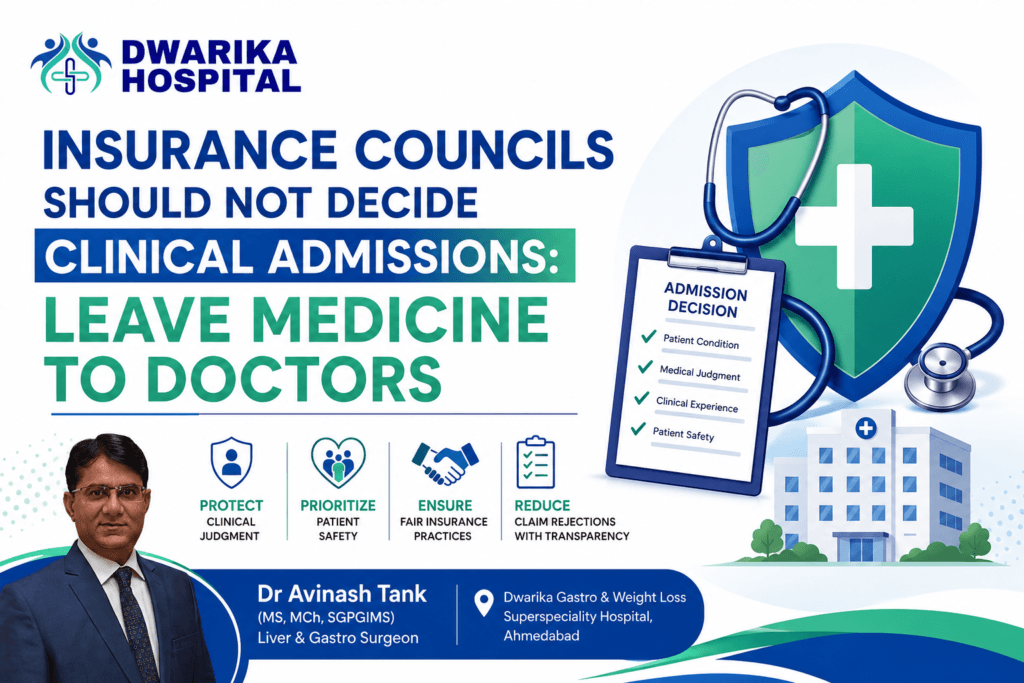
Healthcare works best when every stakeholder performs the role they are trained for. Doctors diagnose and treat patients. Hospitals provide care. Regulators oversee standards. Insurance companies finance risk. Problems arise when one stakeholder begins to dictate the professional responsibilities of another.
The recent attempt by the General Insurance Council (GIC) to issue “clinical admission guidelines” for patients with fever has raised serious concerns across the medical fraternity. While reducing unnecessary hospitalization and preventing insurance fraud are legitimate goals, determining when a patient requires hospital admission is fundamentally a clinical decision, not an insurance decision.
Admission Decisions Are Clinical Decisions
For decades, doctors have been trained using internationally accepted medical textbooks, evidence-based guidelines, specialty society recommendations, and years of supervised clinical practice. Every physician understands the indications for hospital admission for common illnesses such as fever, pneumonia, dengue, malaria, typhoid, urinary tract infections, sepsis, and countless other conditions.
The science of admission is not arbitrary. It depends on multiple clinical factors:
- Severity of illness
- Age of the patient
- Associated diseases
- Pregnancy
- Immune status
- Laboratory findings
- Social circumstances
- Risk of rapid deterioration
No two patients with “fever” are identical.
A 28-year-old healthy individual with viral fever may safely recover at home. An elderly diabetic with the same temperature may develop septic shock within hours.
Reducing this complex medical judgment to an insurance checklist is both scientifically unsound and potentially dangerous.
Medical Guidelines Should Be Written by Clinicians
If India requires updated admission guidelines, they should be developed by:
- Indian Medical Association (IMA)
- National Medical Commission (NMC)
- Specialty Associations
- Medical Colleges
- Academic experts
- Infectious disease specialists
- Internal medicine physicians
- Pediatricians
- Critical care experts
These organizations have the expertise, independence, and credibility to define evidence-based clinical standards.
Insurance councils should certainly participate in discussions regarding financing healthcare, but they should not redefine medical indications for hospitalization.
Medicine should remain in the hands of doctors.
Conflict of Interest Cannot Be Ignored
Insurance companies have a legitimate commercial objective—to reduce payouts while maintaining profitability.
Doctors have a professional and ethical obligation—to provide the safest care for patients.
These objectives are not always aligned.
When the organization responsible for paying claims begins deciding who should or should not be admitted, an inherent conflict of interest emerges.
Even if the intention is good, the perception remains problematic because financial incentives may influence clinical recommendations.
Healthcare policy must avoid even the appearance of such conflicts.
Clinical Judgment Cannot Be Standardized Like Insurance Policies
Medicine is not mathematics.
Many serious illnesses initially present as “simple fever.”
Examples include:
- Dengue with impending shock
- Scrub typhus
- Leptospirosis
- Severe malaria
- Early meningitis
- Septicemia
- Neutropenic fever
- Febrile illness in transplant recipients
- Fever in elderly patients
- Fever during pregnancy
The decision to admit often depends upon experience rather than laboratory numbers alone.
Experienced clinicians frequently recognize subtle warning signs before investigations become abnormal.
Insurance guidelines cannot replace bedside clinical judgment.
Defensive Medicine Will Increase
If doctors fear future claim rejections, they may face two undesirable choices:
- Admit patients when necessary and risk insurance denial.
- Avoid admission to satisfy insurance criteria, exposing patients to complications.
Neither benefits patients.
Clinical independence is essential for safe medical practice.
The Real Issue Is Claim Rejections
If the Insurance Council genuinely wishes to reduce claim disputes, the focus should not begin with admission guidelines.
It should begin with transparency.
Publish a White Paper on Claim Rejections
The insurance industry should publish a comprehensive White Paper analyzing claim rejections since the inception of health insurance in India.
Such a report should answer important questions:
- How many claims were filed?
- How many were rejected?
- Why were they rejected?
- Which reasons are increasing?
- Which are preventable?
- Which stakeholders contribute most?
Without such data, policy interventions risk addressing symptoms rather than causes.
Analyse Claim Rejections of last 20 yrs in Five-Year Blocks
Instead of issuing clinical directives, the Council should conduct a scientific audit by dividing claim data into five-year periods.
For each five-year block, analyse:
Policy-related reasons
- Mis-selling of insurance
- Hidden exclusions
- Non-disclosure confusion
- Complex policy wording
- Waiting period misunderstandings
Insurance company-related reasons
- Excessive documentation demands
- Delayed approvals
- Inconsistent interpretation of policy clauses
- Administrative delays
- Technical claim denials
Policyholder-related reasons
- Non-disclosure of medical history
- Policy lapse
- Waiting period violations
- Incorrect documentation
- Fraudulent claims
Hospital-related reasons
- Incomplete records
- Coding errors
- Billing discrepancies
- Documentation deficiencies
- Inappropriate admission practices
Such an evidence-based analysis would identify the true drivers of claim disputes and enable targeted reforms.
Issue Guidelines for Reducing Claim Rejections—Not Clinical Admissions
Once the causes are scientifically identified, the Insurance Council should publish practical recommendations aimed at reducing avoidable claim rejections.
These could include:
- Standardized pre-authorization processes.
- Uniform documentation requirements.
- Simplified policy language.
- Digital claim submission protocols.
- Better hospital billing standards.
- Consumer education.
- Training for insurance agents.
- Time-bound grievance resolution.
- Transparent appeal mechanisms.
- Independent medical review boards for disputed claims.
Such reforms would directly improve trust between patients, hospitals, and insurers.

Patient Safety Must Remain the First Priority
Clinical guidelines should always prioritize patient outcomes rather than claim economics.
A delayed admission may save one insurance claim but cost a patient’s life.
The consequences of under-admission are often irreversible.
The responsibility for these decisions ultimately rests with treating physicians, who remain legally and ethically accountable for patient outcomes.
Collaborative Reform Is the Way Forward
India needs stronger collaboration between insurers, hospitals, clinicians, regulators, and patient groups—not unilateral directives from any one stakeholder.
A national consensus committee comprising clinicians, insurers, IRDAI, public health experts, hospital representatives, and patient advocacy groups could develop balanced recommendations that protect both patients and the sustainability of health insurance.
Conclusion
Reducing unnecessary hospitalization is an important objective. So is controlling healthcare costs. However, these goals should never come at the expense of clinical autonomy or patient safety.
Doctors have spent years mastering the science of diagnosis and admission decisions through medical education, residency, textbooks, and evidence-based practice. These standards should continue to be defined by eminent clinicians and professional medical bodies—not by organizations with a financial stake in claim payouts.
If the insurance industry truly seeks to reduce claim rejections and restore public confidence, the first step should be transparency.
Publish a comprehensive white paper analysing claim rejections since the inception of the industry, categorize the causes across insurers, policy sellers, policyholders, and hospitals in five-year intervals, and then issue targeted reforms that address the real problems.
The healthcare system functions best when every stakeholder respects professional boundaries.
Doctors should decide who needs admission. Insurance companies should ensure fair, transparent, and timely reimbursement. Patients deserve both sound medical care and equitable insurance practices.
Was this article helpful?

Super-specialist GI, bariatric & cancer surgeon. SGPGIMS (India's premier GI centre) + advanced training in Japan & South Korea. Read full profile →
Last reviewed: July 2026





Comments
Be the first to share your thoughts on this article.