

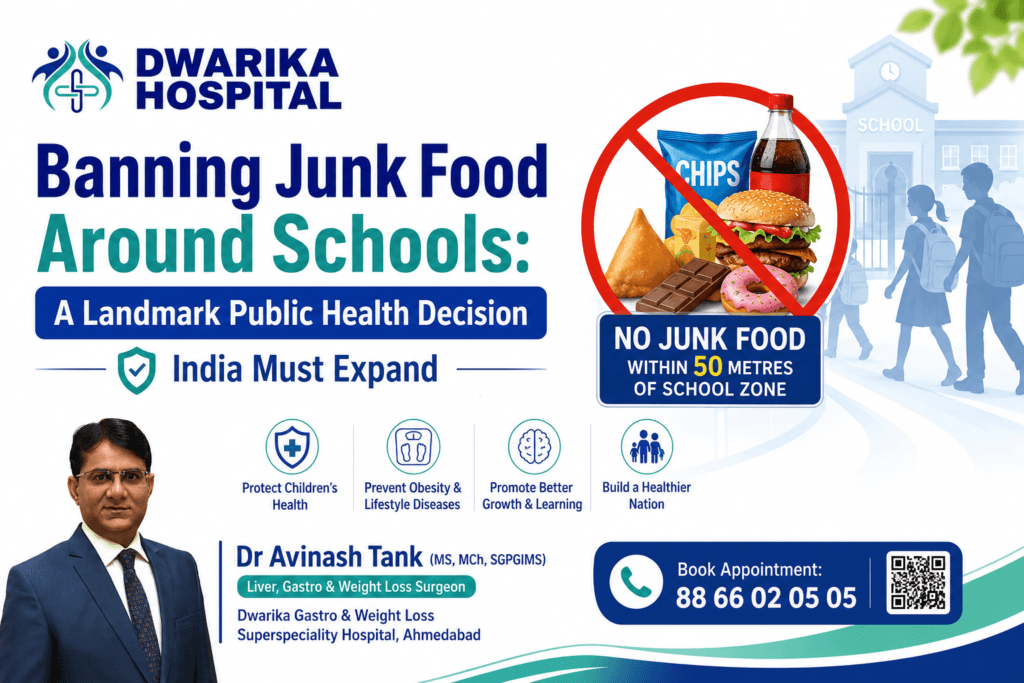
Banning Junk Food Around Schools: A Landmark Public Health Decision India Must Expand
By Dr. Avinash Tank (MS, MCh, SGPGIMS)
Surgical Gastroenterologist | Bariatric & Metabolic Surgeon | Public Health Educator
A Historic Decision That Deserves National Attention
Maharashtra’s decision to prohibit the sale of junk food—including samosa, vada pav, chips, sugary drinks, fried snacks, chocolates, and ultra-processed packaged foods—inside schools and within a 50-meter radius is not merely an administrative order.
It is a public health intervention.
For decades, India has invested heavily in treating obesity, diabetes, heart disease, fatty liver disease, and cancer.
Yet we have invested comparatively little in preventing these diseases where they actually begin—during childhood.
The school environment shapes eating behaviour more powerfully than almost any other setting. Restricting unhealthy food availability sends a clear message:
Children should not be surrounded by foods that increase their lifetime risk of disease.
This policy deserves appreciation—but it should also be viewed as the beginning, not the end, of India’s fight against childhood obesity.
India’s Silent Childhood Health Crisis
India faces a paradox.
While undernutrition still affects millions, childhood overweight and obesity are increasing rapidly, particularly in urban areas.
Modern children consume:
- Ultra-processed snacks
- Sugary beverages
- Packaged juices
- Chips
- Instant noodles
- Bakery products
- Processed meats
- Fast food multiple times weekly
These foods are:
- High in calories
- High in refined carbohydrates
- High in unhealthy fats
- High in sodium
- Low in fibre
- Low in protein
- Low in micronutrients
The result is a generation developing adult diseases at increasingly younger ages.
The Gastroenterologist’s Perspective
Every week in clinical practice, we see diseases that were once considered illnesses of middle age appearing in teenagers and young adults.
These include:
- Fatty liver disease (MASLD)
- Gallstones
- Severe obesity
- Acid reflux
- Constipation
- Irritable bowel syndrome
- Prediabetes
- Type 2 diabetes
- High blood pressure
Many of these conditions begin with unhealthy dietary habits established during school years.
Obesity is not simply about appearance.
It affects nearly every organ:
- Liver
- Pancreas
- Heart
- Brain
- Kidneys
- Hormones
- Bones
- Gut microbiome
Why School Food Matters More Than Parents Realize
Children spend nearly one-third of their day at school.
School food environments influence:
- Food preferences
- Taste development
- Reward pathways in the brain
- Social eating behaviour
- Long-term dietary habits
If children repeatedly see:
- Chips
- Soft drinks
- Fried snacks
- Sugary treats
they begin to perceive these foods as normal daily choices.
Conversely, if healthier options become the norm, lifelong habits improve.
Junk Food Is Not Just “Extra Calories”
Ultra-processed foods affect health through multiple biological mechanisms.
1. Excess Sugar
High sugar intake contributes to:
- Childhood obesity
- Fatty liver disease
- Insulin resistance
- Dental decay
2. Refined Flour (Maida)
Refined carbohydrates rapidly raise blood glucose levels and reduce satiety, encouraging overeating.
3. Unhealthy Fats
Repeatedly heated oils and trans fats promote:
- Chronic inflammation
- Dyslipidaemia
- Cardiovascular disease
4. Excess Salt
High sodium consumption during childhood increases the risk of hypertension later in life.
5. Food Additives
Many ultra-processed foods contain:
- Artificial flavours
- Preservatives
- Colouring agents
- Emulsifiers
Emerging research suggests some additives may adversely affect gut microbiota and metabolic health.
Why a 50-Metre Ban Makes Sense
If junk food remains immediately outside school gates, children will simply purchase it before entering or after leaving school.
Creating a buffer zone reduces:
- Impulse buying
- Peer pressure
- Daily exposure
- Aggressive marketing
This strategy has been used successfully in several countries to create healthier school environments.
What Other Countries Have Done
Many countries have strengthened school nutrition policies:
- The United Kingdom restricts high-fat, high-sugar, and high-salt foods in schools.
- Japan integrates nutrition education with balanced school meals.
- United States federal nutrition standards regulate foods sold during school hours.
- Several European countries limit sugary drinks and unhealthy vending machine options in educational institutions.
India can adapt these lessons to local dietary patterns and cultural preferences.
But Banning Alone Is Not Enough
A ban without healthy alternatives may simply shift consumption elsewhere.
Schools should simultaneously promote:
- Fresh fruits
- Roasted chana
- Sprouts
- Peanuts
- Coconut water
- Buttermilk
- Unsweetened milk
- Seasonal local snacks
- Whole-grain preparations
Healthy food must become:
- Affordable
- Attractive
- Easily available
Nutrition Education Must Become a Core Subject
Children learn mathematics daily.
They learn science daily.
Yet many finish school without understanding:
- Calories
- Protein
- Fibre
- Sugar
- Food labels
- Healthy cooking
- Portion control
Nutrition literacy should become a structured part of school education from primary classes onward.
The Missing Link: Physical Activity
Diet alone cannot solve childhood obesity.
Schools should guarantee:
- Daily physical education
- Outdoor play
- Sports participation
- Reduced sedentary classroom time
Every child should achieve at least 60 minutes of moderate to vigorous physical activity each day, in line with international recommendations.
A National Strategy India Needs
As a public health educator, I believe India should consider a comprehensive childhood nutrition policy that includes:
- Nationwide junk food restrictions around schools.
- Mandatory front-of-pack warning labels on high-sugar, high-salt, and high-fat foods.
- Restrictions on marketing unhealthy foods to children.
- Healthier school canteen guidelines.
- Routine height, weight, and BMI monitoring with parental counselling.
- Nutrition education integrated into the curriculum.
- Daily physical activity programmes.
- Incentives for schools achieving healthy nutrition standards.
- Collaboration with local farmers to supply fresh produce.
- Public awareness campaigns involving parents, teachers, and healthcare professionals.
Challenges That Must Be Addressed
Implementation will determine success.
Authorities should ensure:
- Fair enforcement.
- Vendor rehabilitation through training and healthier product options.
- Affordable nutritious alternatives.
- Continuous monitoring.
- Community engagement.
Without these measures, policies risk becoming symbolic rather than transformative.
The Economic Case for Prevention
Treating obesity-related diseases is expensive.
Preventing them is far more cost-effective.
Every child who develops healthy eating habits today represents a future adult with a lower risk of:
- Diabetes
- Heart disease
- Stroke
- Liver disease
- Kidney disease
- Certain cancers
Investing in prevention is one of the highest-return investments any healthcare system can make.
Final Editorial Opinion
As a gastroenterologist and bariatric surgeon, I routinely treat the consequences of unhealthy eating. Surgery, medications, and hospital care can help many patients—but they cannot replace prevention.
Maharashtra’s decision to restrict junk food in and around schools is a courageous and evidence-informed public health measure.
It recognizes that the environments in which children learn should also protect their health.
However, this initiative should be viewed as the first step toward a broader national strategy.
Lasting success will depend on replacing unhealthy choices with nutritious, affordable alternatives; embedding nutrition education into school curricula; promoting daily physical activity; and engaging parents, educators, healthcare professionals, and local communities.
If implemented thoughtfully and expanded across India, this policy has the potential to reduce the future burden of obesity, fatty liver disease, type 2 diabetes, cardiovascular disease, and several gastrointestinal disorders.
The greatest achievement of this initiative may not be the foods removed from school gates, but the healthier generation it helps create.
Key Takeaways
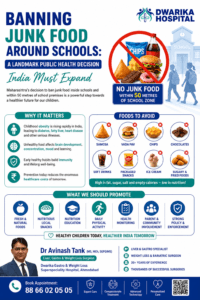
- Restricting junk food near schools is a preventive public health intervention, not merely a food regulation.
- Childhood eating habits strongly influence lifelong risks of obesity and digestive diseases.
- A ban should be accompanied by healthy, affordable food alternatives and nutrition education.
- Daily physical activity is essential to complement dietary improvements.
- India would benefit from a comprehensive national school nutrition policy that prioritizes prevention over treatment.
Healthy children today are the foundation of a healthier India tomorrow. Banning Junk Food Around Schools: A Landmark Public Health Decision India Must Expand
Was this article helpful?

Super-specialist GI, bariatric & cancer surgeon. SGPGIMS (India's premier GI centre) + advanced training in Japan & South Korea. Read full profile →
Last reviewed: July 2026





Comments
Be the first to share your thoughts on this article.