

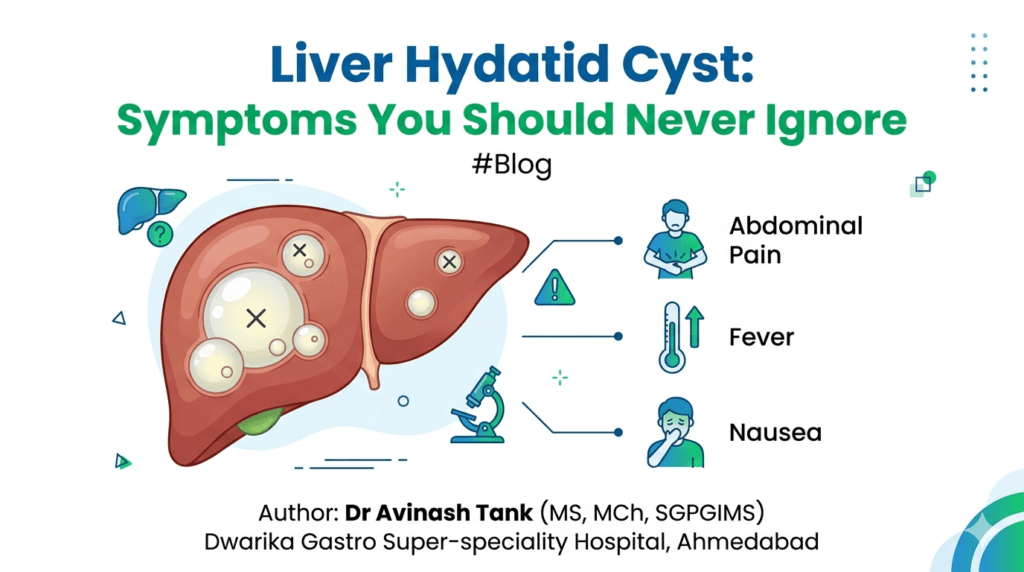
Liver Hydatid Cyst: Symptoms You Should Never Ignore (Detailed Patient Guide)
When it comes to liver hydatid cyst, one of the biggest challenges is that patients often ignore early symptoms. The disease grows silently, and by the time symptoms become obvious, the cyst may already be large or complicated.
This article focuses only on symptoms—explained in a simple, patient-friendly way—so that you can identify warning signs early and seek timely treatment.
What is a Liver Hydatid Cyst (Quick Recap)?
A liver hydatid cyst is a parasitic infection caused by Echinococcus worms. Humans accidentally get infected, and the parasite forms a fluid-filled cyst inside the liver.
The liver is the most commonly affected organ because it acts as a filter for blood coming from the intestine.
Why Symptoms Are Often Missed
Hydatid cysts grow very slowly. Many patients:
- Have no symptoms for years
- Ignore mild discomfort
- Attribute symptoms to gas, acidity, or indigestion
This delay is risky because the cyst can grow large or rupture.
Symptoms of Liver Hydatid Cyst (Explained in Detail)
1. Right Upper Abdominal Pain (Most Common Symptom)
What Patients Feel
- Dull, continuous pain on the right side of the abdomen (just below ribs)
- Sometimes heaviness rather than sharp pain
- Pain may increase after meals
Why It Happens
As the cyst grows, it stretches the liver capsule, which has pain-sensitive nerves.
When to Worry
- Pain lasting more than 2–3 weeks
- Increasing intensity
- Not relieved by acidity medicines
2. Abdominal Fullness or Swelling
What Patients Notice
- Feeling of bloating or fullness
- Tightness in upper abdomen
- Clothes feeling tighter around the waist
Reason
A large cyst occupies space inside the liver and presses on nearby organs like:
- Stomach
- Intestine
3. Nausea and Vomiting
Symptoms
- Feeling like vomiting
- Reduced appetite
- Occasional vomiting
Why It Happens
The cyst presses on the stomach, affecting digestion.
4. Loss of Appetite (Anorexia)
What You Feel
- No interest in food
- Early fullness after small meals
Impact
This may lead to:
- Weakness
- Nutritional deficiency
5. Unexplained Weight Loss
Important Warning Sign
If you are losing weight without trying, it should never be ignored.
Reason
- Chronic infection affects metabolism
- Reduced food intake
6. Fever (Especially in Complicated Cases)
Type of Fever
- Mild to moderate
- Sometimes high-grade with chills
Indicates
- Infection inside the cyst
- Formation of liver abscess
7. Jaundice (Serious Symptom)
What You See
- Yellow eyes and skin
- Dark urine
- Pale stools
Why It Happens
The cyst may compress bile ducts, blocking bile flow.
Important
This is a late and serious sign—requires urgent evaluation.
8. Palpable Lump in Abdomen
What Patients Feel
- A mass in the upper abdomen
- Sometimes visible swelling
Meaning
The cyst has become large enough to be felt externally.
9. Allergic Reactions (Danger Signal)
Symptoms
- Skin rash
- Itching
- Sudden swelling
Why It Happens
Leakage of cyst fluid can trigger immune reaction.
10. Sudden Severe Pain (Emergency Symptom)
What Happens
- Sudden, intense abdominal pain
- May be associated with vomiting or fainting
Possible Cause
Cyst rupture, which is a medical emergency.
Silent Phase vs Symptomatic Phase
| Stage | What Happens |
| Early Stage | No symptoms |
| Growing Stage | Mild pain, fullness |
| Advanced Stage | Multiple symptoms appear |
| Complicated Stage | Rupture, infection, jaundice |
Symptoms Based on Cyst Size
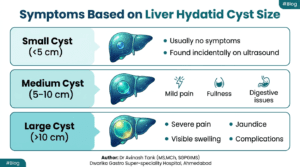
Small Cyst (<5 cm)
- Usually no symptoms
- Found incidentally on ultrasound
Medium Cyst (5–10 cm)
- Mild pain
- Fullness
- Digestive issues
Large Cyst (>10 cm)
- Severe pain
- Visible swelling
- Jaundice
- Complications
Symptoms That People Commonly Misinterpret
Many patients confuse hydatid cyst symptoms with:
- Gas or acidity
- Fatty liver
- Indigestion
- Muscle pain
This is why self-medication delays diagnosis.
High-Risk People Who Should Be Extra Careful
You should be more alert if:
- You live in rural areas
- You have close contact with dogs
- You work with livestock
- You consume unwashed vegetables
Even mild symptoms in these groups should not be ignored.
When Symptoms Become Dangerous
Seek urgent medical attention if you notice:
- Sudden severe abdominal pain
- High fever with chills
- Yellow discoloration of eyes
- Breathing difficulty
- Skin allergy with collapse
These may indicate life-threatening complications.
Why Early Symptom Recognition is Important
Early detection helps:
- Avoid major surgery
- Reduce complications
- Enable simpler treatment
- Improve recovery
Real-Life Example (Common Scenario)
A patient may say:
“Doctor, I had mild right-side pain for 6 months. I thought it was gas. Suddenly, I developed severe pain and fever.”
On investigation, a large hydatid cyst with infection is found.
This situation could have been prevented with early diagnosis.
Key Takeaways for Patients
- Do not ignore persistent right-sided abdominal pain
- Bloating + loss of appetite = warning sign
- Jaundice is a serious late symptom
- Sudden pain may indicate rupture (emergency)
- Early consultation can prevent complications
When to Consult a Doctor
Consult a specialist if you have:
- Pain in right upper abdomen for more than 2 weeks
- Unexplained weight loss
- Persistent nausea or fullness
- Fever without clear cause
Call to Action (CTA)
Don’t ignore early symptoms—they may save your life.
If you are experiencing any of the above signs, get evaluated by a liver specialist.
👉 Book your consultation today for early diagnosis and proper treatment on 8866020505
Was this article helpful?

Super-specialist GI, bariatric & cancer surgeon. SGPGIMS (India's premier GI centre) + advanced training in Japan & South Korea. Read full profile →
Last reviewed: July 2026


Comments
Be the first to share your thoughts on this article.