

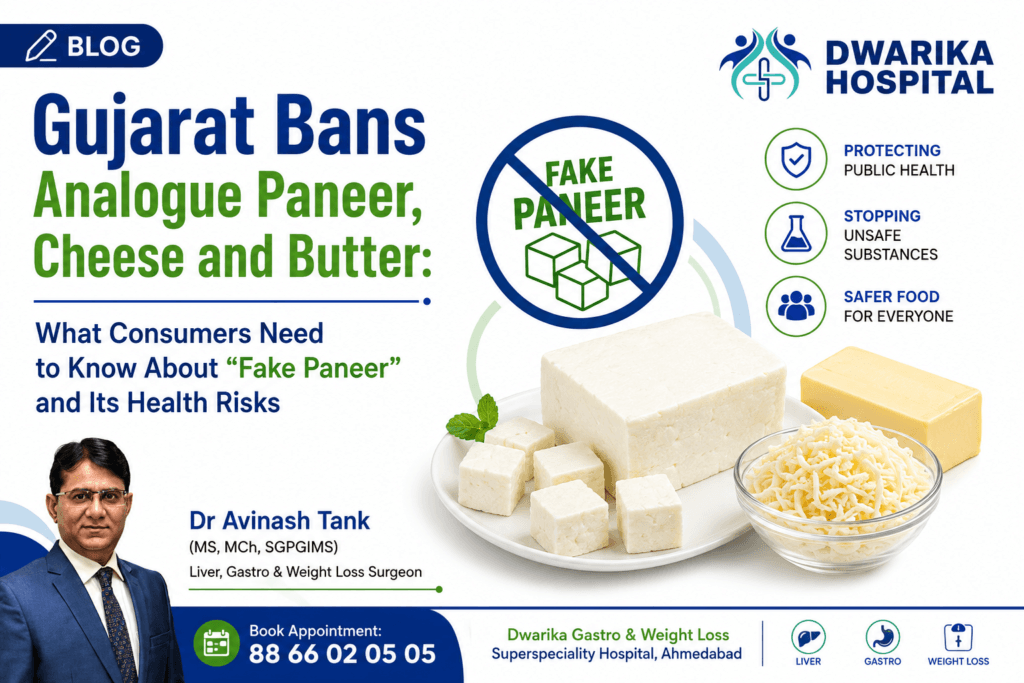
Gujarat Bans Analogue Paneer, Cheese and Butter: What Consumers Need to Know About “Fake Paneer” and Its Health Risks
Gujarat has taken a major food-safety step by banning the manufacture, storage, transportation, distribution and sale of unstandardised analogue paneer, cheese and butter. The action follows inspections and laboratory testing that identified non-standard dairy substitutes being sold in the state. But what exactly is analogue paneer, how is it different from real paneer, and should consumers be worried about their health?
#HealthNews
Dr Avinash Tank (MS, MCh, SGPGIMS)
Liver, Gastrointestinal & Obesity Surgeon
Dwarika Gastro & Weight Loss Superspeciality Hospital, Ahmedabad
Gujarat bans analogue paneer: Why is this news important?
A food-safety controversy surrounding analogue paneer, cheese and butter has triggered a statewide crackdown in Gujarat.
The Gujarat government announced a ban on the production, storage, transportation, distribution and sale of unstandardised analogue paneer, cheese and butter, citing concerns about food safety, consumer deception and nutritional quality. The prohibition has been implemented under the Food Safety and Standards Act, 2006.
The issue quickly moved from government notification to enforcement.
Food-safety authorities carried out inspections across Gujarat. In a two-day enforcement drive, authorities reportedly inspected 842 establishments and destroyed about 1,705 kg of analogue paneer and cheese products valued at approximately ₹5.28 lakh.
In Ahmedabad, the civic food department collected samples from multiple locations for laboratory testing. The Times of India reported that 22 samples were collected across the city following the ban.
This raises an important question for every consumer:
If paneer looks like paneer, how can you know whether it is actually made from milk?
What is analogue paneer?
Analogue paneer is a non-dairy product designed to resemble traditional paneer.
Traditional paneer is a milk-based product. Under FSSAI’s standard, paneer is produced from milk or milk solids through precipitation using permitted acidulants and heating.
Analogue paneer, by contrast, can be manufactured using ingredients such as:
- Vegetable oils or fats
- Starch
- Vegetable protein
- Milk powder or other dairy-derived ingredients in some formulations
- Emulsifiers
- Other permitted or non-permitted additives depending on the formulation
The important point is that it is not equivalent to conventional milk-based paneer.
FSSAI itself recognises “analogues in the dairy context” as a category of products. Regulatory requirements also distinguish dairy products from analogues and prescribe specific labelling requirements.
The current Gujarat action is specifically directed at unstandardised analogue products that authorities say were being sold in ways that could mislead consumers.
Why is analogue paneer cheaper than real paneer?
This is one of the reasons analogue paneer has become attractive to some commercial food businesses.
Traditional paneer depends substantially on milk as its raw material.
Analogue products can substitute some or much of the milk-derived fat and protein with less expensive ingredients such as vegetable fats, starches and other components.
That can significantly reduce manufacturing costs.
The problem begins when a cheaper substitute is presented to the consumer as ordinary paneer without proper disclosure.
This creates two issues:
- Consumer deception
- Potential nutritional differences
The Gujarat government has therefore linked the crackdown not only to food safety but also to protecting consumers and genuine dairy producers.
Is analogue paneer the same as “fake paneer”?
Not necessarily.
The terms “fake paneer,” “analogue paneer” and “adulterated paneer” are often used interchangeably in social media, but they do not always mean exactly the same thing.
An analogue product may be deliberately manufactured as a substitute product. The critical regulatory question is whether it:
- meets applicable food-safety requirements,
- uses permitted ingredients,
- is correctly labelled,
- is being sold under the correct product name, and
- is being represented honestly to consumers.
FSSAI’s regulatory framework specifically recognises dairy analogues and has labelling requirements for them.
Therefore, not every non-dairy analogue should automatically be described as poisonous or toxic.
The more important concern is whether an unstandardised product is being sold illegally or misleadingly, or contains ingredients that do not meet food-safety requirements.
Why has Gujarat banned analogue paneer, cheese and butter?
According to government statements, the decision followed food-safety inspections, sampling and laboratory testing conducted across Gujarat.
The state said authorities detected non-standard analogue dairy products and expressed concern about their nutritional quality and potential impact on public health.
The government’s action covers:
- Production
- Storage
- Transportation
- Distribution
- Sale
of unstandardised analogue paneer, cheese and butter.
The government has also announced plans for a multi-department task force to enforce the prohibition. Deputy Chief Minister Harsh Sanghavi warned that enforcement could include sealing establishments rather than relying only on monetary penalties.
What did the Ahmedabad raids find?
The Ahmedabad Municipal Corporation has begun enforcement following the statewide prohibition.
According to reports, AMC teams collected 22 samples from different parts of Ahmedabad for testing. Similar inspections were conducted elsewhere in Gujarat.
The broader state enforcement drive also reported substantial seizures.
Among the reported quantities destroyed:
- Vadodara: about 471 kg
- Surat: about 235 kg initially
- Rajkot: about 115 kg
- Junagadh: about 585 kg
- Additional quantities were seized in other districts.
Overall, more than 1.7 tonnes of analogue paneer and cheese were reportedly destroyed during the two-day operation.
These numbers demonstrate why the issue has attracted significant public-health attention.
Is analogue paneer harmful to health?
This is perhaps the most important question.
The answer requires some nuance.
An analogue product is not automatically dangerous simply because it is an analogue.
The health concern depends on its ingredients, manufacturing process, food-safety compliance, nutritional composition, contamination and how it is consumed.
However, replacing milk-derived ingredients with vegetable fats, starches and other ingredients can change the nutritional profile substantially.
Traditional paneer is a source of:
- Protein
- Fat
- Calcium and other nutrients associated with dairy
- Energy
A formulation containing significant amounts of starch or vegetable fat may provide a different balance of protein, fat and carbohydrates.
The Gujarat authorities have specifically raised concerns about the nutritional value of the products detected during their enforcement operations.
Therefore, the biggest consumer lesson is:
Do not assume that a product that looks like paneer provides the same nutrition as milk-based paneer.
Can analogue paneer increase cholesterol?
This question has received considerable attention because some analogue products may contain vegetable fats or other added fats.
However, it would be scientifically incorrect to claim that all analogue paneer automatically increases cholesterol.
The effect depends on:
- The type of fat used
- Amount consumed
- Overall diet
- Saturated-fat content
- Trans-fat content, if present
- Individual metabolic health
- Total calorie intake
For people already trying to control obesity, diabetes, fatty liver or cholesterol, routinely consuming highly processed, calorie-dense food substitutes without knowing their nutritional composition may be undesirable.
The better approach is to check the ingredient list and nutrition information rather than judging a food solely by its appearance.
Does analogue paneer contain protein?
It can—but the quantity and quality may differ substantially from traditional paneer.
Traditional paneer is fundamentally a milk-based protein-containing food.
An analogue product may use starches, vegetable fats and other ingredients, and therefore its protein content can be different.
This matters particularly for:
- Children
- Adolescents
- Older adults
- Vegetarians relying heavily on dairy for protein
- People trying to lose weight
- People recovering from illness or surgery
- Individuals with increased protein requirements
Therefore, “paneer” should not automatically be considered a reliable protein source unless consumers know what product they are actually buying.
How can consumers identify real paneer?
This is difficult to determine simply by looking at a block of paneer.
Colour, softness and appearance alone cannot reliably prove that paneer is genuine.
Consumers should instead:
1. Buy from reputable sources
Choose established dairies, supermarkets or food businesses with good food-safety practices.
2. Check the label
For packaged products, read:
- Product name
- Ingredient list
- Nutrition information
- Manufacturer details
- FSSAI licence details
- Batch number
- Manufacturing/expiry information
FSSAI standards specify how standardised paneer products should be named and labelled.
3. Look for unusual ingredient combinations
If a product marketed as paneer prominently contains ingredients such as vegetable fat, starch or other non-dairy components, consumers should examine the label carefully.
4. Don’t depend on viral home tests
Social media frequently promotes tests involving boiling, frying, iodine, rubbing or stretching paneer.
These tests may be unreliable and should not be treated as laboratory confirmation of adulteration.
If there is a serious concern about a product, laboratory analysis is far more meaningful.
Can you identify fake paneer by texture?
Not reliably.
Some consumers believe that real paneer must:
- Break easily
- Be extremely soft
- Turn yellow when heated
- Smell a particular way
- Release water when pressed
But these observations are influenced by:
- Milk composition
- Manufacturing technique
- Moisture
- Storage
- Temperature
- Age of the product
Therefore, texture alone cannot establish whether a product is genuine paneer.
Laboratory testing is the appropriate method when regulatory confirmation is required.
Why is this issue especially important for restaurants?
Restaurants, caterers, hotels and food-service businesses can use substantial quantities of paneer, cheese and butter.
A cheaper substitute can therefore create a strong financial incentive.
The concern becomes particularly serious if customers order:
- Paneer tikka
- Paneer butter masala
- Shahi paneer
- Palak paneer
- Paneer sandwiches
- Cheese-based foods
while assuming that the ingredients are conventional dairy products.
Gujarat authorities have therefore specifically warned food businesses, restaurants, traders and other food operators following the ban.
Is analogue cheese also covered by the Gujarat ban?
Yes.
The current prohibition is not limited to paneer.
It also covers unstandardised analogue cheese and analogue butter.
This is important because dairy analogues can occur across several food categories.
FSSAI’s regulatory framework separately recognises dairy products and dairy analogues, including cheese analogues.
What does FSSAI say about paneer?
FSSAI’s standard defines paneer as a product obtained from milk, with or without added milk solids, using permitted acidulants and heating.
The standard also establishes compositional requirements, including limits related to moisture and milk fat.
This distinction is important.
A food that merely looks like paneer is not necessarily nutritionally or legally equivalent to standard paneer.
Does this mean everyone should stop eating paneer?
No.
The Gujarat ban should not be interpreted as a warning against paneer itself.
Traditional paneer can be a useful source of protein and other nutrients, particularly in vegetarian diets.
The issue is product authenticity, food safety, nutritional composition and honest labelling.
For a healthy diet, paneer can be included in appropriate portions along with:
- Vegetables
- Pulses
- Whole grains
- Fruits
- Nuts and seeds
- Adequate water
- Overall balanced nutrition
The bigger concern is frequently consuming highly processed, high-fat or high-calorie foods while assuming that they are nutritionally equivalent to their traditional counterparts.
What should people with diabetes, obesity or fatty liver know?
This is particularly relevant because many people consider paneer a “healthy” or “high-protein” food.
The word paneer does not automatically make a food low-calorie or healthy.
A product made with substantial fat can be calorie-dense.
For people managing:
- Obesity
- Type 2 diabetes
- Fatty liver
- High cholesterol
- Metabolic syndrome
the total nutritional composition and portion size matter.
Choosing a genuine, appropriately portioned protein source is generally more sensible than relying on an inexpensive processed substitute whose nutritional composition is unclear.
What should consumers do if they suspect adulterated paneer?
Do not simply rely on social-media videos or home experiments.
Instead:
- Keep the packaging if available.
- Note the manufacturer and batch details.
- Keep the purchase bill where possible.
- Photograph the product and label.
- Report suspected violations through appropriate food-safety authorities.
- Do not continue consuming a product you strongly suspect is unsafe.
Food-safety enforcement agencies can collect samples and send them for appropriate laboratory analysis.
The bigger lesson: Know what is actually on your plate
The Gujarat analogue paneer controversy is larger than paneer.
It raises an important question about modern food systems:
Are consumers always getting the food they think they are buying?
A food can look familiar while its ingredients are substantially different.
This is particularly important when a product is marketed as a source of protein, milk nutrition or a traditional food.
The solution is not fear.
It is food literacy.
Consumers should learn to distinguish between:
Milk product → dairy-based product → dairy analogue → adulterated or non-compliant product.
These are not necessarily interchangeable categories.
Final message for consumers
The Gujarat government’s action against unstandardised analogue paneer, cheese and butter is an important reminder that food safety begins with knowing what we are eating.
The immediate concern is not that every analogue product is poisonous. Rather, consumers need protection from unstandardised, unsafe or misleadingly marketed products.
For everyday consumers, the safest practical approach is simple:
Buy from trusted sources, read labels, avoid suspiciously cheap products, don’t rely on viral home tests, and remember that appearance cannot prove authenticity.
The recent Gujarat enforcement drive—with more than 1,700 kg of analogue paneer and cheese reportedly destroyed—shows that the issue is not merely theoretical.
For families, restaurants and healthcare-conscious consumers, this is a good time to ask one simple question before buying:
“Is this really paneer—or does it only look like paneer?”
Quick Answers: Gujarat Analogue Paneer Ban
What is analogue paneer?
A non-dairy or partly non-dairy substitute designed to resemble conventional paneer.
Why has Gujarat banned it?
The state has prohibited unstandardised analogue paneer, cheese and butter following food-safety inspections and laboratory testing.
Is all analogue paneer poisonous?
No. It is inaccurate to label every analogue product as poisonous. The concern is compliance, ingredients, safety, nutritional quality and misleading sale.
Is real paneer made from milk?
Yes. FSSAI’s paneer standard defines paneer as a milk-based product.
Can you identify fake paneer by looking at it?
No. Appearance and texture alone cannot reliably establish authenticity.
Can analogue paneer be lower in protein?
It can have a different nutritional composition from traditional paneer, depending on its formulation.
Should people stop eating paneer?
No. Genuine paneer can form part of a balanced diet when consumed appropriately.
What should consumers check?
Buy from reliable sources and check the product name, ingredients, nutrition information, manufacturer and FSSAI-related details.
Medical Disclaimer: This article is for public health education and is based on currently reported government and media information. Individual dietary requirements vary. People with diabetes, obesity, liver disease, high cholesterol or other metabolic conditions should discuss personalised dietary choices with a qualified healthcare professional.
Sources: Gujarat government/food-safety enforcement reports, Times of India reports dated August 6–7, 2026, PTI reporting, and FSSAI standards and guidance on dairy products and analogues.
Monitor Gujarat food-safety updates on analogue dairy products
Was this article helpful?

Super-specialist GI, bariatric & cancer surgeon. SGPGIMS (India's premier GI centre) + advanced training in Japan & South Korea. Read full profile →
Last reviewed: July 2026





Comments
Be the first to share your thoughts on this article.