


Reading Time: 6 minutes
PM-JAY Cancer Care Debate: Why the New Oncologist Rule Matters.
The decision has a strong public-safety logic, but it also risks shrinking access to cancer care in places that already face doctor shortages. A balanced blog should examine both sides, especially because PM-JAY cancer services are large in scale and heavily used by rural patients.
Introduction
The recent rule affecting MD oncologists under PM-JAY has triggered a serious debate about quality, access, and regulatory consistency.
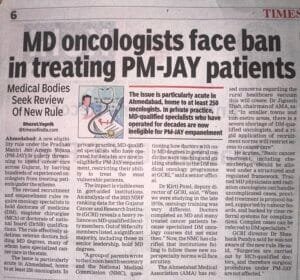
On one side, policymakers want tighter qualification standards for cancer treatment; on the other, many experienced fellowship-trained doctors say they are being unfairly excluded from serving poor patients under the scheme.[3][4]
This article explains the issue, presents the case in favour of the decision, and then makes the case against it using verified statistics from government and official sources.[5][1]
What the decision means
The rule, as reported, limits PM-JAY cancer treatment eligibility to doctors with certain recognised super-speciality degrees, which has made many fellowship-trained oncologists ineligible for empanelment or claim processing. Reports also indicate that some hospitals have removed specialists from their PM-JAY rosters because they can no longer generate claims under the scheme.[4][6][3]
This matters because cancer care under PM-JAY is not a small program. The government has reported over 68 lakh cancer treatments worth more than Rs. 13,000 crore under the scheme, and more than 75% of these treatments were availed in rural areas.[2][1]
Why the rule exists
The most defensible argument for the decision is that cancer care is complex, high-risk, and highly protocol-driven. Government reporting shows PM-JAY cancer coverage includes more than 200 packages and over 500 procedures across medical oncology, surgical oncology, radiation oncology, and palliative care, so the system has a legitimate interest in ensuring that only properly recognised specialists deliver these services.[7][2]
The logic is straightforward: when treatment involves chemotherapy, surgery, radiation, and targeted therapy, qualification standards must be clear, consistent, and auditable. In a publicly funded scheme, this also helps reduce misuse, incorrect coding, and variation in quality.[8][1]
## In favour of the decision
A strong **pro** argument is patient safety. Cancer treatment errors can have severe consequences, and formal super-speciality training is designed to standardise knowledge, surgical judgment, and multidisciplinary decision-making. When public money is involved, the government has a duty to make sure the doctors treating beneficiaries meet a clearly defined benchmark.[1][3]
Another argument is accountability. PM-JAY already covers a very large beneficiary base, and the scheme extends Rs. 5 lakh per family annually to around 55 crore beneficiaries across roughly 12.37 crore families, so a stricter credential rule can be seen as a way to protect a massive public system from uneven practice.[1]
A third argument is alignment with evidence-based care. The government has emphasized structured cancer packages, targeted therapies, district day care centres, and standard protocols under the scheme, and this model works best when specialist credentials are uniform across states.[9][2]
## In favour: quality control
The quality-control argument is especially important because cancer care often requires rapid, coordinated decisions. Reports show PM-JAY now includes targeted therapies and large-scale oncology services, which means the treatment environment is becoming more specialized, not less.[2][1]
In that context, authorities may reasonably prefer doctors whose qualifications are easy to verify through NMC-recognised degrees, because this reduces ambiguity for empanelment and claim approval. It also creates one clear national standard rather than multiple interpretations across states.[6][3]
For a government insurance program, standardization can be as important as access. Without it, quality may vary widely between urban centres, semi-urban hospitals, and smaller facilities.[8][2]
## In favour: fairness in public funding
Supporters of the rule can also argue that public schemes should not automatically reward informal pathways if formal super-speciality seats exist. If PM-JAY funds treatment from public money, then patients and taxpayers have a right to expect doctors to have the most formally recognised qualifications available under current regulation.[3][5]
This is especially relevant because the government has invested heavily in cancer infrastructure and cancer financing. According to official data, over 68 lakh cancer treatments have already been supported, so the scale of public investment makes credential discipline important.[2][1]
From this angle, the rule is not anti-doctor; it is pro-standards. It tries to ensure that high-burden cancer care is delivered by specialists whose training is nationally recognised and legally unambiguous.[3][1]
## Against the decision
The strongest criticism is that the rule may reduce access to care in areas already facing a shortage of specialists. The article reports that the issue is especially acute in cities like Ahmedabad and in non-metro regions where experienced oncologists are few, and removing fellowship-trained doctors can worsen the gap rather than improve care.[3]
This concern is not theoretical. Government data shows that more than 75% of PM-JAY cancer treatments are availed by rural patients, which means any sudden reduction in the specialist pool is likely to hit rural India hardest.[1][2]
If a district has one skilled oncologist with years of practical experience but no new NMC-recognised degree, excluding that doctor may mean beneficiaries must travel farther, wait longer, or forgo treatment altogether.[4][2]
## Against: experienced doctors matter
Another major objection is that the rule may undervalue real-world expertise. Many of the affected doctors reportedly have decades of surgical and oncology experience, and some have even trained younger specialists and led cancer departments.[4][3]
Medicine is not only about the certificate on the wall; it is also about judgment, case volume, complication management, and long-term performance. A fellowship-trained doctor who has treated thousands of patients may be more practically prepared than a newly qualified degree-holder in some settings.[10][3]
The concern is especially sharp in India, where oncology capacity remains uneven. If a policy removes functioning specialists from a public scheme without creating enough replacements, the result may be a paper-standard victory and a clinical access loss.[2][4]
## Against: rural access risk
The rural impact deserves special attention. The government says over 75% of cancer treatments under PM-JAY are used by rural beneficiaries, and targeted therapies also show a similarly high rural share.[1][2]
That means PM-JAY is not mainly an urban benefit program; it is a lifeline for patients outside major centres. In many smaller towns, fellowship-trained doctors are the only practical oncology resource available, so a blanket exclusion can create a treatment vacuum.[3]
The problem is not just one of convenience. In cancer care, delays can change outcomes, and additional travel or administrative hurdles can convert a treatable cancer into an advanced one.[2]
## Against: policy confusion
A further criticism is regulatory inconsistency. Reported coverage suggests that state authorities have interpreted NHA and NMC rules differently, and some officials say NMC-recognised qualifications are required while others note that NHA guidelines do not clearly contain that clause.[3]
That kind of ambiguity is dangerous in a national scheme. Doctors, hospitals, and patients need a single, transparent rulebook, not a patchwork of interpretations that changes by state or portal.[4][3]
If a rule is important enough to remove doctors from PM-JAY empanelment, it should be published clearly, uniformly, and with transition safeguards.[6][3]
## What a balanced policy could look like
A better approach may be a phased model rather than an immediate exclusion. The government could require recognition-based qualification for new empanelment while protecting experienced fellowship-trained oncologists through grandfathering, peer review, or case-audit mechanisms.[9][3]
This would preserve safety while avoiding sudden service disruption in underserved areas. It would also respect the reality that many cancer services under PM-JAY are already being delivered in rural and semi-urban settings by experienced clinicians who are deeply embedded in local referral networks.[1][2]
In practical terms, the best policy is likely not “either credentials or experience,” but “credentials plus demonstrated competence,” backed by audit, tumour boards, and outcome monitoring.[8][9]
## Conclusion
PM-JAY Cancer Care Debate: Why the New Oncologist Rule Matters.. The decision to tighten oncology eligibility under PM-JAY has a genuine quality-control rationale, and that argument should not be dismissed. Cancer treatment under a public insurance scheme involves huge volumes, public money, and potentially dangerous procedures, so strong standards are reasonable.[2][1]
At the same time, the blanket exclusion of experienced fellowship-trained oncologists risks reducing access, especially in rural and smaller-city India where more than three-quarters of PM-JAY cancer care already goes. The best solution is a calibrated policy that protects standards without removing practical access to life-saving treatment.[1][2]
Sources
[1] targeted therapies for cancer care have seen over 4.5 lakh … – PIB https://www.pib.gov.in/PressReleaseIframePage.aspx?PRID=2118795
[2] Over 75% cancer treatments under PMJAY availed by rural areas https://ddnews.gov.in/en/over-75-cancer-treatments-under-pmjay-availed-by-rural-areas-health-minister/
[3] New PMJAY rule disqualifies hundreds of cancer specialists https://timesofindia.indiatimes.com/city/mumbai/new-pmjay-rule-disqualifies-hundreds-of-cancer-specialists/articleshow/130048672.cms
[4] New PMJAY rule bars many cancer specialists from treating patients https://health.economictimes.indiatimes.com/news/industry/new-pmjay-rule-bars-many-cancer-specialists-from-treating-patients/130048832
[5] Press Release: Press Information Bureau https://www.pib.gov.in/PressReleseDetailm.aspx?PRID=2118795
[6] New PMJAY rule bars hundreds of experienced cancer specialists … https://economictimes.com/news/new-updates/new-pmjay-rule-bars-hundreds-of-experienced-cancer-specialists-from-treating-patients-under-ayushman-bharat-scheme-heres-the-reason-why/articleshow/130060464.cms
[7] Over 68 lakh cancer treatments done under PMJAY, majority in rural … https://health.economictimes.indiatimes.com/news/policy/over-68-lakh-cancer-treatments-done-under-pmjay-majority-in-rural-areas-nadda/119185208
[8] Gujarat govt Issues New Guidelines for PMJAY Hospitals to Prevent … https://www.newsonair.gov.in/gujarat-govt-issues-new-guidelines-for-pmjay-hospitals-to-prevent-irregularities/
[9] Towards a Cancer-Free India – PIB https://www.pib.gov.in/PressReleasePage.aspx?PRID=2102729
[10] PMJAY cancer specialist rules: New eligibility criteria – OC Academy https://www.ocacademy.in/blogs/pmjay-cancer-specialist-rules-eligibility/
[11] IMG_5635.jpeg https://ppl-ai-file-upload.s3.amazonaws.com/web/direct-files/attachments/images/77701454/62c4a045-6869-49c1-96f3-365cfedbb548/IMG_5635.jpeg?AWSAccessKeyId=ASIA2F3EMEYETNNS3DTP&Signature=B4lzprarLKtcAQi%2BRdJAGtX7dBo%3D&x-amz-security-token=IQoJb3JpZ2luX2VjEBsaCXVzLWVhc3QtMSJGMEQCIA4fpsE8ZNtsWV3t%2B6tAh5g87w5oNhqBJ%2BqHMjebNgqzAiBE0ZL4o2vpFNPHJ0psK29alAQhjGnGf7JqTn6oHBvpIyr8BAjk%2F%2F%2F%2F%2F%2F%2F%2F%2F%2F8BEAEaDDY5OTc1MzMwOTcwNSIM9Gmuuv7m5VkC13lcKtAE8iqELCTap57hQBlu0Q2ijT%2Bm9bqy3gwxj6J8hrX64PTBhGkhgaDHtTfrgftuqQzmGADMUcx7nERCfRYxRsy4xcT0OKr1KRAg9qdeLtAIHzhhp1b%2F2lIMJJ2lkujx0M44RVCn%2FctiZuNw77QW8Qbzrlulwp4E5w61SJFn5wfl0J2Ab2EIvSE%2BHEFPI4l%2FKNzd7MH6aXsPRrO7eAy8ucB%2Bbl%2BIeQmRcva9o5d8gouLWH9WSxNbMQkdZ%2BdjxiuZkI%2FdxubMe56nmEAN%2Bt9dLFCLHVBbzGARHCEti6aduxJcHqtBFFwW1X3YuguD4na0JgZRVWGj8n7Y%2BRCc5QYoi2JOMzzaiT1REm9WN5lB5xFq7SKY2FkJj%2BhSOL5Jj86KHUiduc7O4dC%2Fa54KN9tRMQPaL5190chsRQzAW1lodYGDN%2B%2FG5Ga1ZRWbZ3C3vuAxZDlSro%2BUMbxG3bzI4aqPYMfrySGB0kRr3w7yEhlUg4thcHpuWFkXE7Xna%2BJcRmRzsSje3UAVuA4znFKy5YcMeCHyk1PSGjyCIbr0bhdE7LhAGMYkuRR0Yd%2BIJCgH8dl3VAUTODOgDYgYWiBVjUE2XVWe2qAFXKbVT%2FyfOGnYnBid7pEh6D5qeY0pdFgxgJWA5y4DV3yFIkowfqdxYBr3Iuu0YcshTjazcpl%2F7f0u%2FM32jXAiVapzZCA9LpJGSG2VtMWiG%2FliknDPt%2BNhWuawmgDRjibhEsnKvAMRrrmnR4onsLkWC7EczAbCOseY30Vfexub5oJ04NeDfB7ZrKWIyTs%2FXDCI4ovPBjqZAUcXT8xQt2II2l7GnReqA0a%2B57CB%2FQzvtgWjwBZ%2Bxxaswvrtg3EjlwN1v0D%2BLPlCe7lhs%2BNAnyck1Lq0U5H7%2BqzTdprtHbaxYBghKqNdnGhf0pC2jEB%2BzEh%2Ftr39XYos5MHdJQgsm6fX9mrI7x%2F0cPXOxgwnTanDnyGzn4Dg9VW0TRSOasIggSGWcRpZB%2Bwv34y9V5frYQH7DA%3D%3D&Expires=1776481678
[12] New PMJAY Rule Bars Many Experienced Oncologists from … https://theindianpractitioner.com/new-pmjay-rule-bars-many-experienced-oncologists-from-treating-cancer-patients/
[13] Big concern in cancer care A new PMJAY rule may restrict many … https://www.instagram.com/p/DWyot07CQWh/
[14] Over 68 lakh cancer treatments provided, Rs. 13,000 crore spent … https://ddnews.gov.in/en/over-68-lakh-cancer-treatments-provided-rs-13000-crore-spent-under-pm-jay-government-outlines-nationwide-cancer-care-achievements/
[15] [PDF] Ministry of Health & Family Welfare – Initiatives & Achievements-2025 https://static.pib.gov.in/WriteReadData/specificdocs/documents/2026/jan/doc202611749801.pdf
[16] Facilitating Cancer Care Through Ayushman Bharat Scheme … http://waocp.com/journal/index.php/apjcc/article/view/963
[17] New PMJAY rule bars many cancer specialists from treating patients https://www.linkedin.com/posts/ramavenugopal_new-pmjay-rule-bars-many-cancer-specialists-activity-7446888734463160320-07q-
[18] Cancer care under Ayushman Bharat needs Rs 33,000 crore … https://economictimes.com/industry/banking/finance/insure/cancer-care-under-ayushman-bharat-needs-rs-33000-crore-annually-far-above-current-allocation-study/articleshow/129589458.cms