

Reading Time: 5 minutes
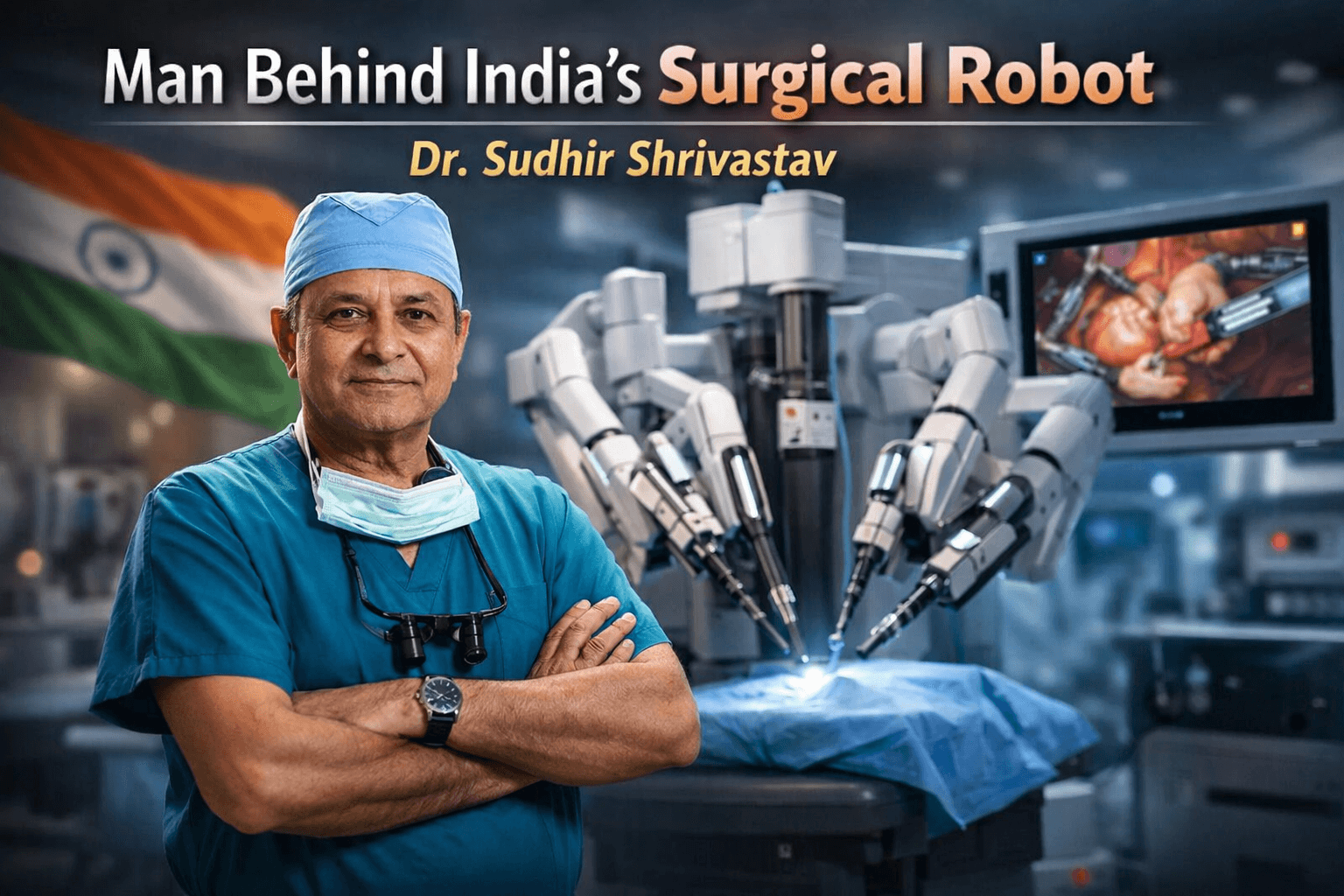
Man Behind India’s Surgical Robot. Dr Sudhir Srivastava: Visionary Cardiac Surgeon and Founder of SS Mantra Surgical Robot Transforming Robotic Surgery in India
Introduction: Why Dr Sudhir Srivastava Matters in the Future of Surgery
The global healthcare landscape is undergoing a technological transformation. Artificial intelligence, digital imaging, precision instruments, and robotic platforms are redefining how surgeons operate. At the center of India’s robotic surgery revolution stands Sudhir Srivastava, an internationally acclaimed cardiac surgeon and the Founder, Chairman, and CEO of SS Innovations International.
Known for pioneering beating-heart totally endoscopic coronary artery bypass (TECAB) procedures and for developing India’s first indigenous multi-specialty surgical robotic platform — the SSi Mantra — Dr Sudhir Srivastava cardiac surgeon has built a legacy that blends surgical mastery with disruptive innovation.
This authority article explores:
- His early life and surgical training
- Breakthrough achievements in robotic cardiac surgery
- The founding and growth of SS Innovations
- The development of the SS Mantra Robot
- Telesurgery and global milestones
- His vision for democratizing robotic surgery
- Leadership philosophy and long-term impact
Early Life and Medical Foundations
Every revolutionary career begins with strong foundations. Dr Sudhir Srivastava completed his medical education in JLN Medical College Ajmer, India at a young age, demonstrating early academic brilliance and discipline. His formative training shaped his technical precision, patient-first mindset, and relentless pursuit of excellence.
Seeking advanced surgical exposure, he moved abroad for cardiothoracic surgical training. He completed residency training at University of British Columbia Hospitals, one of North America’s respected training ecosystems for cardiothoracic surgery.
This international exposure proved transformative. It introduced him to:
- Advanced minimally invasive techniques
- Robotic surgical platforms
- Research-based surgical protocols
- Global quality standards
During this phase, Dr Sudhir Srivastava cardiac surgeon began developing a deep interest in robotic cardiac surgery — at a time when robotic systems were still evolving and rarely used in complex heart procedures.
Establishing Surgical Excellence in Cardiac Surgery
Dr Srivastava’s early clinical career was marked by high surgical volumes, technical refinement, and continuous innovation.
He co-founded Alliance Hospital, where he served as Chairman and led cardiovascular services. During this period, he began pushing boundaries in robotic cardiothoracic procedures.
Pioneering Beating-Heart TECAB
One of his most remarkable contributions to cardiac surgery was performing:
- The world’s first single-vessel beating heart TECAB in the United States
- The first double-vessel beating heart TECAB
- The first triple-vessel beating heart TECAB
Later, while associated with University of Chicago, he performed the world’s first quadruple-vessel beating-heart totally endoscopic coronary artery bypass surgery.
These procedures are technically demanding because:
- The heart continues beating
- There is no sternotomy
- The operation is done endoscopically
- Robotic precision is required
Over his career, Dr Sudhir Srivastava cardiac surgeon has performed:
- 1,400+ robotic cardiothoracic surgeries
- 750+ beating-heart TECAB procedures
This is widely considered among the largest global experiences in robotic beating-heart bypass surgery.
Identifying the Gap: Why Robotic Surgery Was Not Accessible
Despite clinical success in the United States, Dr Srivastava identified a critical problem.
Robotic surgical systems available globally were:
- Extremely expensive
- Dependent on imported technology
- Limited to premium urban hospitals
- Unaffordable for most patients in developing nations
While robotic surgery offered benefits such as:
- Smaller incisions
- Reduced blood loss
- Faster recovery
- Shorter hospital stay
- Improved precision
The cost barrier restricted access.
When Dr Sudhir Srivastava cardiac surgeon visited India and other emerging economies, he observed:
- Skilled surgeons eager to adopt robotics
- Patients needing minimally invasive surgery
- Hospitals unable to afford imported systems
This gap became the seed of a bold vision.
Founding SS Innovations International
Determined to democratize access, Dr Srivastava founded SS Innovations International.
The company was established with a mission:
To create an affordable, high-performance, indigenous surgical robotic platform capable of serving global healthcare needs.
Unlike incremental innovation, this was a foundational engineering challenge:
- Develop robotic arms
- Build visualization systems
- Engineer instrument articulation
- Ensure precision motion scaling
- Create ergonomic surgeon consoles
- Integrate telesurgery capabilities
The result was the SSi Mantra.
The SSi Mantra Surgical Robotic System: A Technological Breakthrough
The SSi Mantra Robot represents one of India’s most ambitious medical engineering projects.
Key Features
- Multi-arm modular robotic system
- 3D 4K high-definition visualization
- Surgeon console with ergonomic design
- 30+ robotic endo-surgical instruments
- Motion scaling and tremor filtration
- Teleproctoring and telesurgery capability
The design emphasized:
- Cost efficiency
- Clinical versatility
- Ease of adoption
- Reduced maintenance burden
Compared to traditional imported platforms, the SSi Mantra significantly reduced acquisition and per-procedure costs — a critical factor in emerging markets.
Clinical Applications of SS Mantra Robot
The SSi Mantra platform supports multi-specialty robotic surgery:
1. Cardiac Surgery
- Coronary artery bypass
- Valve procedures
- Minimally invasive cardiac interventions
2. Urology
- Prostatectomy
- Nephrectomy
3. Gynecology
- Hysterectomy
- Myomectomy
4. General Surgery
- Hernia repair
- Colorectal surgery
5. Thoracic Surgery
- Lung resections
- Mediastinal procedures
The platform was engineered to ensure surgeons transitioning from laparoscopy could adapt with structured training.
Global Milestones and Telesurgery Revolution
One of the most remarkable chapters in Dr Srivastava’s journey is telesurgery.
He performed a historic intercontinental robotic cardiac telesurgery, operating remotely across thousands of kilometers.
This achievement demonstrated:
- Low latency performance
- Real-time robotic response
- Secure digital transmission
- Feasibility of remote expert intervention
The SSi Mantra became one of the first robotic systems to integrate teleproctoring and telesurgery into its design architecture.
Why Telesurgery Matters
- Rural access to expert surgeons
- Disaster zone surgical support
- Military medical applications
- Cross-border expert consultation
- Training without physical travel
This positions Dr Sudhir Srivastava cardiac surgeon not just as a clinician, but as a future-focused healthcare architect.
Democratizing Robotic Surgery in India
India has:
- A large patient population
- Skilled surgeons
- Growing healthcare infrastructure
- Tier 2 and Tier 3 city expansion
The introduction of an indigenous robotic system allows:
- Reduced capital cost
- Lower maintenance expense
- Reduced disposable cost
- Faster adoption in mid-sized hospitals
This shift may redefine:
- Surgical training models
- Medical device manufacturing ecosystem
- Healthcare equity in emerging markets
Dr Sudhir Srivastava cardiac surgeon has repeatedly emphasized that robotic surgery should not be a luxury service, but a standard of care where clinically appropriate.
Leadership Philosophy and Entrepreneurial Courage
Transitioning from surgeon to medical technology entrepreneur requires:
- Risk tolerance
- Engineering collaboration
- Regulatory navigation
- Fundraising ability
- Team building
Dr Srivastava demonstrated unusual cross-domain capability.
His leadership style reflects:
- Clinical credibility
- Engineering curiosity
- Long-term strategic thinking
- Patient-centered innovation
He built multidisciplinary teams including:
- Robotic engineers
- Software developers
- Surgeons
- Regulatory specialists
- Manufacturing experts
Few clinicians globally have successfully bridged surgery and robotics entrepreneurship at this scale.
Regulatory Pathways and Global Expansion
Medical robotics requires rigorous:
- Quality assurance
- Regulatory approvals
- Clinical validation
- Safety trials
SS Innovations pursued structured regulatory pathways across multiple geographies.
Global expansion includes:
- Southeast Asia
- Middle East
- Europe
- United States ambitions
This growth positions India not just as a consumer of medical technology, but as a producer and exporter of high-end surgical robotics.
The Future of Robotic Surgery Under His Vision
Dr Sudhir Srivastava cardiac surgeon envisions a future where:
- Robotic systems integrate AI-assisted guidance
- Data analytics improve surgical outcomes
- Remote surgery becomes normalized
- Training simulators accelerate surgeon competency
- Robotics becomes standard in complex surgeries
He also advocates:
- Surgeon upskilling
- Technology adaptation
- Ethical AI integration
- Global collaborative networks
Impact on Medical Education
Robotic surgery demands structured training.
SS Innovations has supported:
- Simulation training
- Tele-mentoring
- Proctoring models
- Skill transfer ecosystems
This ensures technology adoption does not compromise patient safety.
Challenges and Criticism in Robotic Surgery
No innovation escapes scrutiny.
Common concerns include:
- Cost justification
- Learning curve
- Evidence comparison vs laparoscopy
- Overuse risk
Dr Srivastava has consistently positioned robotic surgery as:
An advanced tool — not a replacement for surgical judgment.
Why Dr Sudhir Srivastava Is a Transformational Figure
Few individuals combine:
- Clinical excellence
- Research contribution
- Entrepreneurial vision
- Engineering innovation
- Global impact
Dr Sudhir Srivastava cardiac surgeon stands at this rare intersection.
His contributions extend beyond personal surgical achievement — they influence:
- National medical manufacturing
- Healthcare access equity
- Global perception of Indian innovation
- Future-ready surgical ecosystems
Conclusion: A Legacy in Motion
Dr Sudhir Srivastava cardiac surgeon has evolved from a pioneering beating-heart surgeon into a global advocate for accessible robotic surgery.
Through SS Innovations International and the SSi Mantra surgical robotic system, he has challenged the assumption that high-end surgical robotics must remain prohibitively expensive and geographically limited.
His work represents:
- Innovation with purpose
- Technology aligned with patient welfare
- A shift from dependency to indigenous capability
- A bold step toward global surgical democratization
As robotic surgery expands worldwide, the name Dr Sudhir Srivastava will remain closely associated with affordability, accessibility, and surgical advancement.