

Reading Time: 3 minutes
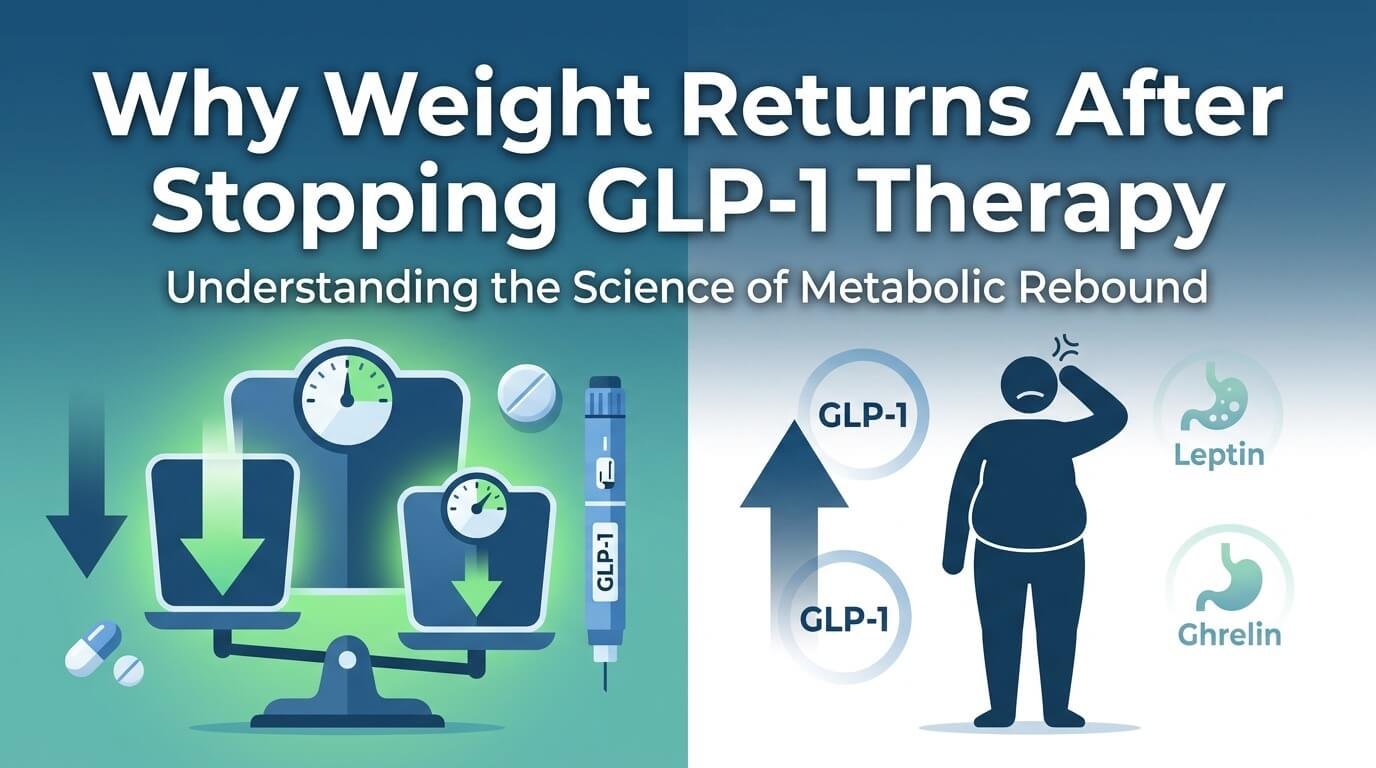
Why Weight Returns After Stopping GLP-1 Therapy. GLP-1 receptor agonists like semaglutide and tirzepatide have transformed obesity treatment by delivering impressive weight loss. However, stopping these therapies often leads to significant weight regain, frustrating patients and clinicians alike.[1][2]
Understanding GLP-1 Agonists
GLP-1 drugs mimic the gut hormone glucagon-like peptide-1, which regulates blood sugar and appetite. They slow gastric emptying, signal fullness to the brain, and boost insulin release while curbing glucagon. In trials like STEP 1, semaglutide users lost 14.9% of body weight over 68 weeks versus 2.4% on placebo.[3][4][5][1]
These medications excel in obesity and type 2 diabetes management, with average losses of 15-25% body weight after a year. Yet, their effects hinge on continuous use, as discontinuation reverses benefits rapidly.[2][6]
The Reality of Weight Regain
Real-world data shows over half of users regain weight within a year of stopping GLP-1s. A meta-analysis of 18 RCTs with 3,771 participants found obesity patients regained 5.63 kg (95% CI: 3.52-7.73) post-discontinuation. In type 2 diabetes, regain averaged 2.03 kg.[7][1]
Key trials confirm this: STEP 1 extension saw two-thirds of lost weight return over a year off semaglutide. SURMOUNT-4 reported over 50% regain after tirzepatide withdrawal. Projections indicate regain plateaus at 75% of lost weight.[4][8][9][2]
Physiological Mechanisms Behind Regain
The body defends its “set point” weight through adaptive responses. Weight loss drops leptin levels, signaling starvation and ramping up hunger via ghrelin surges. GLP-1s suppress these, but stopping restores appetite drive.[5][10][11][12]
Metabolic slowdown occurs too: energy expenditure falls post-loss, amplified without drug support. Delayed gastric emptying normalizes, hastening nutrient absorption and overeating risk. Central nervous system changes revert, diminishing satiety signals.[10][12][1]
Hormonal shifts include rising ghrelin and falling peptide YY, fueling rebound. A 2025 review linked abrupt appetite inhibition loss to hunger surges and fat regain.[11][5]
Evidence from Landmark Trials
STEP Trials (Semaglutide)
STEP 1 showed robust loss, but extension revealed 11.6% regain from nadir over 52 weeks. STEP 4 and 10 echoed this, with liraglutide and semaglutide users regaining substantially.[1][2][4]
SURMOUNT Trials (Tirzepatide)
SURMOUNT-4: After 36 weeks of loss, placebo switch led to near-complete regain over 52 weeks, versus sustained loss on continued drug. Post-hoc analysis confirmed 25%+ regain in most.[8][13]
SCALE and Others (Liraglutide)
SCALE trials noted regain post-3 mg liraglutide, less severe than semaglutide (4.29 kg vs. 8.21 kg). Meta-subgroups highlighted agent differences.[2][1]
| Trial | Drug | Treatment Duration | Regain Amount | Time Post-Stop | Citation |
|——-|——|———————|—————|—————-|———-|
| STEP 1 Extension | Semaglutide 2.4 mg | 68 weeks | ~2/3 of loss (~10%) | 52 weeks | [4] |
| SURMOUNT-4 | Tirzepatide | 36 weeks | >50% of loss | 52 weeks | [8][13] |
| Meta-Analysis (Obesity) | Various GLP-1s | Median 52 weeks | 5.63 kg | Median 21 weeks | [1][7] |
| S-LiTE | Liraglutide 3 mg | 52 weeks | Variable | 52 weeks | [1] |
Longer follow-up (>26 weeks) worsens regain: 7.31 kg vs. 2.51 kg.[1]
Beyond Weight: Metabolic Rebound
Regain isn’t isolated—HbA1c rises 0.25% in obesity, 0.65% in T2D. Waist circumference increases 3.81 cm, BMI 2.34 kg/m², SBP 4.15 mmHg. Lipids worsen slightly (e.g., TG up).[7][1]
These reverse cardiovascular gains, underscoring chronic therapy needs. In T2D, FPG stabilizes but glycemic control deteriorates.[2][1]
Factors Influencing Regain Severity
Semaglutide triggers more regain than liraglutide (8.21 kg vs. 4.29 kg). Longer treatment/follow-up amplifies it. Real-world discontinuation hits 50-65%, due to cost, GI side effects.[1]
Psychological factors like emotional eating compound physiological drives. No strong baseline therapy modifier seen.[11][1]
Strategies to Mitigate Regain
Gradual tapering may ease rebound, though unproven in large RCTs. Lifestyle intensification—diet, exercise—during withdrawal helps, per S-LiTE.[14][11][1]
Combination therapies (e.g., with SGLT2i) or lower maintenance doses show promise. Continued use preserves loss, as SURMOUNT-4 proved. Guidelines urge shared decisions on indefinite therapy.[15][8][2]
For Indian contexts like Gujarat, affordable access and cultural diets challenge adherence; integrate yoga, low-GI foods.[user context implied]
Future Directions and Clinical Implications
Ongoing trials explore tapers, combos, gene predictors. As use grows in gastroenterology/obesity clinics, counsel on lifelong commitment.[15][2]
Regain doesn’t erase all benefits—some residual loss persists—but vigilance is key. For patients at Dwarika Gastro, emphasize monitoring post-stop.[user context][9]
Sources
[1] Over Half Regain Weight After Stopping GLP-1s https://www.medscape.com/viewarticle/over-half-regain-weight-after-stopping-glp-1s-2025a1000vmt
[2] Metabolic rebound after GLP-1 receptor agonist discontinuation https://pmc.ncbi.nlm.nih.gov/articles/PMC12702299/
[3] Semaglutide Treatment Effect in People With Obesity – STEP 1 https://www.acc.org/Latest-in-Cardiology/Clinical-Trials/2021/02/18/19/23/STEP-1
[4] Weight regain and cardiometabolic effects after withdrawal of … – PMC https://pmc.ncbi.nlm.nih.gov/articles/PMC9542252/
[5] Weight Loss and Maintenance Related to the Mechanism of Action … https://pmc.ncbi.nlm.nih.gov/articles/PMC8189979/
[6] Weight Reduction with GLP-1 Agonists and Paths for … – PMC https://pmc.ncbi.nlm.nih.gov/articles/PMC11940170/
[7] Metabolic rebound after GLP-1 receptor agonist … https://pubmed.ncbi.nlm.nih.gov/41399474/
[8] The SURMOUNT-4 Randomized Clinical Trial – PubMed https://pubmed.ncbi.nlm.nih.gov/38078870/
[9] Study Reveals Weight Regain Post GLP-1 Receptor Agonist Treatment https://www.healthday.com/healthpro-news/weight-loss/weight-regain-seen-after-cessation-of-glp-1-receptor-agonists-in-adults-with-overweight-obesity
[10] Why Weight Regain Happens After GLP-1s https://activated.health/why-weight-regain-happens-after-glp-1s-and-how-to-prevent-it/
[11] REBOUND OBESITY AFTER GLP-1 AGONISTS DISCONTINUATION https://www.gjphm.org/index.php/gjphm/article/view/336
[12] A Comprehensive Review on Weight Gain following … – PMC https://pmc.ncbi.nlm.nih.gov/articles/PMC11101251/
[13] A Post Hoc Analysis of the SURMOUNT-4 Trial – PubMed https://pubmed.ncbi.nlm.nih.gov/41284285/
[14] Weight Regain After Liraglutide, Semaglutide or Tirzepatide … https://pmc.ncbi.nlm.nih.gov/articles/PMC12155999/
[15] Weight Maintenance after GLP-1 RA Withdrawal Exposes Critical … https://www.medcentral.com/endocrinology/obesity/weight-maintenance-after-glp-1-ra-withdrawal-exposes-critical-research-gaps
[16] Post metabolic bariatric surgery weight regain: the importance of GLP-1 levels https://www.nature.com/articles/s41366-024-01461-2
[17] Rebound or Retention: A Meta-Analysis of Weight Regain After the … https://pubmed.ncbi.nlm.nih.gov/41116804/
[18] Semaglutide Treatment Effect in People With Obesity – STEP 1 https://www.acc.org/latest-in-cardiology/clinical-trials/2021/02/18/19/23/step-1
[19] Time to weight plateau with tirzepatide treatment in the … – PMC https://pmc.ncbi.nlm.nih.gov/articles/PMC12096058/