

Reading Time: 4 minutes
Malaria Vaccine: Complete Guide: A Breakthrough in Prevention, Schedule, Success Rate.
Malaria remains one of the most significant infectious diseases worldwide, especially in tropical countries. Despite advances in treatment and vector control, it continues to cause substantial morbidity and mortality, particularly among children. The development of a malaria vaccine marks a historic milestone in global public health.
This article provides a comprehensive overview of malaria vaccines, including their types, vaccination schedule, effectiveness (success rate), and current availability in India on occasion of World Malaria Day 2026
Understanding Malaria and the Need for a Vaccine
Malaria is caused by parasites of the genus Plasmodium, transmitted through the bite of infected female Anopheles mosquitoes. Among the species, Plasmodium falciparum is the most dangerous and responsible for severe disease and death.
Traditional prevention strategies include:
- Insecticide-treated bed nets
- Indoor residual spraying
- Antimalarial medications
However, these methods alone have not been sufficient to eliminate malaria. A vaccine provides an additional and powerful preventive tool.
Types of Malaria Vaccines
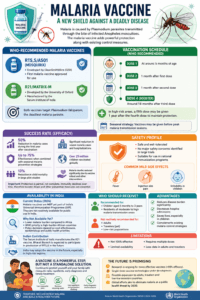
Currently, two malaria vaccines have been recommended by the World Health Organization (WHO):
1. RTS,S/AS01 (Mosquirix)
- Developed by GlaxoSmithKline (GSK)
- First malaria vaccine approved for use
2. R21/Matrix-M
- Developed by the University of Oxford
- Manufactured by the Serum Institute of India
Both vaccines target Plasmodium falciparum, the deadliest malaria parasite.
Vaccination Schedule
The malaria vaccine is primarily designed for children living in malaria-endemic areas, especially in Africa.
Standard Schedule (WHO Recommended)
- Dose 1: At around 5 months of age
- Dose 2: 1 month after first dose
- Dose 3: 1 month after second dose
- Dose 4 (Booster): Around 18 months after the third dose
This is a 4-dose schedule, which is essential for optimal protection.
Optional Fifth Dose
- In high-risk areas, a fifth dose may be given one year after the fourth dose to maintain protection.
Seasonal Strategy
In regions with seasonal malaria transmission, vaccines may be administered before peak transmission seasons to maximize effectiveness.
Success Rate (Efficacy)
The success of malaria vaccines varies depending on the region, transmission intensity, and use of additional preventive measures.
Key Effectiveness Data
- 50% reduction in malaria cases during the first year after vaccination
- Up to 75% effectiveness when combined with seasonal malaria prevention strategies
- 13% reduction in child mortality in large pilot studies
- Significant reduction in:
- Severe malaria cases
- Hospitalizations
Real-World Impact
- Over 25 million children vaccinated globally
- Malaria deaths reduced significantly in recent years due to vaccine rollout and other interventions
Important Considerations
- Protection is partial, not complete
- Immunity declines over time, hence booster doses are essential
- Works best when combined with:
- Mosquito nets
- Antimalarial drugs
- Public health measures
Safety Profile
Both RTS,S and R21 vaccines have been extensively studied and are considered:
- Safe and well-tolerated
- No major safety concerns identified in large trials
- Suitable for use in national immunization programs
Common mild side effects:
- Fever
- Injection site pain
- Irritability in children
Availability in India
Current Status
As of 2026:
- Malaria vaccines are NOT yet part of India’s Universal Immunization Programme (UIP)
- They are not routinely available for public use in India
Why Not Available in India Yet?
- Lower malaria burden compared to Africa
- India has reduced malaria cases significantly in recent years
- WHO Priority
- Initial rollout is focused on high-burden African countries, where malaria deaths are highest
- Policy Decisions
- Vaccine introduction depends on:
- Cost-effectiveness
- Epidemiology
- Public health priorities
- Vaccine introduction depends on:
Indian Contribution
India plays a significant role in malaria vaccine development:
- The Serum Institute of India manufactures the R21 vaccine
- Bharat Biotech is expected to participate in production of RTS,S in the future
This indicates that India may adopt the vaccine in the future, especially in high-risk regions.
Who Should Receive the Malaria Vaccine?
Currently recommended for:
- Children aged 5 months to 3 years
- Residents of moderate to high malaria transmission areas
Not routinely recommended for:
- Adults
- Travelers (yet)
- Low-risk populations
Advantages of Malaria Vaccine
- Reduces disease burden significantly
- Decreases hospital admissions
- Saves lives, especially in children
- Complements existing malaria control strategies
Limitations
- Not 100% effective
- Requires multiple doses
- Limited availability
- Less data in adults and travelers
Future of Malaria Vaccination
The future looks promising with ongoing research:
- Development of more effective vaccines (>90% efficacy)
- Single-dose vaccine technologies under development
- Possible expansion to:
- Adults
- Travelers
- Low-transmission countries
Global efforts aim to eliminate malaria as a public health threat by 2030.

Conclusion
Malaria Vaccine: Complete Guide: A Breakthrough in Prevention, Schedule, Success Rate. The malaria vaccine represents a major scientific breakthrough in infectious disease prevention. With a structured 4-dose schedule and a success rate of up to 50–75%, it offers meaningful protection against one of the world’s deadliest diseases.
While currently limited to African countries, India is actively involved in vaccine production and may introduce it in the future based on public health needs.
However, it is important to remember that the malaria vaccine is not a standalone solution. It must be used alongside traditional preventive measures such as mosquito control, early diagnosis, and timely treatment.
Key Takeaways
- Two WHO-approved vaccines: RTS,S and R21
- 4-dose schedule starting at 5 months
- 50–75% effectiveness depending on use
- Not yet available for routine use in India
- Best used as part of a comprehensive malaria control strategy