

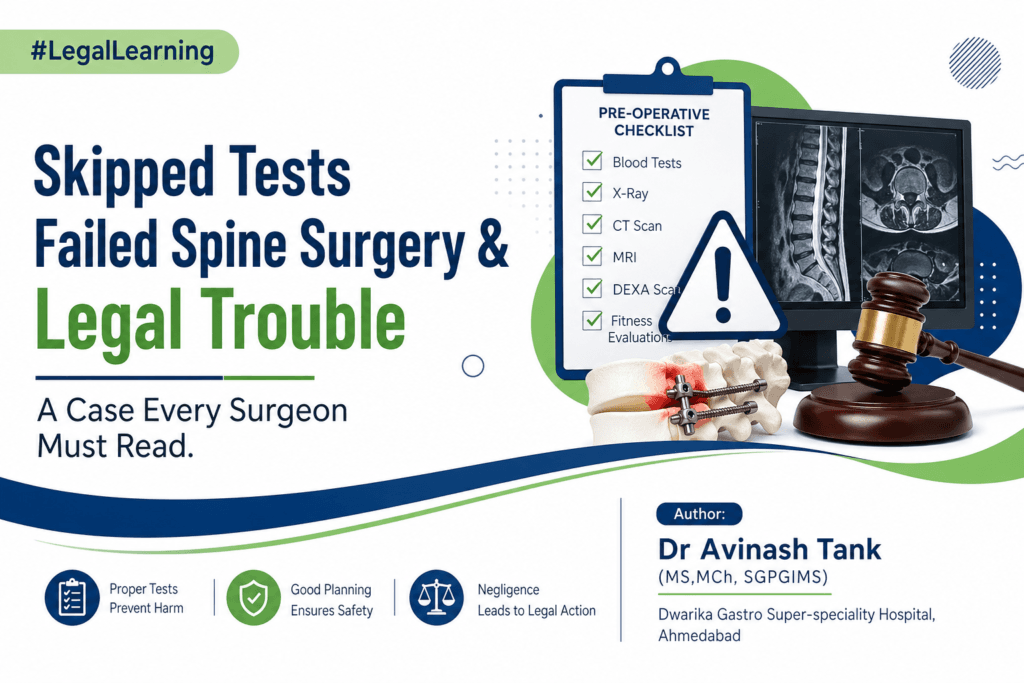
Skipped Tests, Failed Spine Surgery & Legal Trouble: A Case Every Surgeon Must Read. Medical negligence cases are rising across India, not merely due to surgical errors but increasingly due to failure in pre-operative planning and diagnostic evaluation.
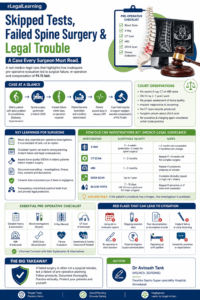
A recent landmark case involving Max Super Speciality Hospital highlights a critical issue: inadequate pre-operative investigations leading to surgical failure and legal liability.
In April 2026, the District Consumer Disputes Redressal Commission, SAS Nagar, Mohali, held a hospital and its neurosurgeon liable for negligence, awarding compensation of ₹4.75 lakh to the patient’s family.
The case revolved around a spine surgery performed without proper diagnostic workup, resulting in deterioration of the patient’s condition and eventual death.
This case is not just a legal event—it is a clinical warning for surgeons, physicians, and hospital administrators.
Case Summary: What Exactly Happened?
Patient Profile
- Elderly patient ( 74 years)
- Known comorbidities: diabetes, hypertension
- Diagnosed with degenerative lumbar spine disease (LCS with listhesis)
Timeline of Events
- Patient admitted in March 2020
- Underwent spinal surgery involving implants (rods and screws)
- Multiple admissions within 19 days
- Required re-operation due to implant failure
- Became bedridden post-surgery
- Eventually died in January 2021
Allegations by Family
- No proper pre-operative diagnostic tests (X-ray, CT, MRI, DEXA)
- Surgery done without assessing fitness
- Old imaging (more than 1 year old) used
- Re-operation charged separately (unfair trade practice)
Defense by Hospital
- Surgery aimed at improving quality of life
- No guarantee of outcome
- Consent was taken
- No expert opinion presented by complainant
Key Court Observations
The Commission made several critical observations:
- Surgery performed without proper assessment of bone quality
- Implants became malpositioned within days
- No recent imaging done before surgery
- Old X-ray (>1 year old) used
- No CT scan records produced
- Surgeon unsure if DEXA scan was done
Court Conclusion
The court held that:
- Failure to perform essential diagnostic tests = breach of duty of care
- Re-operation due to failed primary surgery = deficiency in service
- Charging again = unfair trade practice
Compensation awarded:
- ₹3.25 lakh + interest
- ₹1 lakh compensation
- ₹50,000 litigation cost
Root Cause Analysis: Where Did It Go Wrong?
1. Lack of Pre-Operative Evaluation
The biggest failure was inadequate pre-operative workup, especially in a high-risk elderly patient.
Missing Components:
- Updated X-ray
- CT scan
- MRI
- Bone density assessment (DEXA)
This directly led to:
- Improper implant placement
- Screw loosening
- Re-surgery
2. Use of Outdated Imaging
The court strongly criticized the use of:
- X-ray more than 1 year old
Clinical Reality:
Using outdated imaging in spine surgery is dangerous because:
- Disease progression is dynamic
- Bone density changes
- Alignment may worsen
- Neurological compression may increase
3. Failure to Assess Surgical Fitness
Despite comorbidities:
- Diabetes
- Hypertension
- Advanced age
No proper risk stratification was documented.
4. Technical Failure of Surgery
Evidence showed:
- Screw loosening
- Rod displacement
- Bone chipping
These indicate:
- Poor planning
- Inadequate anchorage (possibly due to osteoporosis)
5. Re-operation & Financial Ethics
Charging for repeat surgery due to initial failure was considered:
- Unfair trade practice
- Ethically questionable
Medico-Legal Principles Highlighted
1. Duty of Care
Doctors must:
- Perform adequate diagnostic tests
- Assess patient suitability
- Plan surgery scientifically
Failure = negligence
2. Standard of Care
Courts evaluate:
“What a reasonable doctor would do in similar circumstances”
In this case:
- Standard protocols were not followed
3. No Need for Expert Opinion
The court reiterated:
- Not all negligence cases require expert opinion
- Obvious lapses (like missing tests) are self-evident
Critical Learning for Surgeons
1. Never Skip Basic Investigations
Mandatory Pre-Operative Tests, must cover two aspects: One, for proper diagnosis or staging (in case of cancer); Two, for proper fitness before surgery (cardio-pulmonary assessment and optimisation of existing medical diseases like Diabetes, Thyroid, Epilepsy etc)
Blood Tests
- CBC
- LFT, RFT
- Blood sugar (FBS, PPBS, HbA1c)
- Coagulation profile
- Infection markers
Imaging
- X-ray (recent)
- CT scan (bony anatomy)
- MRI (neural structures)
- DEXA scan (bone density)
2. How Old Can Diagnostic Tests Be? (Medico-Legal Perspective)
This is one of the most important takeaways.
X-ray
- Acceptable: Within 4–6 weeks
- Spine cases: preferably <2 weeks
- Not acceptable: >3 months (unless stable condition)
CT Scan
- Acceptable: Within 1–2 months
- Complex surgery: repeat if >4 weeks old
MRI
- Acceptable: Within 1–3 months
- Neurological symptoms progression → repeat immediately
DEXA Scan
- Acceptable: up to 1 year
- BUT:
- Must be correlated clinically
- In elderly → repeat if surgery planned
Blood Tests
- Acceptable: within 7–10 days
- For major surgery: within 48–72 hours preferred
Golden Rule:
“If the patient’s condition has changed, the investigation is outdated—irrespective of time.”
3. Special Considerations in Elderly Patients
High-Risk Factors
- Osteoporosis
- Poor healing capacity
- Comorbidities
Mandatory Add-ons
- Bone density assessment
- Cardiac clearance
- Anesthesia fitness
- Functional status evaluation
4. Documentation is Your Legal Shield
Always document:
- Pre-operative investigations
- Risk explanation
- Consent details
- Alternative treatment options
Consent Alone Does NOT Protect You
Even if consent is taken:
- Negligence cannot be justified
- Courts prioritize standard care over consent
5. Surgical Planning Matters
Before implant surgery:
- Assess bone quality
- Choose correct implant size
- Plan fixation strategy
Failure leads to:
- Implant loosening
- Litigation
6. Avoid Defensive Surgery
Do not operate if:
- Patient is unfit
- Investigations incomplete
- Benefit unclear
7. Re-Operation: Ethical & Legal Aspects
If re-operation required:
- Explain cause clearly
- Avoid financial exploitation
- Document transparency
Broader Impact on Healthcare System
Rising Medical Negligence Cases
Cases like this highlight:
- Increasing patient awareness
- Legal accountability
- Need for protocol-based practice
Shift Toward Evidence-Based Surgery
Courts now expect:
- Scientific justification
- Proper documentation
- Standard protocols
Checklist for Surgeons Before Surgery
Pre-Operative Checklist
Clinical
- Diagnosis confirmed
- Comorbidities optimized
Investigations
- Recent imaging available
- Blood tests updated
- Fitness clearance done
Legal
- Informed consent taken
- Risks explained
- Documentation complete
Red Flags That Can Lead to Litigation
- Using old reports
- Skipping imaging
- Poor documentation
- Early implant failure
- Multiple surgeries in short duration
- Financial disputes
Practical Protocol for Safe Surgical Practice
Step 1: Re-evaluate Patient
- Clinical + radiological correlation
Step 2: Update Investigations
- Never rely on outdated reports
Step 3: Multidisciplinary Clearance
- Physician + anesthetist
Step 4: Risk Stratification
- ASA grading
Step 5: Informed Consent
- Realistic expectations
Lessons for Hospitals
- Implement pre-surgical audit system
- Mandatory checklist before OT
- Digital record keeping
- Peer review for high-risk surgeries
Final Thoughts
The case against Max Super Speciality Hospital is not just about one surgeon—it is a system failure in pre-operative care.
The most powerful takeaway:
“A failed surgery is often not an intraoperative mistake—it is a preoperative planning failure.”
Key Takeaways for Surgeons
- Never operate without updated investigations
- Old reports = legal risk
- Elderly patients need extra evaluation
- Consent does not replace standard care
- Documentation is your strongest defense
Conclusion
Skipped Tests Failed Spine Surgery & Legal Trouble A Case Every Surgeon Must Read.. Modern surgery is no longer judged only by technical skill but by:
- Decision-making
- Pre-operative planning
- Documentation
- Ethical practice
This case reinforces a simple but critical truth:
“The safest surgery is the one that is planned thoroughly.”

Super-specialist GI, bariatric & cancer surgeon. SGPGIMS (India's premier GI centre) + advanced training in Japan & South Korea. Read full profile →
Last reviewed: July 2026




Comments
Be the first to share your thoughts on this article.