

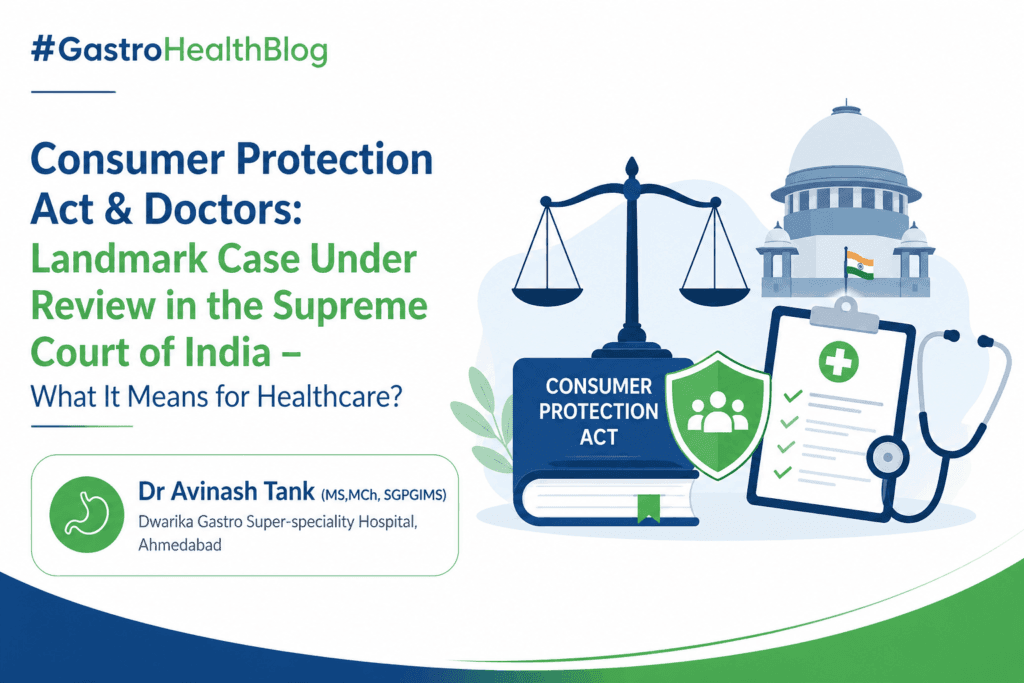
Consumer Protection Act & Doctors: Landmark Case Under Review in the Supreme Court of India – What It Means for Healthcare
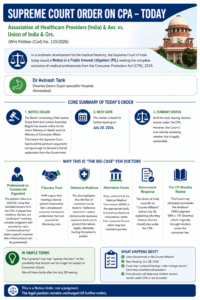
The recent development in the Supreme Court of India has sparked intense discussion across the healthcare and legal communities. In the case titled Association of Healthcare Providers (India) & Anr. vs Union of India & Ors. (Writ Petition No. 110/2026), the Court has issued a notice in response to a Public Interest Litigation (PIL) seeking the complete exclusion of medical professionals from the Consumer Protection Act, 2019.
This is not a final judgment—but it is undeniably a significant legal moment that could reshape the doctor-patient relationship in India.
What Exactly Happened?
A bench led by the Chief Justice, along with Justice Joymalya Bagchi, has issued notice to:
- Ministry of Health and Family Welfare
- Ministry of Consumer Affairs
This means the Court found the petition substantial enough to seek a formal response from the Government.
Next Hearing Date: July 28, 2026
Current Status:
Doctors continue to fall under the Consumer Protection Act—no immediate change has been made.
Background: How Did Doctors Come Under Consumer Law?
The inclusion of medical professionals under consumer law dates back to the landmark case:
Indian Medical Association vs V. P. Shantha
In this historic ruling, the Supreme Court held that:
- Medical services fall under “services” as defined in consumer law
- Patients are “consumers”
- Doctors and hospitals can be sued for deficiency in service
This judgment fundamentally changed medical accountability in India.
What Is the Current Petition Arguing?
The petition by healthcare providers presents several key arguments:
1. 🧠 Medicine Is Not a Commercial Service
The petition claims that:
- Medicine is a profession, not a business
- Outcomes cannot be guaranteed like products
- Clinical decisions involve uncertainty and judgment
This challenges the applicability of consumer law, which is traditionally suited for goods and predictable services.
2. 🤝 Doctor-Patient Relationship Is Built on Trust
Unlike a buyer-seller relationship:
- Medical care involves fiduciary responsibility
- Trust is essential for treatment success
Treating this relationship as transactional may erode confidence on both sides.
3. 🛡️ Rise of Defensive Medicine
One of the most important concerns raised:
- Doctors may order unnecessary investigations
- Treatment decisions may become legally driven rather than clinically driven
- Healthcare costs increase significantly
This phenomenon—called defensive medicine—ultimately harms patients financially and sometimes medically.
4. 🏛️ Alternative Mechanism Already Exists
The petition suggests that professional misconduct should be handled by:
👉 National Medical Commission
- NMC has domain expertise
- It is better equipped to evaluate medical negligence
- Consumer courts may lack clinical understanding
5. 📢 Demand for Reconsideration of 1995 Judgment
The Court may revisit the foundational ruling in:
👉 Indian Medical Association vs V. P. Shantha
If reconsidered, this could reverse decades of legal precedent.
Important Clarification: This Is NOT a Final Judgment
It’s crucial to understand:
- This is a notice order, not a decision
- No law has been changed yet
- Doctors are still legally accountable under consumer courts
However, the fact that the Court has entertained the petition signals judicial openness to reconsider the issue.
Why This Case Matters So Much
For Doctors
- Could reduce legal pressure and litigation stress
- May improve clinical decision-making freedom
- Potential decline in defensive medicine practices
But:
- Could also raise concerns about reduced accountability
For Patients
- Consumer courts provide accessible and affordable justice
- Exclusion may force patients to:
- Approach civil courts (time-consuming)
- Rely solely on medical councils
This raises concerns about patient rights and protection.
For Hospitals & Healthcare System
- May impact:
- Insurance policies
- Risk management systems
- Hospital protocols
A shift could redefine legal liability structures across the healthcare ecosystem.
The Core Legal Debate
At its heart, this case raises a fundamental question:
Should healthcare be treated as a service under consumer law—or as a specialized professional domain requiring separate legal treatment?
This debate balances two critical principles:
| Patient Protection | Professional Autonomy |
| Right to compensation | Freedom in clinical decisions |
| Accountability | Reduced legal fear |
| Consumer rights | Medical expertise |
What Happens Next?
Before the next hearing:
- The Government will file a Counter-Affidavit
- The Court may:
- Continue hearings
- Refer the matter to a larger constitutional bench
- Examine whether the current legal framework is sustainable
Possible Outcomes
Scenario 1: No Change
- Doctors remain under the Consumer Protection Act
- Status quo continues
Scenario 2: Partial Reform
- Special guidelines for medical cases in consumer courts
- Expert panels integrated into legal proceedings
Scenario 3: Complete Exclusion
- Medical negligence handled only by:
- Civil courts
- Medical regulatory bodies
This would be a major legal shift.
In Simple Terms
The Supreme Court has opened the door to reconsider whether doctors should be treated like service providers under consumer law.
But as of now:
Nothing has changed legally.
💬 Expert Perspective
From a healthcare standpoint, a balanced approach may be ideal:
- Maintain patient rights and access to justice
- Introduce medical expertise in legal evaluation
- Prevent misuse of litigation
- Reduce unnecessary defensive practices
🏁 Conclusion
Consumer Protection Act & Doctors. This case is not just about doctors or courts—it is about the future of healthcare delivery in India.
The final verdict—whenever it comes—will influence:
- How doctors practice
- How patients seek justice
- How healthcare systems function
For now, all eyes remain on the next hearing in July 2026.
📢 Call to Action
If you are a healthcare professional or patient:
- Stay updated with legal developments
- Understand your rights and responsibilities
- Seek expert advice when needed
Author:
Dr. Avinash Tank (MS, MCh, SGPGIMS)
Dwarika Gastro Super-speciality Hospital, Ahmedabad
Was this article helpful?

Super-specialist GI, bariatric & cancer surgeon. SGPGIMS (India's premier GI centre) + advanced training in Japan & South Korea. Read full profile →
Last reviewed: July 2026



Comments
Be the first to share your thoughts on this article.