

Reading Time: 6 minutes
Dalchini (Cinnamon): Complete Guide of Health Benefits, Uses, Nutrition, Side Effects & Scientific Evidence
Quick Facts
- Cinnamon (Dalchini) is a traditional spice rich in antioxidants and bioactive compounds such as cinnamaldehyde that may support metabolic and overall health.
- Common uses include flavoring foods and beverages, supporting digestion, and as a complementary aid for blood sugar management and weight-control strategies.
- Research suggests cinnamon may help improve insulin sensitivity, support heart health, reduce inflammation, and assist glucose regulation.
- For most healthy adults, a commonly recommended intake is about 1–3 grams (approximately ½–1 teaspoon) per day.
- Ceylon cinnamon (Cinnamomum zeylanicum) is generally preferred for regular use because it contains much lower levels of coumarin than Cassia cinnamon.
- Excessive intake may cause digestive irritation, allergic reactions, medication interactions, or liver-related concerns from high coumarin exposure, especially with Cassia cinnamon.
Introduction
Dalchini, commonly known as cinnamon, is one of the world’s oldest and most valued spices. It is obtained from the inner bark of trees belonging to the genus Cinnamomum. For thousands of years, cinnamon has been used in cooking, traditional medicine, religious ceremonies, and food preservation.
Among the different species, Cinnamomum zeylanicum (True Cinnamon or Ceylon Cinnamon) is often considered superior. It has a delicate flavor, contains less coumarin, and offers a better safety profile than many other varieties.
Ceylon vs Cassia Cinnamon
| Feature | Ceylon Cinnamon (Cinnamomum zeylanicum) | Cassia Cinnamon (Cinnamomum cassia and related species) |
| Coumarin Content | Very low | Significantly higher |
| Safety Profile | Generally preferred for regular, long-term use due to lower coumarin exposure | Excessive long-term intake may increase the risk of coumarin-related liver concerns |
| Taste | Mild, sweet, delicate, and slightly citrus-like | Stronger, spicier, and more pungent flavor |
| Recommended Usage | Suitable for frequent culinary use and daily consumption within recommended amounts | Best used in moderation, especially when consumed regularly or in supplement form |
In Ayurveda, Dalchini is classified as a warming spice. It is believed to balance Vata and Kapha doshas while supporting digestion and metabolism.
Today, cinnamon is widely studied for its potential role in diabetes, obesity, heart disease, fatty liver disease, polycystic ovary syndrome (PCOS), and chronic inflammation.
Amazing Facts About Dalchini
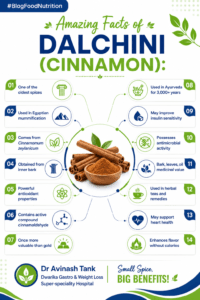
15 Interesting Facts
- Cinnamon is one of the oldest spices known to mankind.
- Ancient Egyptians used cinnamon during mummification.
- True cinnamon comes from Cinnamomum zeylanicum.
- The spice is obtained from the tree’s inner bark.
- Cinnamon has powerful antioxidant properties.
- It contains the active compound cinnamaldehyde.
- Cinnamon was once considered more valuable than gold.
- Ayurveda has used cinnamon for over 3,000 years.
- It may help improve insulin sensitivity.
- Cinnamon possesses antimicrobial activity.
- The bark, leaves, and essential oil all have medicinal value.
- It is widely used in herbal teas and traditional remedies.
- Cinnamon may support heart health.
- It can enhance flavor without adding calories.
- Research continues to explore its role in metabolic diseases.
Why Cinnamon Was Once More Valuable Than Gold
Historically, cinnamon was one of the most expensive commodities traded between Asia, the Middle East, and Europe. Traders kept its source secret, which increased its rarity and value.
In ancient times, cinnamon was presented to kings, emperors, and religious institutions as a luxury gift. Wealthy families often stored it alongside precious metals and jewels.
Hidden Health Benefits
In addition to its pleasant aroma and flavor, cinnamon contains several bioactive compounds that may:
- Improve glucose metabolism
- Reduce oxidative stress
- Support digestive health
- Enhance insulin sensitivity
- Inhibit microbial growth
- Reduce chronic inflammation
- Support cardiovascular health
These properties make cinnamon much more than a simple kitchen spice.
Cinnamon Overview
Common Names in Indian Languages
| Language | Name |
| Hindi | Dalchini |
| Gujarati | Taj |
| Marathi | Dalchini |
| Bengali | Daruchini |
| Tamil | Lavangapattai |
| Telugu | Dalchinachekka |
| Kannada | Lavangada Chakke |
| Malayalam | Karuva |
| Sanskrit | Tvak |
Major Cinnamon-Growing States in India
Although India imports significant quantities of cinnamon, it is also cultivated in several states, including:
- Kerala
- Tamil Nadu
- Karnataka
- Andhra Pradesh
- Odisha
- Northeastern states
The warm and humid climate of southern India is particularly suitable for cinnamon cultivation.
Harvesting and Processing
Cinnamon is obtained from the inner bark of young shoots.
Harvesting Steps
- Mature stems are cut.
- The outer bark is removed.
- The inner bark is carefully peeled.
- Bark strips are dried.
- Drying causes the strips to curl into quills.
- The quills are graded and packaged.
Because this process requires considerable labor, it contributes to cinnamon’s value.
Chemical Composition
Key Active Compounds
Cinnamon contains many biologically active compounds, including:
- Cinnamaldehyde
- Eugenol
- Cinnamic acid
- Coumarin (very low in true cinnamon)
- Polyphenols
- Catechins
- Proanthocyanidins
- Flavonoids
- Essential oils
Together, these compounds contribute to cinnamon’s medicinal properties.
Role of Cinnamaldehyde
Cinnamaldehyde is the main active compound responsible for cinnamon’s characteristic aroma and many of its biological effects.
Research suggests that cinnamaldehyde may:
- Improve insulin sensitivity
- Reduce inflammation
- Act as an antioxidant
- Inhibit harmful bacteria
- Support cardiovascular function
Many of cinnamon’s potential therapeutic benefits are linked to this compound.
Other Bioactive Components
The bark contains several beneficial phytochemicals.
Polyphenols
These are potent antioxidants that help combat oxidative stress.
Flavonoids
They help protect cells from damage.
Tannins
These compounds possess antimicrobial and anti-inflammatory properties.
Essential Oils
Essential oils provide cinnamon’s aroma and contribute to its medicinal effects.
Nutritional Value
Nutrition Per 100 Grams
Approximate values:
- Calories: 247 kcal
- Carbohydrates: 81 g
- Fiber: 53 g
- Protein: 4 g
- Fat: 1.2 g
- Calcium: 1000 mg
- Iron: 8 mg
- Magnesium: 60 mg
- Potassium: 431 mg
Because cinnamon is usually consumed in small amounts, the actual nutrient intake per serving is much lower.
Vitamins, Minerals and Antioxidants
Cinnamon contains several important nutrients.
Vitamins
- Vitamin A
- Vitamin K
- Small amounts of B vitamins
Minerals
- Calcium
- Iron
- Magnesium
- Potassium
- Manganese
Antioxidants
- Polyphenols
- Flavonoids
- Proanthocyanidins
These antioxidants help neutralize free radicals and protect cells from oxidative damage.
Is Cinnamon Nutrient-Dense?
Yes. Cinnamon is considered nutrient-dense because it provides substantial amounts of antioxidants, minerals, and phytochemicals relative to the quantity consumed.
However, its primary health value comes from its bioactive compounds rather than its calorie or macronutrient content.
Health Benefits
Cinnamon and Type 2 Diabetes
One of the most researched uses of cinnamon is blood glucose management.
Several clinical studies suggest that cinnamon may:
- Improve insulin sensitivity
- Reduce fasting blood glucose
- Improve glucose utilization
- Reduce post-meal blood sugar spikes
Despite these findings, cinnamon should not replace prescribed diabetes medications.
Can Cinnamon Reduce HbA1c?
Some studies have reported modest reductions in HbA1c among people with Type 2 Diabetes.
HbA1c reflects average blood glucose levels over approximately three months. Any improvements are generally modest and may vary between individuals.
Cinnamon appears to work best when combined with:
- A healthy diet
- Regular exercise
- Weight management
- Appropriate medical treatment
Benefits for Weight Management
Cinnamon may support weight-management efforts by:
- Improving insulin sensitivity
- Reducing cravings
- Enhancing satiety
- Stabilizing blood sugar
- Supporting metabolic health
Although it is not a miracle weight-loss ingredient, it can be a useful addition to a balanced dietary strategy.
Safety and Side Effects
Medical Disclaimer
The information provided in this article is intended for educational and informational purposes only. It should not be considered medical advice, diagnosis, or treatment. Cinnamon should never be used as a substitute for professional healthcare, prescribed medications, or personalized medical guidance.
Recommended Daily Intake
For most healthy adults, culinary use of cinnamon is generally considered safe. A commonly used intake range is about 1–3 grams (approximately ½–1 teaspoon) per day.
Higher supplemental doses have been used in research studies. However, long-term safety may vary depending on the type of cinnamon and an individual’s health status.
Ceylon cinnamon (Cinnamomum zeylanicum) is generally preferred for regular use because it contains much lower levels of coumarin than Cassia cinnamon.
Potential Side Effects
Cinnamon is usually well tolerated when consumed in moderate amounts. However, excessive intake may cause:
- Mouth or throat irritation
- Digestive discomfort
- Allergic reactions in sensitive individuals
- Skin irritation from topical exposure to cinnamon oil
- Potential interactions with medications affecting blood sugar, blood clotting, or liver function
People with liver disease, bleeding disorders, or known cinnamon allergies should use extra caution.
Coumarin Toxicity and Cassia Cinnamon
Cassia cinnamon, which is commonly sold in many markets, contains significantly higher levels of coumarin than Ceylon cinnamon.
Excessive coumarin intake over time may increase the risk of:
- Liver toxicity
- Elevated liver enzymes
- Liver injury in susceptible individuals
For this reason, frequent high-dose consumption of Cassia cinnamon supplements is generally not recommended. Choosing Ceylon cinnamon may help reduce coumarin exposure while still providing cinnamon’s characteristic flavor and potential health benefits.
When to Consult a Healthcare Professional
Anyone considering cinnamon for therapeutic purposes—such as blood sugar management, weight loss, PCOS, cardiovascular health, or other medical conditions—should consult a qualified healthcare professional before use.
Medical supervision is especially important for:
- People with diabetes taking glucose-lowering medications
- Pregnant or breastfeeding women
- Individuals with liver disease
- People taking anticoagulants or other prescription medications
- Children and older adults with chronic health conditions
Professional guidance can help ensure safe use and reduce the risk of adverse effects or drug interactions.
Scientific References
- Khan A, Safdar M, Ali Khan MM, Khattak KN, Anderson RA. Cinnamon improves glucose and lipids of people with type 2 diabetes. Diabetes Care. 2003;26(12):3215–3218. doi:10.2337/diacare.26.12.3215.
- Allen RW, Schwartzman E, Baker WL, Coleman CI, Phung OJ. Cinnamon use in type 2 diabetes: an updated systematic review and meta-analysis. Annals of Family Medicine. 2013;11(5):452–459. doi:10.1370/afm.1517.
- Leach MJ, Kumar S. Cinnamon for diabetes mellitus. Cochrane Database of Systematic Reviews. 2012;(9). doi:10.1002/14651858.CD007170.pub2.
- Akilen R, Tsiami A, Devendra D, Robinson N. Glycated haemoglobin and blood pressure-lowering effect of cinnamon in multi-ethnic Type 2 diabetic patients in the UK: a randomized, placebo-controlled, double-blind clinical trial. Diabetic Medicine. 2010;27(10):1159–1167. doi:10.1111/j.1464-5491.2010.03079.x.
- Ranasinghe P, Pigera S, Premakumara GAS, Galappaththy P, Constantine GR, Katulanda P. Medicinal properties of ‘true’ cinnamon (Cinnamomum zeylanicum): a systematic review. BMC Complementary and Alternative Medicine. 2013;13:275. doi:10.1186/1472-6882-13-275.
- Namazi N, Khodamoradi K, Khamechi SP, et al. The impact of cinnamon supplementation on anthropometric indices and body composition: a systematic review and meta-analysis of randomized controlled trials. Complementary Therapies in Medicine. 2019;43:92–101. doi:10.1016/j.ctim.2019.01.022.
- Haghighatdoost F, Hariri M. Effect of cinnamon supplementation on blood glucose and lipid levels in type 2 diabetic patients: a systematic review and meta-analysis of clinical trials. Nutrition. 2019;57:167–174. doi:10.1016/j.nut.2018.06.002.
- Abraham K, Wöhrlin F, Lindtner O, Heinemeyer G, Lampen A. Toxicology and risk assessment of coumarin: focus on human data. Molecular Nutrition & Food Research. 2010;54(2):228–239. doi:10.1002/mnfr.200900281. This review highlights potential safety concerns associated with excessive coumarin intake, particularly from Cassia cinnamon, underscoring the importance of moderation and the lower-coumarin profile of Ceylon cinnamon.