

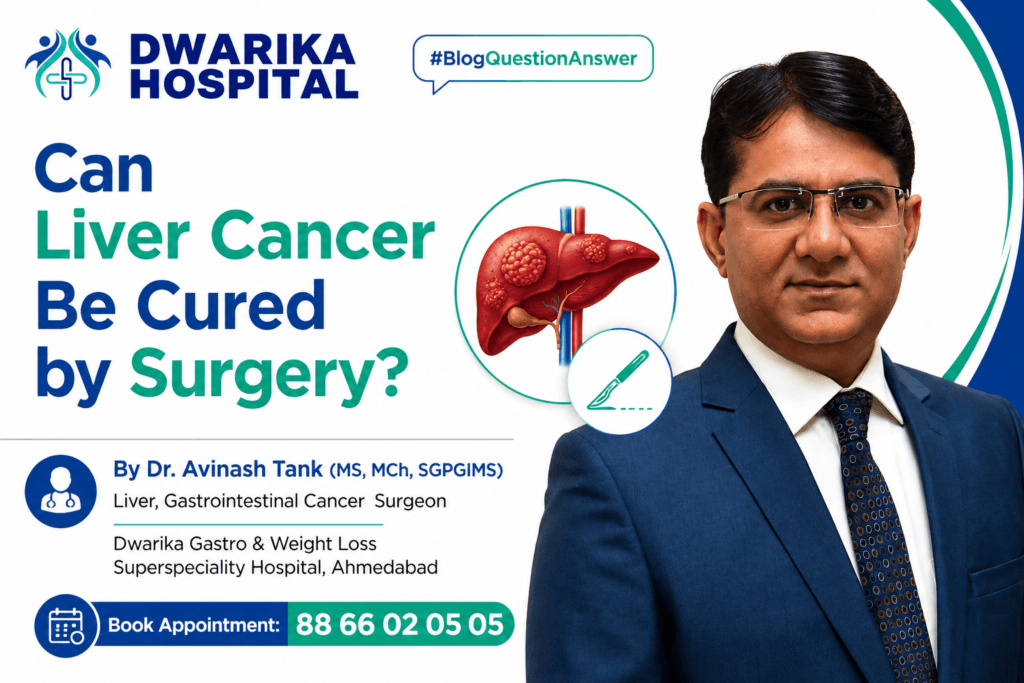
Can Liver Cancer Be Cured by Surgery?
Yes, liver cancer can be cured by surgery, particularly when it is diagnosed at an early stage and the tumour can be completely removed while preserving enough healthy liver tissue.
Surgery is considered one of the most effective treatment options for selected patients with liver cancer. However, not every patient is a candidate for surgery.
The likelihood of long-term disease control depends on factors such as tumour size, number of tumours, tumour location, liver function, presence of cirrhosis, and whether the cancer has spread outside the liver.
In carefully selected patients, liver resection or liver transplantation may provide the best opportunity for long-term survival.
Early diagnosis and evaluation by a specialist team are important because treatment options are often greatest when liver cancer is detected before symptoms become severe.
Why Patients Ask This Question
A diagnosis of liver cancer can be overwhelming. One of the first questions many patients and families ask is:
“Can this be cured?”
This question is understandable because liver cancer is often perceived as an aggressive disease.
Many people assume that all cancers are incurable or that treatment can only prolong life. Others may have heard stories of patients doing well after surgery and wonder whether the same outcome is possible for them.
Understanding whether surgery can cure liver cancer helps patients:
- Make informed treatment decisions
- Understand realistic expectations
- Seek specialist evaluation early
- Explore all available treatment options
- Reduce anxiety caused by uncertainty
The good news is that for some patients, surgery may offer the possibility of long-term survival and even cure.
The Short Answer
In selected patients diagnosed at an early stage, surgery may offer the best chance for long-term disease control and, in some cases, cure.
However, eligibility depends on:
- Tumour size
- Number of tumours
- Tumour location
- Liver function
- Presence of cirrhosis
- Overall health
- Whether cancer has spread
When the cancer is confined to the liver and can be completely removed, surgery often becomes the preferred treatment approach.
Understanding the Background
What Is Liver Cancer?
Liver cancer occurs when abnormal cells within the liver grow uncontrollably and form a tumour. The most common type is Hepatocellular Carcinoma (HCC), which accounts for most primary liver cancers.
Why Stage Matters
Not all liver cancers are the same.
A small tumour confined to one part of the liver behaves very differently from a cancer that has invaded blood vessels or spread to other organs.
Generally:
| Stage | Possibility of Curative Treatment |
| Early Stage | Often possible |
| Intermediate Stage | Sometimes possible |
| Advanced Stage | Less likely |
| Metastatic Stage | Usually not curative |
Why Liver Function Matters
Unlike many other cancers, treatment decisions in liver cancer depend not only on the tumour but also on the condition of the liver itself.
Many patients with liver cancer also have:
- Cirrhosis
- Chronic hepatitis B
- Chronic hepatitis C
- Fatty liver disease
Even if a tumour can technically be removed, surgery may not be safe if the remaining liver cannot function adequately.
Detailed Answer
When Surgery Can Cure Liver Cancer
Surgery may offer the greatest chance of cure when:
The Cancer Is Found Early
Smaller tumours are often easier to remove completely.
The Tumour Is Localized
Cancer confined to the liver is more likely to be treated successfully.
Liver Function Is Preserved
Patients with healthy liver function generally tolerate surgery better.
Complete Removal Is Possible
The goal is to remove all visible cancer while preserving sufficient healthy liver tissue.
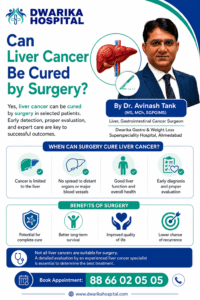
Types of Curative Surgery
Liver Resection
Part of the liver containing the tumour is removed.
This may be considered when:
- The tumour is localized
- Liver function is adequate
- No significant spread exists
Liver Transplantation
In selected patients, liver transplantation removes both:
- The cancer
- The diseased liver
This can be particularly beneficial for patients with cirrhosis and small liver cancers meeting specific criteria.
When Surgery May Not Be Possible
Surgery may not be recommended if:
- Cancer has spread outside the liver
- Multiple tumours occupy large portions of the liver
- Severe liver dysfunction is present
- Major blood vessels are extensively involved
- Serious medical conditions increase surgical risk
In these situations, other treatments may be considered.
Factors That Influence Surgical Success
Tumour Size
Smaller tumours generally have better outcomes.
Number of Tumours
Single tumours often have more favourable outcomes than multiple tumours.
Blood Vessel Involvement
Invasion into major vessels may reduce the likelihood of cure.
Surgical Margins
Removing the entire tumour with adequate margins improves outcomes.
Liver Health
Patients with good liver function often recover better.
Can Liver Cancer Return After Surgery?
Yes.
Even after successful surgery, liver cancer can recur.
Recurrence may occur because:
- Microscopic cancer cells remain undetected
- Underlying liver disease persists
- New cancers develop in damaged liver tissue
This is why regular follow-up is important.
What Happens After Surgery?
Most patients require:
- Imaging surveillance
- Blood tests
- Liver function monitoring
- Specialist follow-up
Early detection of recurrence may allow additional treatment options.
What Current Evidence Shows
Current international guidelines support surgery as a potentially curative treatment for selected patients with liver cancer.
Clinical studies consistently show that:
- Early-stage liver cancers have the best outcomes
- Complete tumour removal improves survival
- Liver transplantation offers excellent outcomes in carefully selected patients
- Multidisciplinary evaluation improves treatment planning
Modern advances in imaging, surgical techniques, liver assessment and perioperative care have expanded treatment options for many patients.
The overall scientific consensus is clear:
For appropriately selected patients, surgery remains one of the most effective treatments for liver cancer.
Common Myths and Facts
Myth 1
Liver cancer is always incurable.
Fact
Some early-stage liver cancers can be successfully treated with surgery.
Myth 2
If liver cancer is diagnosed, surgery is automatically required.
Fact
Treatment depends on tumour characteristics and liver function.
Myth 3
Older patients cannot undergo liver surgery.
Fact
Biological fitness often matters more than chronological age.
Myth 4
Removing part of the liver is impossible.
Fact
The liver has remarkable regenerative capacity.
Myth 5
If cancer returns after surgery, no treatment options remain.
Fact
Additional treatments may still be available.
Dr Avinash Tank’s Perspective
One of the most important lessons in liver cancer care is that timing matters. Patients diagnosed early often have more treatment options available.
Unfortunately, liver cancer may remain silent for long periods, which is why surveillance is so important in individuals with cirrhosis, hepatitis B, hepatitis C and other high-risk conditions.
When evaluating a patient for surgery, we consider not only the tumour but also the overall health of the liver.
The goal is to achieve effective cancer treatment while maintaining adequate liver function. Every patient is unique, and treatment decisions should ideally be made through a multidisciplinary approach involving surgeons, gastroenterologists, radiologists and oncologists.
Patients with newly diagnosed liver cancer should seek specialist assessment early because timely evaluation can significantly influence available treatment options.
Key Takeaways
✓ Liver cancer can sometimes be cured by surgery.
✓ Early diagnosis improves treatment options.
✓ Surgery is most effective when cancer remains confined to the liver.
✓ Liver function is a critical factor in treatment planning.
✓ Liver resection and transplantation are potential curative treatments.
✓ Not all patients are candidates for surgery.
✓ Regular surveillance remains important after treatment.
✓ Multidisciplinary evaluation helps optimize outcomes.
✓ Recurrence is possible, making follow-up essential.
✓ Specialist assessment should not be delayed.
Related Resources
Disease Hub
Liver Cancer Knowledge Hub
Service Page
Liver Cancer Surgery
Related Articles
- What Are the First Signs of Liver Cancer?
- Can Liver Cancer Be Detected in a Blood Test?
- What Is the Survival Rate for Liver Cancer?
Frequently Asked Questions
Can stage 1 liver cancer be cured?
Many patients with stage 1 liver cancer may be candidates for potentially curative treatment, including surgery.
Is liver surgery dangerous?
Like all major operations, liver surgery carries risks, but advances in surgical care have improved safety significantly.
How much of the liver can be removed?
The amount depends on tumour location and liver function. The liver can regenerate to some extent after surgery.
Does liver cancer always return after surgery?
No. Some patients remain cancer-free long term, although surveillance remains important.
Is liver transplantation better than liver resection?
The answer depends on individual circumstances, tumour characteristics and liver health.
Can elderly patients undergo liver cancer surgery?
Many older patients may still be suitable candidates if overall health is good.
How long is recovery after liver surgery?
Recovery varies depending on the extent of surgery and individual health factors.
What if surgery is not possible?
Other treatments may include ablation, TACE, targeted therapy, immunotherapy or supportive care.
References
- NCCN Guidelines: Hepatobiliary Cancers
- ESMO Clinical Practice Guidelines for Hepatocellular Carcinoma
- ASCO Guidance on Liver Cancer Management
- World Health Organization (WHO) Cancer Resources
- Recent peer-reviewed studies indexed in PubMed regarding liver cancer surgery, transplantation and survival outcomes
Learn More About Liver Cancer
Explore our comprehensive Liver Cancer Knowledge Hub to understand symptoms, causes, diagnosis, staging and treatment options.
Request Specialist Evaluation
If you or a family member has been diagnosed with liver cancer, early specialist assessment can help determine whether surgery or other treatments may be appropriate.
Contact Us
For appointments, consultations and further information, connect with our team through phone, WhatsApp or online appointment scheduling.
Was this article helpful?

Super-specialist GI, bariatric & cancer surgeon. SGPGIMS (India's premier GI centre) + advanced training in Japan & South Korea. Read full profile →
Last reviewed: July 2026


Comments
Be the first to share your thoughts on this article.