

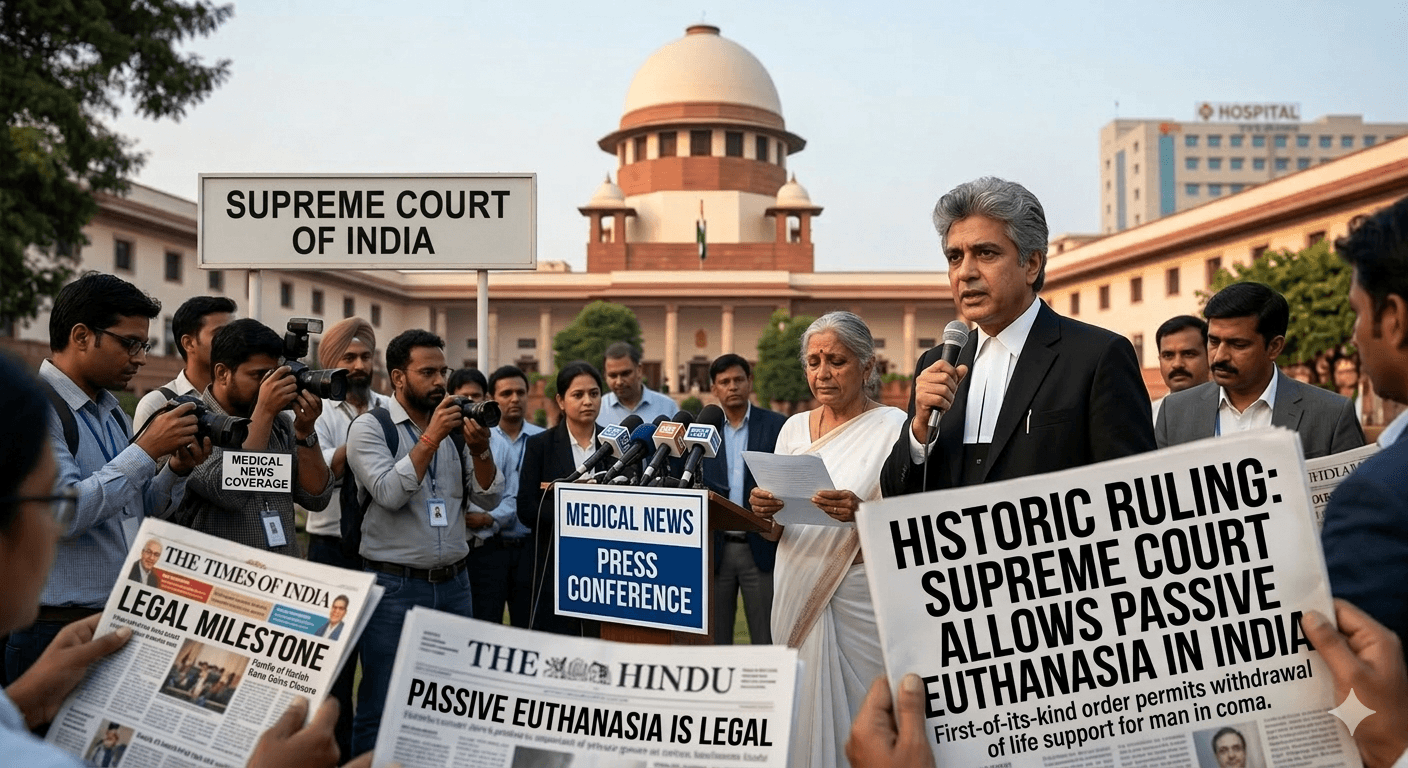
Supreme Court Issues Historic First Order Authorizing Passive Euthanasia in India. In a historic decision on March 11, 2026, the Supreme Court of India moved beyond legal theory to practice, authorizing the first-ever application of passive euthanasia for a specific individual.
The case of 32-year-old Harish Rana, who spent 13 years in a persistent vegetative state (PVS), marks a definitive shift in how the Indian legal and medical systems approach the “right to die with dignity.”
This ruling provides a vital roadmap for families and medical professionals dealing with irreversible terminal conditions.
Here is an in-depth breakdown of what this means, the legal framework in India, and who should consider this path.
The Case of Harish Rana: A Decade of Agony
Harish Rana’s story began in 2013 when a fall from a fourth-floor balcony left him with diffuse axonal injury—a severe, irreversible form of brain damage.
For over a decade, Harish remained bedridden, unresponsive, and entirely dependent on a feeding tube (PEG) and a tracheostomy tube for breathing.
His parents, Ashok Rana and Nirmala Devi, dedicated their lives and life savings to his care, eventually selling their home to fund medical costs.
In 2024, they approached the courts, arguing that their son’s condition was “beyond recovery” and that prolonging his life was no longer an act of care, but one of cruelty.
While the Delhi High Court initially rejected the plea, the Supreme Court ultimately ruled that keeping Harish alive via Clinically Assisted Nutrition and Hydration (CANH) was a “technologically mediated medical intervention” that could be legally withdrawn when it no longer served the patient’s best interests.
Understanding Euthanasia: Active vs. Passive
To navigate this complex topic, it is essential to understand the distinction between the two primary forms of euthanasia, as only one is legal in India.
1. Passive Euthanasia (Legal in India)
This involves the withdrawal or withholding of life-sustaining treatment. It allows the underlying disease or injury to take its natural course, leading to death.
* Examples: Turning off a ventilator, stopping dialysis, or removing a feeding tube.
* The Logic: The patient dies because their body can no longer sustain itself without artificial aid.
2. Active Euthanasia (Illegal in India)
This involves a direct, positive act to end a patient’s life, such as administering a lethal injection.
* The Logic: Death is caused by an external agent rather than the underlying illness. This remains a criminal offense in India.
Who Should Consider Passive Euthanasia?
The Supreme Court has set a high bar for who qualifies for passive euthanasia. It is not an option for those with treatable illnesses or mental health struggles; it is reserved for the most extreme medical circumstances.
1. Patients in a Persistent Vegetative State (PVS)
Like Harish Rana or the famous case of Aruna Shanbaug, these are individuals who have lost all cognitive function and awareness of their surroundings but retain some basic involuntary functions (like breathing). If medical boards determine the condition is irreversible, passive euthanasia may be considered.
2. Terminally Ill Patients
Individuals with incurable diseases (such as advanced stage-4 cancers or end-stage organ failure) where death is imminent and medical interventions only serve to prolong the process of dying rather than improving the quality of life.
3. Those with “Brainstem Death”
When the brainstem—the part of the brain that controls vital functions like breathing—has permanently ceased to function, even if the heart is still beating via a machine.
The Legal Process: How It Works in India
Since the landmark Common Cause (2018) judgment and its 2023 and 2026 refinements, India has a specific procedure for passive euthanasia.
The “Living Will” (Advance Medical Directive)
The best way to ensure your wishes are met is to draft a Living Will. This is a legal document where a healthy person specifies that if they ever fall into a terminal or vegetative state, they do not want to be kept on life support.
* How to make one: It must be signed by the individual in the presence of two witnesses and attested by a Notary or Gazetted Officer.
If No Living Will Exists (The Harish Rana Route)
If a patient is incapacitated and has no Living Will, the family or “next friend” must follow these steps:
* Primary Medical Board: The hospital forms a board of three doctors (with at least five years of experience) to examine the patient.
* Secondary Medical Board: A second board, including a doctor nominated by the District Chief Medical Officer, must concur with the first board’s findings.
* Judicial Oversight: While the 2023 rules simplified the process, complex cases—like Harish’s—still often require the intervention of the High Court or Supreme Court to ensure “best interests” are met.
The Medical Ethics: “Best Interest” vs. “Duty of Care”
The Supreme Court emphasized that doctors have a “duty of care” to heal. However, when healing is no longer possible, that duty shifts to providing a dignified death.
In Harish Rana’s case, the court noted that CANH (feeding tubes) is a medical treatment, not just “food and water.” Just as a patient has the right to refuse surgery, they (or their guardians) have the right to refuse a feeding tube if it only serves to “mechanically prolong a life that has lost all quality and dignity.”
“Survival is not always the same as living,” the court observed, noting that for Harish, death would be a “release” from endless misery. Supreme Court Issues Historic First Order Authorizing Passive Euthanasia in India