Reading Time: 4 minutes
Consumer Protection Act & Healthcare in India: Boon or Burden? A Critical Analysis Amid Supreme Court Review.
Introduction
The Consumer Protection Act (CPA) is one of India’s most significant socio-economic legislations, designed to safeguard the rights of consumers against unfair practices. Over time, its application has expanded beyond goods to include services, including healthcare.
However, the inclusion of doctors and hospitals under this Act has sparked intense debate—culminating in the Supreme Court of India currently re-examining whether healthcare should remain under its purview.
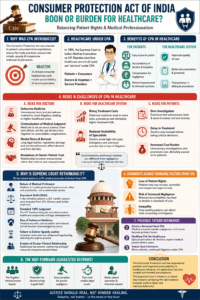
1. Why Was the Consumer Protection Act Introduced?
Historical Background
The original Consumer Protection Act, 1986 was enacted to address a major imbalance:
- Consumers were often powerless against large businesses and service providers
- Legal remedies were slow, expensive, and inaccessible
The law aimed to:
- Provide simple, speedy, and inexpensive redressal
- Protect consumers from unfair trade practices and service deficiencies
- Empower citizens in a growing market economy
Later, the law was modernized as the Consumer Protection Act, 2019, incorporating:
- E-commerce regulation
- Product liability
- Central Consumer Protection Authority (CCPA)
Core Objective
To reduce consumer helplessness and ensure accountability of service providers.
2. Inclusion of Healthcare Under CPA
A landmark judgment in 1995 (Indian Medical Association vs V.P. Shantha) changed Indian medico-legal practice:
- Healthcare services (if paid) were classified as “services”
- Patients became consumers
- Doctors and hospitals became service providers
This allowed patients to file complaints in consumer courts for:
- Medical negligence
- Deficiency in service
- Overcharging
3. Benefits of CPA in Healthcare
A. For Patients
1. Easy Access to Justice
- Consumer courts are faster than civil courts
- Minimal legal fees
2. Accountability in Healthcare
- Doctors/hospitals must maintain standards of care
- Encourages ethical practice
3. Compensation for Negligence
- Patients can claim damages for:
- Wrong treatment
- Surgical errors
- Misdiagnosis
4. Patient Empowerment
- Reduces blind dependence on doctors
- Promotes informed decision-making
B. For Healthcare System
1. Quality Improvement
- Hospitals implement:
- Better documentation
- Standard protocols
2. Transparency
- Billing, consent, and procedures become more structured
4. Risks & Challenges of CPA in Healthcare
A. Risks for Doctors
1. Defensive Medicine
Doctors may:
- Order unnecessary tests
- Avoid high-risk cases
👉 This increases healthcare costs without improving outcomes
2. Criminalization of Medical Judgment
- Medicine is not an exact science
- Even best efforts can fail
Yet:
- Doctors face litigation for unavoidable complications
3. Mental Stress & Burnout
- Long legal battles
- Reputation damage
A case mentioned how litigation nearly forced a doctor to quit the profession
4. Breakdown of Doctor–Patient Trust
- Relationship becomes transactional rather than ethical
B. Risks for Healthcare System
1. Rising Treatment Costs
- Defensive medicine → more tests → higher bills
2. Reduced Availability of Specialists
- Doctors avoid:
- Emergency care
- High-risk surgeries
C. Risks for Patients
1. Over-Investigation
- Unnecessary CT scans, MRIs, tests
2. Delay in Treatment
- Doctors may hesitate before taking critical decisions
3. Increased Cost Burden
- Ultimately passed on to patients
5. Limitations of the CPA in Healthcare
- Delay in justice (contrary to original aim)
- Backlog of cases
- Difficulty in proving medical negligence
- Confusion between:
- Civil negligence
- Professional judgment
6. Why is the Supreme Court Rethinking It? (2024–2026 Debate)
Recent Development
The Supreme Court of India has issued notice on a PIL seeking:
👉 Exclusion of doctors from Consumer Protection Act
Key Reasons Behind Review
1. Nature of Medical Profession
- Medicine is a noble profession, not a commercial service
- Based on:
- Trust
- Ethics
- Uncertainty
2. Precedent Shift (Lawyers Case 2024)
- In Bar of Indian Lawyers vs D.K. Gandhi (2024):
- Lawyers were excluded from CPA
- Argument:
- Doctors deserve similar treatment
3. Outdated 1995 Judgment
- The V.P. Shantha ruling (1995) may no longer reflect:
- Modern healthcare complexities
- Evolving legal interpretations
4. Rise of Defensive Medicine
- Courts acknowledged:
- Increased unnecessary tests
- Cost escalation
- Reduced clinical freedom
5. Failure to Deliver Speedy Justice
- Ironically:
- Consumer courts now face delays and backlog
- Defeating original purpose
6. Erosion of Doctor–Patient Relationship
- Petition claims:
- Relationship has become “commercial and legal” instead of compassionate
7. Arguments Against Removing Doctors from CPA
Not everyone supports exclusion.
Concerns
1. Loss of Patient Rights
- Patients may lose easy legal remedy
2. Increased Medical Negligence Risk
- Reduced accountability
3. Inequality
- Only rich patients may afford civil litigation
8. Possible Future Scenarios
Scenario 1: Doctors Removed from CPA
- Medical councils handle negligence
- Civil courts become primary forum
Scenario 2: Modified CPA for Healthcare
- Special provisions for doctors
- Expert medical panels before cases
Scenario 3: Status Quo Continues
- Minor reforms
- Continued litigation under CPA
9. Balanced Way Forward (Suggested Reforms)
A middle path is essential:
✅ Pre-litigation medical review boards
✅ Protection for doctors acting in good faith
✅ Strict penalties for proven negligence
✅ Fast-track medico-legal courts
✅ Better patient awareness
Conclusion
The Consumer Protection Act has undeniably empowered patients and improved accountability in healthcare. However, its application to medical practice has also created unintended consequences—including defensive medicine, rising costs, and erosion of trust.
The ongoing review by the **Supreme Court of India marks a critical turning point. The final decision will shape the future of healthcare delivery in India—balancing patient rights with medical autonomy.
Key Takeaways
- CPA was introduced to protect consumers from exploitation
- Healthcare was included after 1995 Supreme Court judgment
- It benefits patients but creates legal pressure on doctors
- Supreme Court is reconsidering due to:
- Changing legal principles
- Impact on healthcare delivery
- Professional nature of medicine