

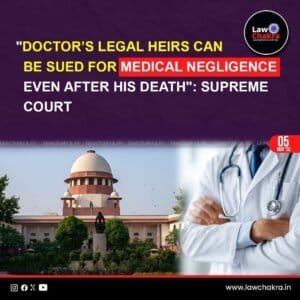
Yes — the news in the image is broadly authentic, but the viral headline is somewhat sensationalized and incomplete.
The actual ruling of the Supreme Court of India is more nuanced:
- The Court did NOT say legal heirs are personally guilty of negligence.
- The Court held that:
- a medical negligence case does not automatically end after the doctor’s death,
- legal heirs can be brought on record,
- and compensation, if awarded, may be recovered only from the deceased doctor’s estate/assets inherited, not from heirs’ personal property.
The judgment arose from the case:
Kumud Lall vs Suresh Chandra Roy (deceased).
The Court relied on provisions of:
- Consumer Protection Act
- Indian Succession Act
- Civil Procedure Code provisions on survival of claims.
So the viral line:
“Doctor’s legal heirs can be sued”
is technically incomplete.
A more accurate interpretation is:
“Medical negligence compensation claims may continue against the deceased doctor’s estate through legal heirs.”
………………………………………………………….
Supreme Court’s New Medical Negligence Ruling: What Every Doctor Must Understand About Liability, Documentation & Risk Management
Introduction
A recent judgment by the Supreme Court of India has created widespread discussion in the medical community after headlines claimed:
“Doctor’s legal heirs can be sued for medical negligence even after his death.”
While the statement is partly true, the actual judgment is more balanced and legally nuanced than viral social media posts suggest.
The Court clarified that medical negligence claims do not automatically end with the death of a doctor. Legal heirs may be brought into the proceedings, but only to the extent of the estate inherited from the deceased doctor — not from their personal assets.
This judgment is not merely a legal development. It is a wake-up call for healthcare professionals regarding:
- Documentation
- Consent practices
- Communication
- Professional indemnity insurance
- Hospital protocols
- Ethical medical practice
- Risk management
This article explains the judgment in simple language and discusses how doctors and hospitals can protect themselves while continuing to provide ethical patient care.
What Did the Supreme Court Actually Say?
The Supreme Court held that:
- Medical negligence claims involving financial compensation may survive even after the death of the doctor.
- Legal heirs can be “impleaded” or added to the case.
- Compensation can be recovered from the doctor’s estate inherited by legal heirs.
- Legal heirs are not personally accused of negligence.
- Personal claims such as pain, suffering, reputation damage etc. may not survive after death in the same way as monetary claims.
This distinction is extremely important.
The Court did NOT criminalize family members.
Instead, it treated negligence compensation similarly to other civil liabilities that survive against a deceased person’s estate.
Background of the Case
The case reportedly originated from a surgery performed in 1990 involving an eye procedure after which the patient allegedly lost vision.
Over decades, the matter traveled through consumer forums and appellate proceedings. During the litigation, the doctor passed away.
The legal question before the Court was:
“Does the medical negligence case end with the doctor’s death?”
The Court answered:
No.
The right to seek compensation can continue against the estate of the deceased doctor.
Why This Judgment Matters to Doctors
This judgment changes the psychological understanding of medico-legal exposure.
Previously many doctors believed:
“Once the doctor dies, the litigation ends.”
Now, the Court has clarified that civil compensation claims may continue.
This means:
- Medical records become even more important.
- Documentation may need preservation for longer durations.
- Hospitals must develop robust legal compliance systems.
- Professional indemnity insurance becomes critical.
- Family financial planning also gains importance.
Does This Mean Doctors Are Unsafe?
No.
Indian courts still require proof of negligence.
A poor outcome alone does not amount to negligence.
The law still recognizes:
- Known complications
- High-risk surgeries
- Failure despite reasonable care
- Emergency decision-making
- Accepted medical practices
Courts generally examine whether the doctor acted according to accepted standards of medical care.
However, poor documentation and poor communication often weaken the doctor’s defense.
The Biggest Protection for Doctors: Documentation
In modern medicine:
“If it is not documented, legally it may be considered not done.”
Proper documentation is the strongest defense against negligence claims.
Essential Documentation Checklist
1. Detailed History
- Symptoms
- Comorbidities
- Previous treatment
- Risk factors
- Allergies
2. Clinical Examination Notes
- Findings
- Differential diagnosis
- Severity assessment
3. Investigation Records
- Lab reports
- Imaging
- Specialist opinions
4. Treatment Decisions
Why a specific treatment was chosen.
5. Consent Forms
Especially for:
- Surgery
- Endoscopy
- ICU procedures
- High-risk interventions
6. Daily Progress Notes
Clear chronological entries are critical.
7. Discharge Summary
Include:
- Diagnosis
- Treatment
- Complications
- Follow-up advice
Importance of Informed Consent
Many negligence disputes arise not because of treatment failure, but because patients or relatives claim:
“Nobody explained the risks.”
A proper informed consent should include:
- Diagnosis
- Planned treatment
- Alternative options
- Possible complications
- Risk of failure
- Need for ICU/blood transfusion/reoperation
- Mortality risk in high-risk cases
Consent should ideally be:
- Procedure-specific
- In understandable language
- Signed by patient/relative/witness
- Dated and timed
Communication Prevents Litigation
One of the biggest triggers for medico-legal conflict is poor communication.
Patients often tolerate complications when:
- doctors remain transparent,
- empathetic,
- accessible,
- and honest.
Communication tips:
- Avoid false reassurance
- Explain uncertainty
- Discuss risks early
- Inform relatives promptly during complications
- Maintain calm behavior during adverse events
Professional Indemnity Insurance Is No Longer Optional
This judgment highlights the importance of indemnity insurance.
Every practicing doctor should consider:
- Adequate indemnity coverage
- Tail coverage after retirement
- Coverage for long-term litigation
- Hospital liability policies
Doctors involved in:
- surgery,
- ICU care,
- obstetrics,
- anesthesia,
- gastroenterology,
- bariatric surgery,
- colorectal surgery
may require higher coverage limits due to increased medico-legal exposure.
Role of Hospitals in Preventing Negligence Claims
Hospitals must establish:
- SOPs (Standard Operating Protocols)
- ICU protocols
- Surgical safety checklists
- Infection control systems
- Documentation audits
- Mortality review meetings
- Ethical committees
Electronic Medical Records (EMR) may also improve traceability and legal defensibility.
Defensive Medicine: A Growing Concern
Such judgments may increase:
- unnecessary investigations,
- excessive referrals,
- fear-based medicine,
- reluctance to treat high-risk patients.
This can increase healthcare costs and affect emergency decision-making.
Therefore, legal reform must balance:
- patient rights
- and doctor protection.
What Doctors Should Start Doing Immediately
Practical Risk-Reduction Steps
Clinical
- Follow standard guidelines
- Avoid shortcuts
- Document high-risk discussions
Administrative
- Maintain records safely
- Use proper consent forms
- Audit documentation regularly
Legal
- Obtain indemnity insurance
- Understand Consumer Protection laws
- Seek medico-legal advice early
Communication
- Train staff in communication
- Maintain respectful interactions
- Address complaints early
Important Clarification About the Judgment
The Court did NOT state:
- every complication is negligence,
- legal heirs are personally criminals,
- doctors can be punished after death.
It only clarified that:
- financial claims linked to negligence may continue against inherited estate/assets.
This is a civil liability principle, not a criminal punishment principle.
Final Thoughts
Medicine is becoming increasingly complex.
Today’s doctors face:
- rising patient expectations,
- social media trials,
- consumer litigation,
- documentation burden,
- and emotional burnout.
At the same time, patients deserve:
- transparency,
- accountability,
- ethical care,
- and fair compensation in genuine negligence cases.
The solution is not fear.
The solution is:
- better systems,
- better communication,
- better documentation,
- ethical practice,
- and institutional risk management.
Good medicine supported by good documentation remains the best legal defense.
References:
- Indian Express report on Supreme Court judgment
- LiveLaw legal analysis
- Medical Dialogues report
- Supreme Court case: Kumud Lall vs Suresh Chandra Roy (deceased)