

Reading Time: 6 minutes
Supreme Court Frames ICU Norms for Hospitals: What It Means for Patients, Doctors & India’s Healthcare Future
India’s healthcare system has taken a major step forward after the Supreme Court endorsed minimum standards for Intensive Care Units (ICUs) across hospitals. These norms aim to define what an ICU must actually contain—infrastructure, equipment, staffing, monitoring systems, and patient safety standards. The move comes at a time when many hospitals advertise ICU facilities, but the quality and readiness of those units vary widely.
For patients and families, this development is crucial. When a loved one needs critical care, they assume an ICU is equipped to save lives. Unfortunately, that has not always been true. Some units lacked trained manpower, adequate monitoring, ventilators, infection control, or proper nurse-to-patient ratios.
This article explains:
- Why ICU care is essential
- Different types of ICU services
- Existing ICU standards in India
- NABH ICU guidelines
- Gaps in present systems
- Why Supreme Court intervention became necessary
- Key highlights of the new Supreme Court ICU norms
- What hospitals must do next
What is an ICU?
ICU stands for Intensive Care Unit. It is a specialized hospital area where critically ill patients receive continuous monitoring, advanced life support, and treatment from trained doctors and nurses.
ICUs are designed for patients whose body systems are unstable and may fail without immediate intervention.
Examples include:
- Severe pneumonia or respiratory failure
- Heart attack with shock
- Stroke
- Major trauma or accidents
- Sepsis (serious infection)
- Post-major surgery recovery
- Poisoning
- Multi-organ failure
- Ventilator-dependent patients
In simple words: When normal ward care is not enough, ICU care becomes lifesaving.
Why ICU Care is Needed
1. Continuous Monitoring
In ICU, vital signs are observed round the clock:
- Heart rate
- Blood pressure
- Oxygen saturation
- Respiratory rate
- ECG rhythm
- Urine output
- Temperature
A small change may indicate deterioration and allows early treatment.
2. Life Support Systems
ICUs provide:
- Ventilators
- Dialysis support
- Vasopressor infusions
- Defibrillators
- Oxygen systems
- Invasive monitoring lines
These technologies cannot be safely managed in a normal ward.
3. Expert Staffing
ICU care depends on:
- Intensivists
- Trained nurses
- Respiratory therapists
- Anaesthetists
- Emergency physicians
- Multidisciplinary backup
4. Faster Decision Making
Seconds matter in critical illness. ICU systems are built for rapid response.
5. Better Survival Rates
Evidence worldwide shows structured critical care improves outcomes when compared with delayed or inadequate management.
Types of ICU Care
Different hospitals offer different ICU models.
1. Medical ICU (MICU)
For severe medical illnesses:
- Sepsis
- Pneumonia
- Liver failure
- Kidney failure
- Poisoning
2. Surgical ICU (SICU)
For post-operative high-risk patients:
- Major abdominal surgery
- Trauma surgery
- Emergency surgery
3. Cardiac ICU / CCU
For:
- Heart attack
- Arrhythmia
- Heart failure
- Cardiogenic shock
4. Neuro ICU
For:
- Stroke
- Brain hemorrhage
- Head injury
- Seizures
5. Pediatric ICU (PICU)
For critically ill children.
6. Neonatal ICU (NICU)
For premature and sick newborn babies.
7. High Dependency Unit (HDU)
Intermediate care between ward and ICU.
ICU Levels Mentioned in New Supreme Court Framework
The newly endorsed norms classify ICUs into levels based on complexity of care:
Level 1 ICU
Basic stabilization and single-organ support.
Level 2 ICU
Continuous monitoring and multi-organ care.
Level 3 ICU
Advanced critical care for severe multi-organ failure and complex cases.
This classification is important because not every hospital can provide tertiary ICU care. But every ICU must honestly state its capability.
Existing ICU Guidelines Before Supreme Court Intervention
Before this judicial push, India had fragmented standards.
Sources of Standards Included:
- Indian Society of Critical Care Medicine (ISCCM) recommendations
- NABH accreditation standards
- State licensing norms
- Fire and biomedical regulations
- Local hospital protocols
While useful, these were not uniformly implemented nationwide.
NABH ICU Guidelines – Current Benchmark in Private Sector
NABH (National Accreditation Board for Hospitals & Healthcare Providers) has been one of the strongest quality frameworks in India.
NABH ICU Expectations Include:
Infrastructure
- Adequate space per bed
- Oxygen, suction, electrical outlets
- Emergency access
- Infection prevention design
Equipment
- Ventilator
- Multiparameter monitors
- Syringe pumps
- Defibrillator
- Crash cart
- Portable suction
Staffing
- Qualified consultants
- Trained nurses
- Defined nurse-patient ratios
- Duty rosters
Processes
- Admission criteria
- Transfer policy
- Documentation
- Medication safety
- Biomedical waste management
Quality Indicators
- Infection rates
- Mortality review
- Ventilator associated pneumonia rates
- Incident reporting
NABH significantly improved standards in accredited hospitals.
Limitations of Existing ICU Guidelines
Despite good frameworks, several challenges remained.
1. Accreditation is Voluntary for Many Hospitals
Many hospitals function without NABH accreditation.
2. Uneven Enforcement
Some institutions maintain standards on paper more than in practice.
3. Rural-Urban Divide
Metro hospitals may offer advanced ICU care, but smaller towns often struggle with:
- Specialists
- Nurses
- Ventilators
- Blood gas testing
- Dialysis backup
4. Misleading Use of “ICU” Label
Some hospitals use the term ICU even when facilities are closer to monitored wards.
5. Shortage of Skilled Staff
A good ICU is manpower-driven, not machine-driven.
6. No Uniform National Minimum Standard
There was no common enforceable definition of what qualifies as an ICU across India.
Why Supreme Court Intervention Was Needed
The Supreme Court stepped in because ICU care directly affects the Right to Life under Article 21 of the Constitution.
If a citizen enters a hospital claiming to have an ICU, the expectation is that minimum lifesaving standards exist.
The Court recognized:
- Wide variation in ICU quality
- Need for realistic minimum standards
- Need for state accountability
- Need for time-bound implementation
- Need for practical norms, not impossible ideals
The Court directed States and Union Territories to prepare action plans and identify essential gaps in manpower and logistics.
Highlights of Supreme Court ICU Guidelines
1. Minimum Essentials for ICU Recognition
Hospitals claiming ICU facilities should have:
- Dedicated ICU space
- Power backup
- Oxygen supply
- Suction system
- Electrical points at each bed
- Proper layout and sanitation
2. Mandatory Equipment
Expected core equipment includes:
- Ventilators
- Monitors
- Defibrillator
- Crash cart
- Infusion pumps
- ECG capability
3. Staffing Norms
The Court-backed framework emphasizes:
- Trained doctors
- 24×7 medical coverage
- Higher nurse-to-patient ratio than wards
- Allied healthcare support
4. Nurse Ratios
Suggested ratios include:
- 1:2 or 1:3 in many ICU settings
- 1:1 for critically unstable or ventilated patients
5. Infection Control
Strict infection prevention protocols are essential.
6. Clinical Appropriateness
Patients stable enough for ward care should be shifted out, allowing ICU beds for those who truly need them.
7. Rural Solutions
The framework reportedly recognizes smaller centers and suggests e-ICU / tele-ICU linkage models.
Why These Guidelines Matter for Patients
Transparency
Families can ask what level ICU is available.
Safety
Better monitoring and staffing reduce preventable complications.
Fair Access
Beds reserved for patients who truly need ICU care.
Accountability
Hospitals can be judged against objective benchmarks.
Why These Guidelines Matter for Doctors
Better Systems
Doctors perform better in organized ICUs.
Reduced Moral Stress
Clinicians often struggle when working in under-equipped units.
Clear Referral Decisions
If Level 1 cannot manage a Level 3 patient, transfer becomes clearer.
Standardization
Uniform processes reduce confusion and variability.
Challenges in Implementation
Even good guidelines face real-world barriers.
1. Cost
Ventilators, monitors, and staffing are expensive.
2. Nurse Shortage
India needs more trained ICU nurses.
3. Intensivist Availability
Specialists are concentrated in cities.
4. Smaller Hospital Burden
Many smaller centers cannot immediately upgrade.
5. Documentation vs Reality
Paper compliance must not replace bedside quality.
What Hospitals Should Do Now
Immediate Actions
- Audit existing ICU facilities
- Check equipment readiness
- Review nurse ratios
- Standardize infection control
- Create transfer protocols
- Train staff
- Emergency drills
Medium-Term Actions
- Tele-ICU partnerships
- NABH preparation
- Data monitoring dashboards
- Clinical governance committees
What Families Should Ask Before ICU Admission
- Is this a full ICU or HDU?
- Is ventilator support available?
- Is a doctor available 24×7?
- What is nurse ratio?
- Is dialysis available if needed?
- Can patient be transferred if condition worsens?
- What are expected costs?
NABH vs Supreme Court Norms: Key Difference
NABH
Quality accreditation framework for hospitals seeking certification.
Supreme Court ICU Norms
A national push toward minimum enforceable baseline standards, especially where accreditation does not exist.
This can bridge a major gap in Indian healthcare.
Expert Perspective
Machines alone do not create ICU excellence. A ventilator without trained nurses, protocols, and rapid medical decisions is not enough. True critical care depends on systems + people + ethics + timely escalation.
Final Verdict
Supreme Court Frames ICU Norms for Hospitals. The Supreme Court’s ICU norms may become one of the most important healthcare reforms in recent years. They address a long-standing reality: not every ICU in India has been equal.
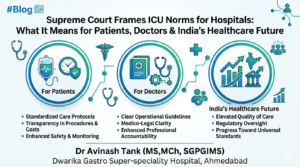
For patients, this means hope for safer care.
For doctors, a stronger system.
For hospitals, a call to modernize.
For policymakers, a test of implementation.
The next phase is not drafting rules—it is turning them into functioning bedsides across India, from metros to remote districts.
If implemented honestly, these norms can save thousands of lives every year. Supreme Court Frames ICU Norms for Hospitals.