

Reading Time: 8 minutes
Health Insurance Rules May Change Soon in India – Key Decisions After IRDAI Meeting with Hospitals.
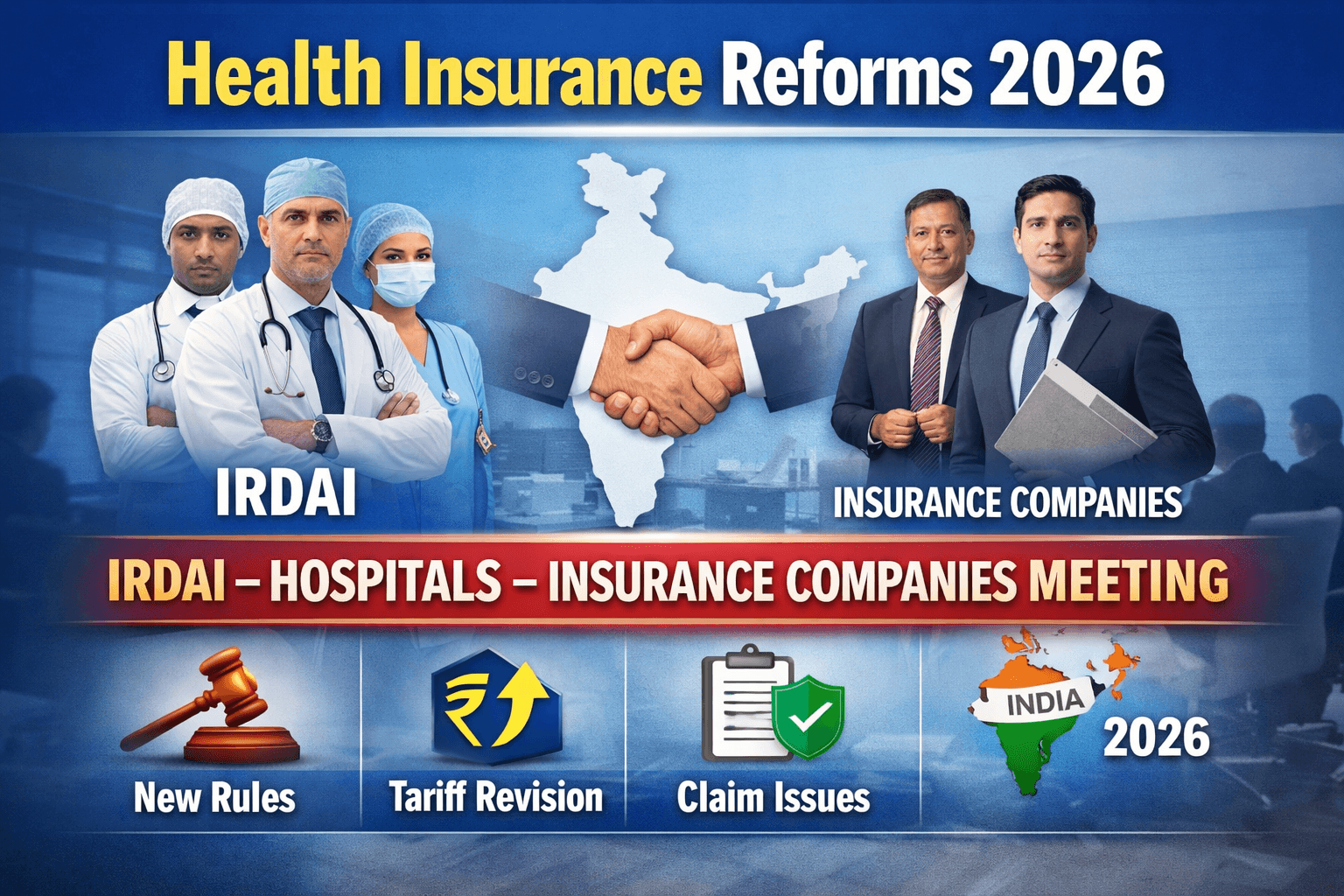
A major milestone in the Indian healthcare and health insurance sector was achieved on March 17, 2026, when a high-level meeting was organized in New Delhi bringing together representatives of hospital associations, insurance companies, regulatory authorities, and industry bodies.
The meeting aimed to discuss long-standing challenges faced by hospitals, nursing homes, insurers, and patients in the health insurance system and to develop a roadmap for future reforms.
Representatives from hospital associations including AHNA and GAHNA participated in the meeting and shared their concerns regarding various operational difficulties faced in day-to-day medical practice related to insurance claims, empanelment, tariffs, and payment delays.
The meeting is being considered historic because for the first time all stakeholders from the healthcare and insurance ecosystem sat together on one platform to discuss solutions.
This interaction is expected to bring long-term improvements in coordination between hospitals and insurance companies and may lead to policy changes that will benefit both healthcare providers and patients.
Participation of Hospital Associations and Representatives
On behalf of AHNA and GAHNA, Dr. Viren Shah, Dr. Bharat Gadhavi, and Dr. Krutesh Shah attended the meeting as representatives of hospital associations. Their participation ensured that the concerns of private hospitals and nursing homes were properly presented before the regulatory authorities and insurance companies.
The meeting was attended by representatives from multiple state-level associations under the Federation of Private Hospital Nursing Homes Association of India (FPHNAI). The presence of such a large number of state representatives made the discussion more comprehensive because issues from different parts of the country could be discussed.
Hospital associations have been demanding reforms in the insurance system for many years, and this meeting provided an opportunity to present those demands directly before decision-making authorities.
Presence of Senior Government, Regulatory and Industry Leaders
The meeting was held in the presence of senior leaders from the healthcare and insurance sector, making it one of the most important industry interactions in recent times. The discussion took place under the guidance of senior officials from the Confederation of Indian Industry (CII), the Insurance Regulatory and Development Authority of India (IRDAI), and leading healthcare policy experts.
Top management representatives from insurance companies, officials from IRDAI, representatives from the General Insurance Corporation (GIC), and leaders from hospital associations participated in the meeting. Nearly eighty delegates attended the interaction, which allowed detailed discussion on multiple issues affecting the health insurance system.
The presence of policymakers along with ground-level healthcare providers ensured that the discussion was practical and focused on real problems rather than theoretical issues.
First Time All Stakeholders Came Together on One Platform
One of the most important aspects of the meeting was that all stakeholders in the healthcare insurance ecosystem came together for the first time on a single platform. Earlier, discussions were usually held separately between regulators and insurers or between hospitals and insurers, but rarely with all parties present together.
This joint meeting created an opportunity to understand each other’s difficulties and expectations. Hospitals explained their problems related to claim delays and low tariffs, while insurance companies highlighted concerns regarding rising costs and lack of standardization.
Such joint discussions are important because the health insurance system can work smoothly only when there is cooperation between insurers, hospitals, and regulators. The meeting is therefore being considered a historic step toward building a more transparent and efficient system.
Major Decisions Taken During the Meeting
Several important decisions were taken during the meeting that may have a long-term impact on the healthcare and insurance sector.
These decisions were aimed at improving transparency, reducing disputes, and making the system more patient-friendly.
One of the key outcomes was the decision to create a formal grievance redressal mechanism for hospitals and nursing homes.
Another important step was the formation of multiple working groups to study different issues related to insurance claims, hospital empanelment, tariffs, and policy design.
These decisions show that the regulator and industry bodies have recognized the need for structural reforms in the health insurance sector.
Creation of Grievance Redressal Mechanism for Hospitals
A major achievement of the meeting was the agreement to create a grievance redressal mechanism for hospitals and nursing homes. For many years, healthcare providers have been demanding a system where they can raise complaints against insurance companies and get timely resolution.
Hospitals often face problems such as delayed payments, unjustified claim rejections, empanelment disputes, and sudden changes in tariffs. Until now, there was no structured system where these issues could be formally addressed.
The new grievance redressal mechanism will allow hospitals to submit their complaints through an official channel, and the issues will be reviewed by the concerned authorities. This is the first time such a system has been proposed at the national level, and hospital associations have welcomed this decision.
Formation of Multiple Working Groups for Health Insurance Reforms
Another major decision taken during the meeting was the formation of several working groups to study key problems in the health insurance sector. These groups will include representatives from hospital associations, insurance companies, and regulatory bodies.
The purpose of these working groups is to analyze the problems in detail and suggest practical solutions that can be implemented at the national level. Each group will focus on a specific area so that reforms can be planned in a systematic manner.
The recommendations given by these groups may become the basis for future policy changes in the health insurance sector.
Working Group on Joint Code of Conduct for Insurers and Providers
One of the working groups will focus on developing a joint code of conduct for insurance companies and healthcare providers. The aim of this initiative is to create clear guidelines for empanelment, billing, claim processing, and dispute resolution.
At present, hospitals often complain about arbitrary decisions by insurers, while insurance companies raise concerns about inconsistent billing practices. A joint code of conduct will help reduce misunderstandings and create a fair system for both parties.
This step is expected to improve trust between hospitals and insurers, which is essential for smooth functioning of the health insurance system.
Working Group on Categorization of Healthcare Providers
Another working group will work on categorizing healthcare providers based on objective parameters such as accreditation, infrastructure, location, and level of services provided.
Currently, different insurance companies follow different criteria for empanelment, which leads to confusion and unfair treatment of hospitals. Some hospitals are paid lower tariffs despite having good facilities, while others face difficulties in getting empanelled.
A standardized classification system will help bring uniformity in empanelment policies and ensure that hospitals are treated fairly across the country.
Working Group on Adoption and Expansion of NHCX
A separate working group will focus on the adoption and expansion of the National Health Claims Exchange (NHCX), which is a digital platform designed to simplify claim processing between hospitals and insurance companies.
Many delays in claim approval occur because of manual documentation and lack of coordination between different stakeholders. The NHCX system aims to make the process faster, more transparent, and more efficient.
By encouraging all hospitals and insurers to use a common digital platform, the working group hopes to reduce delays and improve patient experience.
Working Group on Claim Trends, Cashless vs Reimbursement and Medical Inflation
Another important working group will conduct detailed studies on claim trends, differences between cashless and reimbursement claims, and the reasons behind increasing medical costs.
Insurance companies often blame hospitals for high bills, while hospitals argue that tariffs have not been revised for many years. A scientific study of data will help understand the real causes of rising healthcare expenses.
These studies may help in designing better insurance policies and fixing realistic tariffs that are fair to both hospitals and insurers.
Working Group on Basic Insurance Products and Wellness Cover
One working group will work on developing simple and affordable insurance products that can increase insurance coverage among the general population.
Many people in India still do not have health insurance because policies are complicated and expensive. The new group will explore the possibility of designing basic insurance products with essential coverage at lower cost.
The group will also study how wellness programs, preventive care, and outpatient treatment can be included in insurance policies so that patients remain healthy and hospitalization can be reduced.
Issues Raised by Hospital Associations During the Meeting
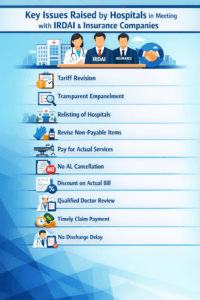
Hospital associations presented several important demands during the discussion. One of the main demands was immediate revision of tariffs for hospitals where rates have not been updated for many years.
Hospitals explained that the cost of equipment, staff, medicines, and infrastructure has increased significantly, but insurance tariffs remain outdated. This creates financial pressure on hospitals and affects the quality of care.
Associations requested that tariffs should be revised in a fair and transparent manner.
1. Demand for Fair Empanelment and Relisting of Hospitals
Hospitals also demanded that the empanelment process should be fair and transparent. Many hospitals have complained that they are removed from insurance panels without proper reason.
Associations requested that all eligible hospitals should be given equal opportunity to work with insurance companies and that hospitals which were delisted unfairly should be reconsidered.
A transparent empanelment policy will help maintain trust between hospitals and insurers.
2. Concerns About Non-Payable Items in Insurance Bills
Another major issue raised during the meeting was the increasing list of items that insurance companies refuse to pay. These include consumables such as surgical gloves, equipment charges, and certain medical supplies.
Hospitals stated that these items are necessary for patient care and should not be excluded from insurance coverage.
Associations demanded that insurance companies should revise the list of non-payable items so that hospitals do not suffer financial loss.
3. Payment for Actual Services Provided
Hospital representatives also demanded that insurance companies should pay for all services that are actually provided during treatment. This includes charges for medical equipment, assistant surgeons, nursing care, and other essential services.
Sometimes these charges are reduced or rejected during claim settlement, which creates disputes between hospitals and insurers.
A clear policy regarding payable services will help avoid unnecessary conflicts.
4, Delay in Authorization and Claim Settlement
Hospitals reported that delays in pre-authorization and final approval from insurance companies often cause problems during patient discharge.
Patients may have to wait for many hours for final approval, which leads to inconvenience and dissatisfaction.
Associations requested that once authorization is given, it should not be cancelled later without proper reason, and claim settlement should be done within a fixed time.
Timely authorization and payment will benefit both hospitals and patients.
5. Need for Qualified Medical Review in Claims
Another important suggestion given during the meeting was that claims should be reviewed only by qualified doctors with appropriate specialization.
Sometimes claims are rejected by non-medical personnel who may not fully understand the clinical situation.
Having qualified doctors review claims will ensure fair decisions and reduce disputes between hospitals and insurance companies.
6. Beginning of a Long but Important Reform Process
The participants agreed that the meeting was only the first step toward solving complex problems in the health insurance sector.
Many issues require detailed study and continuous discussion before final decisions can be implemented.
However, the fact that all stakeholders have come together and agreed to work jointly is a positive sign for the future.
Hospital associations also stated that they will continue to engage with regulators and insurers to ensure that reforms are implemented in a practical manner.
Conclusion:
A Historic Step Towards Better Health Insurance System in India.
The meeting held on March 17, 2026 marks an important milestone in the Indian healthcare and health insurance sector. The creation of grievance redressal mechanisms, formation of working groups, and open discussion between hospitals and insurers show that serious efforts are being made to improve the system.
If the decisions taken during the meeting are implemented successfully, they may lead to faster claim processing, fair tariffs, better insurance products, and improved patient experience.
Although the journey ahead is long, this meeting has created hope that the health insurance system in India will become more transparent, efficient, and patient-friendly in the coming years. Health Insurance Rules May Change Soon in India – Key Decisions After IRDAI Meeting with Hospitals. Health Insurance Rules May Change Soon in India – Key Decisions After IRDAI Meeting with Hospitals