

Reading Time: 6 minutes
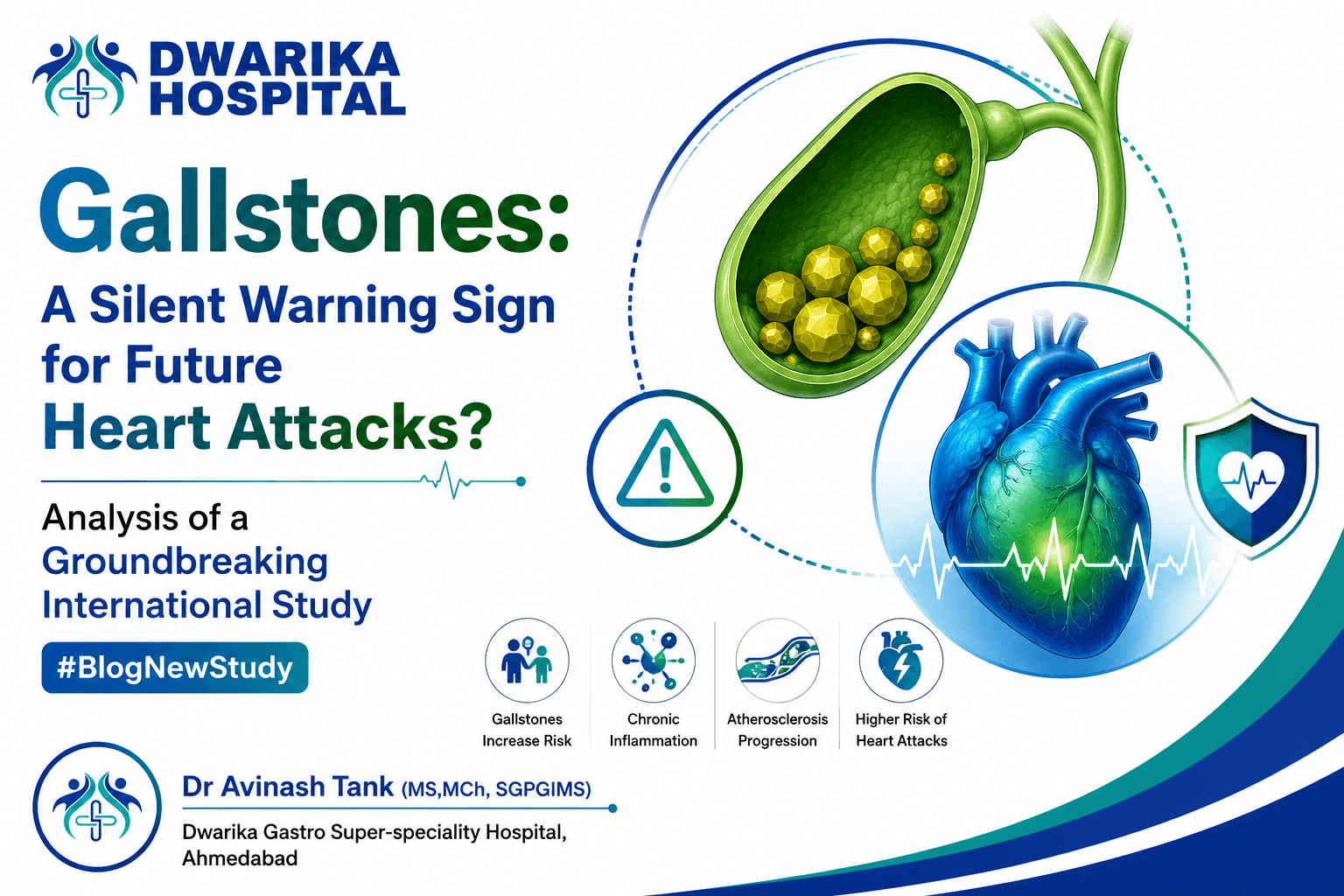
Gallstones: A Silent Warning Sign for Future Heart Attacks? Analysis of a Groundbreaking International Study.
. Gallstones: A Driver of Cardiovascular Disease? A Triangulation Study
Authors: Fairfield CJ et al.
Journal: Frontline Gastroenterology (2026)
Summary of the Paper
This landmark study challenges the traditional perception of gallstone disease as a purely biliary disorder and proposes that gallstones may represent an important marker—and potentially a contributor—to cardiovascular disease (CVD).
Using a sophisticated “triangulation” approach combining observational epidemiology, meta-analysis, cholecystectomy outcomes, and Mendelian randomization (MR), the investigators explored whether gallstones merely coexist with cardiovascular risk factors or actively contribute to cardiovascular pathology.
The study analyzed data from 457,048 participants in the UK Biobank, including 32,528 individuals with gallstone disease.
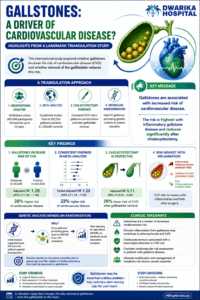
During follow-up, 25,667 participants developed cardiovascular disease. Patients with gallstones demonstrated a significantly higher incidence of CVD than controls (7.9% vs 5.4%).
Even after adjustment for numerous confounders including age, sex, BMI, smoking, diabetes markers, lipid profile, dietary factors, and physical activity, gallstones remained associated with a 28% increased risk of cardiovascular disease (adjusted HR 1.28).
The investigators strengthened these findings through a meta-analysis incorporating more than 202,000 gallstone patients and 1.25 million controls.
The pooled analysis demonstrated a 23% increased cardiovascular risk among gallstone carriers (HR 1.23).
One of the most important observations involved cholecystectomy. Compared with active gallstone carriers, patients who underwent cholecystectomy experienced a substantial reduction in cardiovascular risk (HR 0.71).
Time-varying analyses further showed that cardiovascular risk was highest in individuals with inflammatory gallstone complications and diminished after gallbladder removal.
Genetic analyses produced more nuanced findings. Mendelian randomization initially suggested that genetic predisposition to gallstones might paradoxically reduce coronary heart disease risk.
However, this apparent protective effect was largely explained by pleiotropic lipid-related genes, particularly variants in the ABCG8 locus, which simultaneously promote gallstones while lowering LDL cholesterol. Once these lipid effects were accounted for, the genetic association disappeared.
The authors conclude that gallstones should be viewed as an important sentinel event for cardiovascular disease.
They hypothesize that chronic gallstone-related inflammation may contribute to atherosclerosis and cardiovascular events and suggest that cholecystectomy could interrupt this inflammatory pathway.
Editorial Commentary
Gallstones Beyond the Gallbladder: A Paradigm Shift in Surgical Gastroenterology
The publication by Fairfield and colleagues represents one of the most thought-provoking contributions to hepatobiliary surgery in recent years.
For decades, surgeons have viewed gallstones through a predominantly mechanical lens: stones cause biliary colic, cholecystitis, pancreatitis, and choledocholithiasis.
The clinical conversation has largely revolved around symptom control and prevention of biliary complications. This study asks a far more ambitious question: Could gallstones influence systemic vascular health and cardiovascular outcomes?
The implications of this question are profound.
If validated, gallstone disease may need to be reclassified from a localized biliary condition to a manifestation of broader cardiometabolic dysfunction with systemic consequences.
The Strength of the Study
One of the most impressive aspects of this work is its methodological design.
Observational studies alone cannot establish causality because gallstone patients are typically older, more obese, more diabetic, and more metabolically unhealthy than controls. Any association with cardiovascular disease could simply reflect shared risk factors.
The investigators therefore employed a triangulation framework, integrating:
- Large-scale cohort analysis
- Meta-analysis of existing studies
- Cholecystectomy outcome analysis
- Mendelian randomization
This approach substantially strengthens confidence in the findings because each methodology addresses different biases. The consistency of the signal across multiple analytical platforms is difficult to ignore.
Gallstones as a Cardiometabolic Marker
From a clinical perspective, perhaps the most immediately useful message is that gallstones appear to be a sentinel marker of future cardiovascular disease.
The adjusted hazard ratio of 1.28 may initially appear modest. However, this effect size is remarkably important because:
- Gallstone disease is extremely common.
- Cardiovascular disease remains the leading cause of mortality worldwide.
- Gallstones often develop years before cardiovascular events.
In practical terms, gallstones may identify a subgroup of patients who are entering the cardiometabolic disease trajectory long before myocardial infarction or stroke occurs.
For surgeons, this is a critical insight.
Traditionally, a patient presenting with symptomatic gallstones is evaluated for surgery and discharged after cholecystectomy. Rarely do we view the gallstone episode as a cardiovascular warning sign.
This study suggests we should.
The Inflammation Hypothesis Makes Biological Sense
The most compelling aspect of the paper is the proposed inflammatory mechanism.
Modern cardiovascular medicine increasingly recognizes inflammation as a central driver of atherosclerosis. Landmark studies such as CANTOS demonstrated that targeting inflammation can reduce cardiovascular events independent of cholesterol lowering.
Gallstone disease provides a plausible inflammatory stimulus:
- Chronic gallbladder inflammation
- Repeated episodes of biliary obstruction
- Cytokine activation
- Systemic low-grade inflammatory signaling
The study demonstrated that cardiovascular risk was highest among patients with inflammatory gallstone complications and lowest after gallbladder removal. This temporal relationship strengthens the inflammatory hypothesis.
For hepatobiliary surgeons, this observation resonates with everyday clinical practice.
We routinely encounter patients with:
- Chronic cholecystitis
- Thickened gallbladder walls
- Recurrent biliary attacks
- Elevated inflammatory markers
Perhaps these manifestations are not confined to the right upper quadrant but reflect systemic inflammatory activation.
Does Cholecystectomy Protect the Heart?
This is arguably the most provocative finding of the paper.
The study reports approximately 29% lower cardiovascular risk among cholecystectomized patients compared with active gallstone carriers.
At first glance, this finding appears revolutionary.
Could laparoscopic cholecystectomy become a cardiovascular prevention strategy?
The answer is not yet.
Several caveats deserve emphasis:
Selection Bias
Patients selected for surgery are often:
- Healthier
- More motivated
- Better connected to healthcare systems
- More likely to receive preventive medical care
Although the authors adjusted extensively for confounding and performed sensitivity analyses, residual bias remains possible.
No Randomized Evidence
No randomized trial has demonstrated that cholecystectomy reduces myocardial infarction, stroke, or cardiovascular mortality.
Current evidence remains observational.
Therefore, surgeons should resist overinterpreting these findings.
Cholecystectomy should still be performed for established biliary indications—not for cardiovascular prevention.
The Mendelian Randomization Puzzle
The MR findings are perhaps the most intellectually fascinating component of the study.
Initially, genetics appeared to contradict observational data.
Genetic predisposition to gallstones seemed associated with lower cardiovascular risk.
However, deeper analysis revealed that certain gallstone-promoting genes, especially ABCG8, also lower LDL cholesterol.
This creates a biological paradox:
- Higher gallstone risk
- Lower LDL
- Lower cardiovascular risk
Thus, the apparent contradiction was driven by lipid biology rather than true protection from gallstones.
This observation highlights an important lesson for clinical researchers:
Not all gallstones are biologically identical.
Some arise predominantly through cholesterol transport abnormalities, while others may reflect metabolic inflammation, obesity, insulin resistance, and lifestyle factors.
Future studies may identify distinct gallstone phenotypes with different cardiovascular implications.
Implications for Bariatric and Metabolic Surgery
The findings are particularly relevant for obesity surgeons.
Gallstones and cardiovascular disease share major upstream determinants:
- Obesity
- Insulin resistance
- Metabolic syndrome
- Type 2 diabetes
- Sedentary lifestyle
Many bariatric patients either already have gallstones or develop them during rapid postoperative weight loss.
The current study reinforces the concept that gallstones are not isolated biliary pathology but part of the broader metabolic disease spectrum.
For bariatric programs, gallstone detection could become another indicator prompting aggressive cardiovascular risk assessment.
What Should Practicing Surgeons Do Differently?
Based on current evidence, several practical recommendations emerge.
1. Treat Gallstones as a Cardiometabolic Red Flag
When gallstones are diagnosed, clinicians should consider:
- Blood pressure assessment
- Diabetes screening
- Lipid profiling
- Weight management counseling
2. Strengthen Lifestyle Counseling
Gallstone patients should be informed that:
- Gallstones may signal broader metabolic dysfunction.
- Future cardiovascular risk may be elevated.
- Lifestyle modification remains essential.
3. Collaborate with Physicians and Cardiologists
Gallstone disease offers an opportunity for early intervention.
A patient presenting with biliary colic at age 40 may experience myocardial infarction at age 55.
The surgeon may be the first clinician to identify this risk trajectory.
4. Avoid Overextending Conclusions
Current evidence does not justify prophylactic cholecystectomy solely to reduce cardiovascular risk.
That conclusion would require randomized trials.
Limitations Worth Highlighting
Despite its strengths, the study has limitations.
Healthy Volunteer Bias
UK Biobank participants tend to be healthier than the general population.
Absolute risks may therefore be underestimated.
Timing Uncertainty
Neither gallstones nor atherosclerosis develop overnight.
The precise onset of both diseases remains difficult to establish.
Residual Confounding
Even sophisticated adjustment cannot fully eliminate confounding from:
- Diet
- Exercise
- Socioeconomic factors
- Healthcare access
Genetic Complexity
MR analyses remain vulnerable to pleiotropy and overlapping biological pathways.
Thus, causality remains strongly suggested but not definitively proven.
Final Perspective
This study marks an important step in redefining the clinical significance of gallstone disease.
For years, surgeons have regarded gallstones as a local mechanical problem requiring local surgical treatment. Fairfield et al. challenge this narrow view and suggest that gallstones may represent a systemic inflammatory and metabolic disorder linked to cardiovascular health.
The most clinically relevant message is not that gallstones cause heart disease beyond doubt, nor that cholecystectomy should be performed to prevent myocardial infarction. Rather, the study reminds us that the gallbladder may be a window into the patient’s broader cardiometabolic future.
Gallstones should therefore be viewed as:
- A marker of metabolic dysfunction
- A potential source of chronic inflammation
- An opportunity for cardiovascular risk assessment
- A trigger for preventive lifestyle intervention
For hepatobiliary surgeons, gastroenterologists, and obesity specialists, this paper broadens the conversation from the biliary tree to the entire cardiovascular system.
The gallstone may no longer be merely a stone in the gallbladder—it may be an early warning signal from the vascular system itself.