

Reading Time: 5 minutes
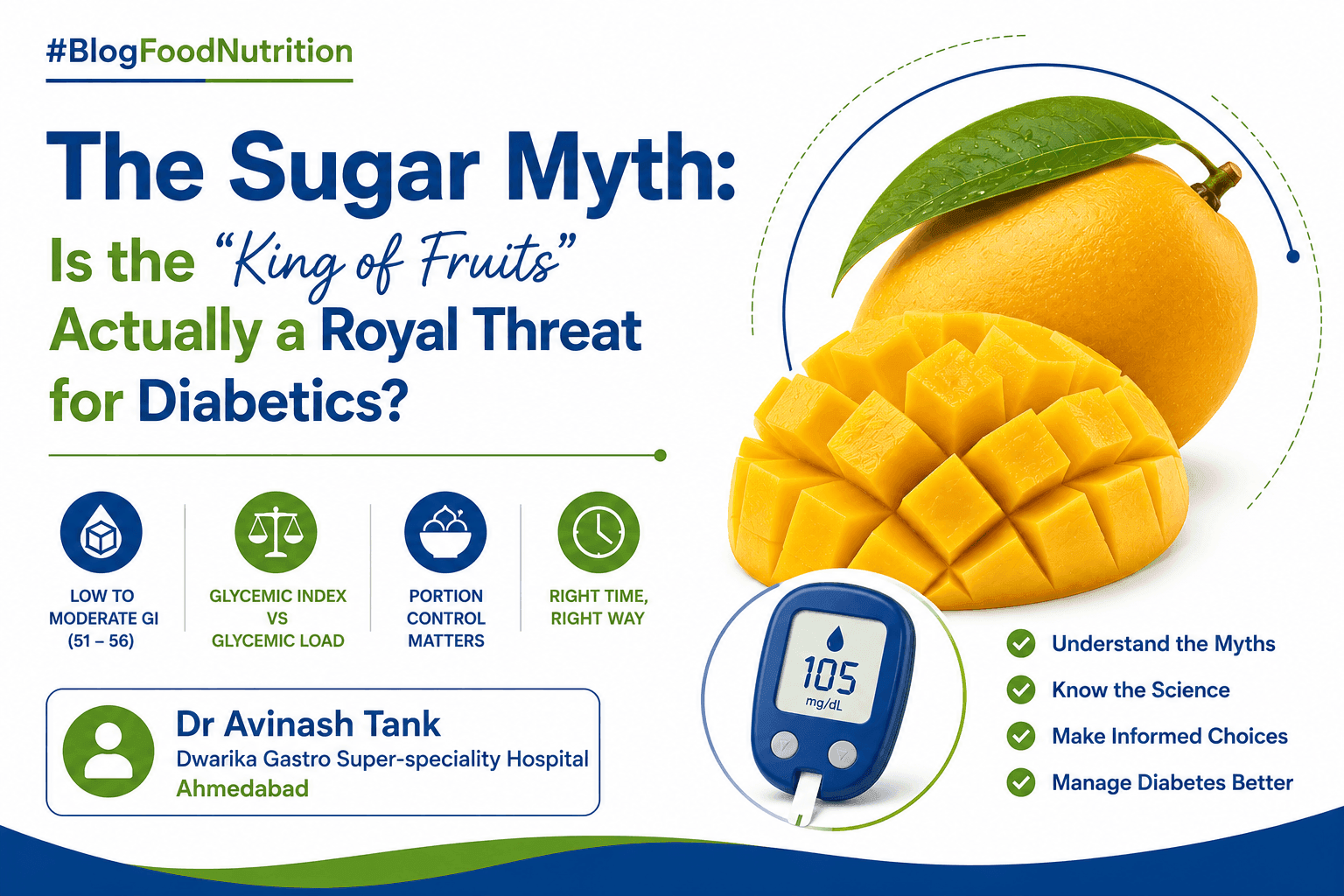
The Sugar Myth: Is the “King of Fruits” Actually a Royal Threat for Diabetics?
Every Summer, the Same Warning Returns
As soon as mango season arrives in India, a familiar piece of advice begins circulating among families, friends, and even some healthcare providers:
“If you have diabetes, stay away from mangoes.”
The logic appears simple. Mangoes are sweet. Sweet foods contain sugar. Sugar raises blood glucose levels. Therefore, mangoes must be dangerous for people with diabetes.
But is the story really that straightforward?
Surprisingly, modern nutrition science suggests that this long-held belief may be an oversimplification. While mangoes do contain natural sugars, they also contain fiber, vitamins, antioxidants, and bioactive compounds that influence how the body processes those sugars.
The truth lies somewhere between unrestricted consumption and complete avoidance.
Let’s separate myth from science.
Why Mangoes Got a Bad Reputation
Mangoes are among the sweetest fruits available. A ripe mango can taste almost dessert-like, making it an easy target for criticism.
Many people assume that the sweetness of a food directly reflects how much it will raise blood sugar levels. However, sweetness and blood sugar impact are not always the same thing.
For years, diabetics were advised to avoid mangoes simply because they contain natural sugars such as fructose, glucose, and sucrose. Unfortunately, this advice often ignored important factors such as serving size, fiber content, and the body’s overall response to food.
As a result, many people with diabetes unnecessarily deprived themselves of one of nature’s most nutritious fruits.
Understanding the Glycemic Index: The Science Behind the Myth
To understand whether mangoes are truly dangerous, we need to discuss the Glycemic Index (GI).
The Glycemic Index measures how quickly a carbohydrate-containing food raises blood sugar levels after eating.
Foods are generally classified as:
- Low GI: Below 55
- Moderate GI: 56–69
- High GI: 70 and above
Many popular mango varieties have a GI ranging from approximately 51 to 56, placing them in the low-to-moderate GI category.
This is a surprising fact for many people.
Compare that with:
- White bread: GI around 75
- Cornflakes: GI around 80
- Glucose solution: GI 100
Despite their sweetness, mangoes do not cause the rapid blood sugar spikes many people assume.
This finding challenges the common belief that all sweet fruits are automatically harmful for diabetics.
Glycemic Index vs Glycemic Load: The Missing Piece
One of the biggest mistakes people make is focusing only on Glycemic Index.
The more practical measure is Glycemic Load (GL).
While GI tells us how quickly carbohydrates are absorbed, Glycemic Load considers how many carbohydrates are actually consumed in a typical serving.
Think of it this way:
A food may have a moderate GI, but if you eat only a small amount, the overall blood sugar impact may still be modest.
For example:
Eating two or three slices of mango is very different from consuming an entire large mango after dinner.
Portion size matters.
This explains why some diabetics can enjoy mangoes without experiencing dramatic glucose spikes, while others may see significant increases after overeating.
Mangoes Offer More Than Just Sugar
When people think about mangoes, they often focus exclusively on sugar content.
However, mangoes are nutritionally rich fruits containing:
Dietary Fiber
Fiber slows digestion and delays glucose absorption, helping reduce sudden blood sugar fluctuations.
Vitamin C
Mangoes are an excellent source of Vitamin C, which supports immunity and acts as an antioxidant.
Vitamin A
Important for vision, skin health, and immune function.
Polyphenols and Antioxidants
Mangoes contain beneficial plant compounds including mangiferin, quercetin, and carotenoids, which may help reduce oxidative stress and inflammation.
Emerging research suggests that these compounds may even have positive metabolic effects, although more studies are needed.
Can Diabetics Eat Mangoes?
The short answer is:
Yes, many diabetics can enjoy mangoes in moderation.
However, moderation is the key word.
Diabetes management is not about completely eliminating every food containing sugar. Instead, it is about understanding portions, timing, and overall dietary patterns.
A person with well-controlled diabetes may often tolerate a small serving of mango as part of a balanced meal plan.
On the other hand, someone with poorly controlled blood sugar may need stricter monitoring and individualized advice.
There is no one-size-fits-all answer.
Smart Ways to Enjoy Mangoes Without Spiking Blood Sugar
1. Control the Portion Size
Instead of eating a whole mango, limit yourself to approximately one small serving.
A practical serving may be around ½ cup of sliced mango.
Smaller portions significantly reduce Glycemic Load.
2. Avoid Mango Juice
Whole mangoes contain fiber.
Mango juice removes much of that fiber and allows sugars to be absorbed more rapidly.
Whole fruit is always the better choice.
3. Pair Mangoes with Protein
Combining mangoes with protein-rich foods may slow digestion.
Examples include:
- Greek yogurt
- Unsweetened curd
- Paneer
- Nuts
This combination often results in a gentler blood sugar response.
4. Add Healthy Fats
Healthy fats can further slow glucose absorption.
Examples include:
- Almonds
- Walnuts
- Pistachios
- Chia seeds
5. Don’t Eat Mangoes as Dessert After a Heavy Meal
Many people consume mangoes immediately after a carbohydrate-rich dinner.
This can substantially increase the total glucose load.
Instead, consider mangoes as a planned snack or part of a balanced meal.
6. Avoid Late-Night Mango Binges
Eating large quantities of mangoes late at night may contribute to higher overnight glucose levels.
Daytime consumption is generally a better strategy for many individuals.
Who Should Be More Careful?
Although mangoes are not forbidden, certain individuals should exercise greater caution:
- People with uncontrolled diabetes
- Individuals with very high HbA1c levels
- Patients experiencing frequent glucose spikes
- Those who consume multiple mangoes in a single sitting
Blood sugar responses vary significantly between individuals.
Monitoring glucose after consuming mangoes can provide valuable personalized information.
The Verdict: Myth or Reality?
The belief that every diabetic must completely avoid mangoes is largely a myth.
Mangoes are not equivalent to candy, sweets, or sugary beverages. Their fiber, nutrients, and moderate Glycemic Index make them fundamentally different from refined sugar products.
The real problem is not the mango itself.
The problem is excessive quantity, poor timing, and lack of portion control.
For most people with well-managed diabetes, enjoying a reasonable serving of mango as part of a balanced diet is entirely possible.
So this summer, instead of fearing the King of Fruits, respect it.
Enjoy it mindfully.
Because when it comes to mangoes and diabetes, the science suggests that moderation—not prohibition—is the smarter strategy.
Final Takeaway
Mangoes are sweet, but sweetness alone does not determine their effect on blood sugar. Understanding Glycemic Index, Glycemic Load, portion size, and food combinations provides a far more accurate picture.
For many diabetics, the question is not “Can I eat mangoes?”
The better question is:
“How can I eat mangoes wisely?”
And the answer is simple: moderate portions, balanced meals, and informed choices.

SEO Keywords
Primary Keywords:
mango and diabetes, can diabetics eat mangoes, mango glycemic index, mango blood sugar, mango for diabetics
Secondary Keywords:
glycemic load of mango, mango nutrition facts, mango season health benefits, diabetes diet fruits, low GI fruits for diabetes
Long-Tail Keywords:
is mango safe for diabetics, does mango increase blood sugar levels, how much mango can a diabetic eat, best time to eat mango for diabetes, glycemic index of Indian mango varieties
SEO H2 & H3 Keywords
H2 Headings:
Why Mangoes Got a Bad Reputation, Understanding the Glycemic Index, Glycemic Index vs Glycemic Load, Can Diabetics Eat Mangoes, Smart Ways to Enjoy Mangoes, Who Should Be More Careful, The Verdict: Myth or Reality
H3 Headings:
Dietary Fiber Benefits, Vitamin C and Antioxidants, Portion Size Matters, Avoid Mango Juice, Pair Mangoes with Protein, Add Healthy Fats, Best Time to Eat Mangoes, Monitoring Blood Sugar After Mango Consumption